The journal, page 2.
Page 2 of 6 of the archive.
All posts
-

Can you trust an AI voice? Our data found no difference
People rate an AI-narrated meditation no differently from one they guide themselves. What that proves about trusting a synthetic voice, and what it does not.
-

Loving-kindness meditation: a guide to the five circles
Metta is five different practices sharing one set of phrases. What each circle actually trains, the technique that moves it, and what to do when one stalls.
-

AI sycophancy: why it agrees about spirituality, not sleep
Anthropic measured sycophancy across ten guidance domains. Spirituality hit 37.9%, health and wellness 2.9%. Here is the full table and what drives it.
-
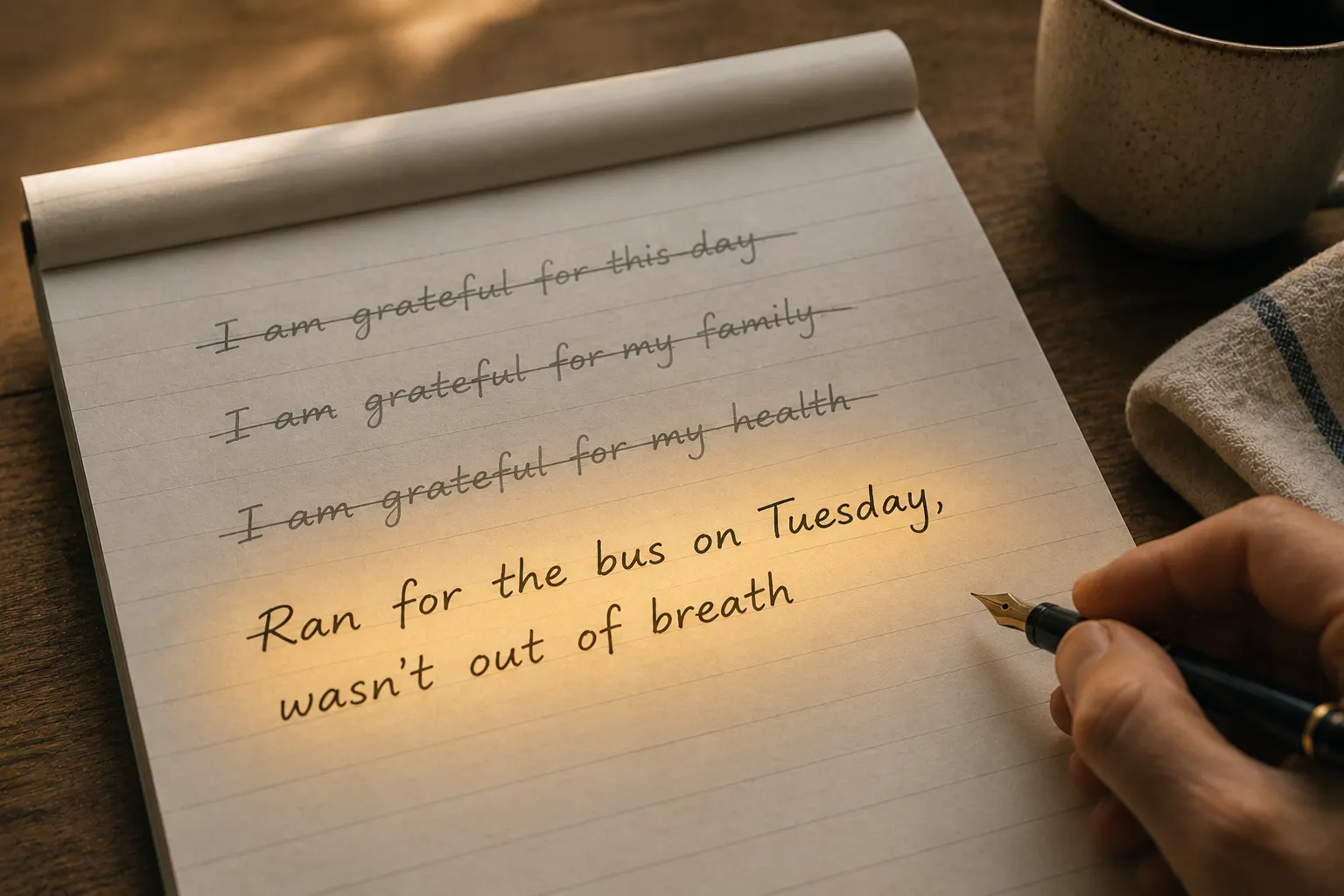
Gratitude journaling that stays alive past week two
Your gratitude list collapsed into the same three things by week two. That's a category problem, not a gratitude problem. Six techniques, and the evidence.
-

How long should you meditate? What the research shows
Research on meditation session length points to frequency and follow through as much as minutes. Here is what the evidence shows, and where it stays uncertain.
-

Is your AI meditation app talking to you, or guiding you?
Most "AI meditation" apps mean chatting with a bot. A real guided session works differently: rooted in technique, shaped by your context, narrated for you.
-

How to lower cortisol naturally (a nervous system approach)
Cortisol isn't a toxin to detox with mocktails or supplements. It's a signal from your nervous system. Here's what genuinely lowers it, backed by research.
-

Yoga Nidra for sleep: rest when your mind won't stop
Yoga Nidra before bed lowers cortisol and settles your nervous system, so the day stops following you into sleep. What it is, why it works, and how to use it.
-

When meditation makes things harder: a kinder path forward
Sometimes meditation makes things harder, not easier. Here's what that feeling means, why it's often part of the path, and the kinder way through it.
-

Meditation for the life you actually have
Most meditation assumes quiet mornings and no one to hold. This pillar is for parents, caregivers, therapists, students, leaders, and the multi-role reader.
-

Meditation for shame that lingers (and the kind that lifts)
Some shame fades with practice. The shame you've earned may not, and that's not failure. An honest look at meditation for shame: living with what stays.
-

Meditation for leaders: the weight you can't hand off
Most leadership meditation optimizes you for the company. This one is for the loneliness, the weight you can't hand off, and the team you carry home at night.
-

Meditation scripts for ADHD: built for racing thoughts
Meditation scripts for ADHD brains: 7 scripts for racing thoughts, executive paralysis, transitions, sensory overload, plus the design notes.
-
AI meditation usage report: data from StillMind users
The first first-party report on AI meditation usage: tone preferences, completion rates, prompt sources, and what 2,500 StillMind users actually do.
-

Save the meditation that worked: why return beats novelty
AI meditation generates a fresh session every time. But the meditations that change you are the ones you return to. Build a library worth keeping.
-

Still angry after forgiving? Meditation for resentment may help
You've tried to forgive. You're still angry. And now angry at yourself for still being angry. Here's why that loop happens and how meditation can move it.
-

Personalized meditation: three tiers behind one word
Three apps say 'personalized meditation' and mean completely different things. Here's the three-tier reality and where the category is heading in 2026.
-

Walking meditation: a guide for the walks you already take
Walking meditation, learned from the route I walk most. Four lineage forms to borrow from, what's on your feet, and AI guidance for the specific walk.
-

Interval meditation bells: matching rhythm to technique
Most timer guides tell you intervals exist. This one matches bell rhythm to practice: Mahasi noting, Sōtō kinhin, Plum Village, and modern type-switching.
-

How to restart meditation when you've already quit
Restart is harder than start. The all-or-nothing trap, the version of practice that broke you, and how to come back without falling into the same loop.