Gratitude journaling that stays alive past week two
Your gratitude list collapsed into the same three things by week two. That's a category problem, not a gratitude problem. Six techniques, and the evidence.
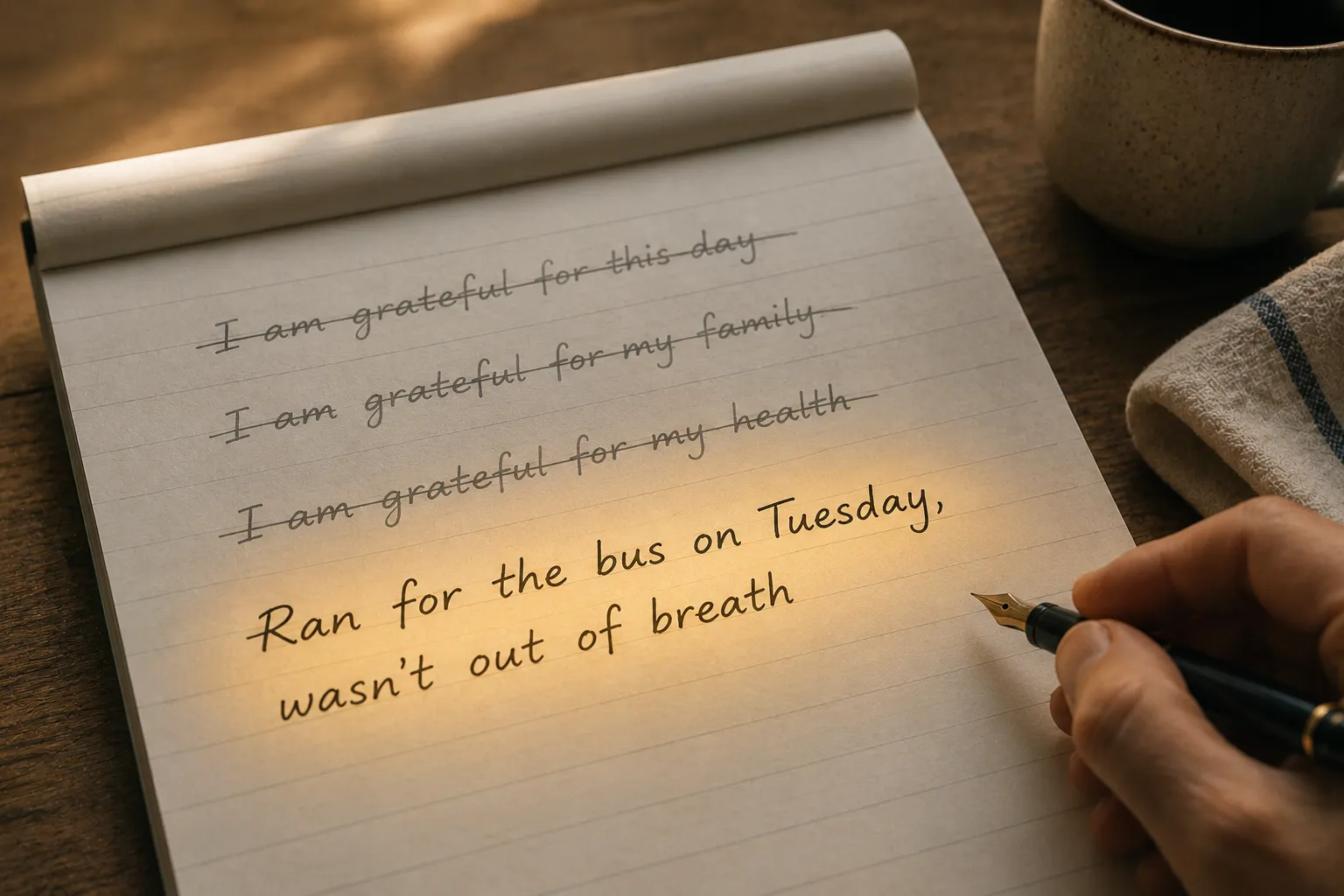
I kept a gratitude journal every morning. Notebook open before I started work, a few things written down, then on with the day. For the first week or so it was genuinely good.
Then it got hard in a way I had not expected. I would sit there for five minutes and the only things that arrived were the same things that had arrived the morning before, and the morning before that. Grateful for my wife. Grateful for my health. Grateful for my kids.
I knew it while it was happening. That is the part most accounts of this leave out. It was not something I discovered weeks later reading back over the pages, it was a live frustration at the page every morning: I wanted something fresh to be grateful for, and I had no method for finding it. Occasionally the day would hand me one. A friend came to stay and I wrote a line about that friendship. But left to myself, with five minutes and a blank page, it was those three.
Here is the part that matters. Those three things are true. My wife, my health and my kids are the biggest things in my life and close to the whole reason I do anything. That was never in question for a second. What went was not the gratitude, it was the sense that writing it down was doing anything. So it stopped, not with a decision. The notebook stayed shut one morning and then it stayed shut.
If that is where you are, four or five items cycling round (coffee, the dishwasher, my family, a roof over my head), there is a specific mechanical reason for it. It is not that you lack discipline, and it is not that you have run out of things to be grateful for. You are writing categories where an instance would go, and there are six ways out of it.
| When this happens | The move | Before | After |
|---|---|---|---|
| The same subject arrives every day, however long you sit there | Keep the subject, go down one level of detail | ”My health" | "Ran for the bus on Tuesday, wasn’t out of breath” |
| Nothing comes, because the day has not happened yet or has already blurred | Catch it as it happens, not at either end of the day | Written at 8am from memory | A line at 3pm: “someone covered for me in the meeting” |
| A printed quota of ten lines and four honest answers | Cut the quota to one to three, go deeper on each | Ten padded lines | One entry with a place and a time in it |
| The entries are true, but they land flat | Ask what almost did not happen | ”My flat" | "The viewing I nearly cancelled, and where I would be living now” |
| You are naming things without feeling anything | Add why it mattered and how it landed | ”Coffee" | "Who brought it, and what it changed about the hour” |
| The page has gone dead entirely | Send one to a person instead of writing it down | Another page to yourself | A message naming what they did, actually sent |
The rest of this post is why each of those works, what the research does and does not support, and the mechanism underneath all six.
This article is part of our complete guide to meditation journaling. New to journaling after practice? Start there.
What the research actually supports
The reliable finding is narrower than the headlines: gratitude writing lifts positive affect, and it does that most clearly when the alternative is doing nothing much.
The founding study is Emmons and McCullough’s 2003 paper in the Journal of Personality and Social Psychology. Go to their own abstract instead of the summaries of it and the claim is careful. The gratitude groups showed heightened well-being across several, though not all, of the outcome measures, and the effect on positive affect, in the authors’ words, appeared to be the most robust finding. That is the sentence the whole field is built on, hedge included.
Twenty-two years later, one of those two authors helped right-size his own field. Choi, Cha, McCullough, Coles and Oishi published a meta-analysis in PNAS covering 145 papers, 163 samples, 727 effect sizes and 24,804 participants across 28 countries. The overall effect on well-being was Hedges’ g = 0.19, with a confidence interval of 0.15 to 0.22. A small increase, reliably measured.
The breakdown is where the real story is, and it depends entirely on what gratitude was compared against. Against people who simply filled in the questionnaires and did nothing else, gratitude scored g = 0.26, on 145 effect sizes. Against a neutral activity like listing your daily activities, 0.16, on 551. Against counting your misfortunes, 0.45, but on only 20. And against another positive activity it came out at −0.15, on 11 effect sizes, with a confidence interval running from −0.55 to 0.25. That last one is not distinguishable from zero, so the honest reading is no detectable difference, not a disadvantage.
Effects were significant in the US, China, Germany, Canada and Australia among others, and not significant in France, India, Japan, the Netherlands or the UK. Before anyone builds a cultural theory on that, the authors point out that France and the Netherlands contributed four and six effect sizes respectively, and that they found no significant moderator explaining the variation at all.
Two other reviews land in the same place. Kerry, Chhabra and Clifton’s 2023 systematic review pooled 44 articles and 16,529 people on life satisfaction specifically, and found no strong evidence that gratitude interventions outperform positively valenced control conditions. Davis and colleagues, in the Journal of Counseling Psychology in 2016, put a number on the same comparison: gratitude performed as well as, but not better than, a psychologically active alternative, at d = −0.03. Against a general alternative-activity control they found d = 0.17 on psychological well-being, and no significant effect on anxiety.
One more, because you will have seen it quoted badly. Wood and colleagues, in 2009, surveyed 401 people and found gratitude predicted better sleep quality, mediated by pre-sleep thinking. That study is cross-sectional and measures trait gratitude, the disposition. It does not show that keeping a journal improves your sleep, and anyone telling you it does has skipped a step.
So: a modest, real effect, strongest on positive affect, and roughly a wash against any other decent practice you might do instead. Our meditation statistics roundup keeps the wider numbers in one place.
If you are the sceptic in the room, that is an honest floor to stand on. It also means the version you do has to earn its ten minutes.
You’re writing categories, not instances
Here is the operation that fixes most stale gratitude journals, and it is not a mindset shift.
“My wife” is a category. “My health” is a category. “A roof over my head” is a category. A category has exactly one entry in it, forever, which is why it repeats: there is only one way to write it. The twenty minutes on the sofa last night, both of us too tired to talk and neither of us reaching for a phone, is an instance. It happened once, at a time, in a room.
The test takes two seconds. Could you have written this exact sentence a year ago, word for word? If yes, it is a category. If it needed last Tuesday to exist, it is an instance.
Now the mechanism, because this is not a willpower problem. Asking yourself what you are grateful for is a memory-retrieval task, and what you get back depends almost entirely on the cue you give it. A blank page is not a cue. You ask an open question with nothing attached to it, and memory does the cheap thing, because that is what memory is for: it returns the most stable, highest-level labels it holds. Your wife. Your health. Your kids.
Morning is the hardest version of this, which is worth saying because morning is what most people are told to do. At 8am there is no day behind you to draw on. Yesterday has already been filed into a summary, and today has not happened yet, so the only inventory open to you is the standing one, the permanent list, which is exactly the list of categories. Evening is not much better. By ten at night the specifics have been compressed into a general sense of how the day went. Either end of the day, you are asking memory to hand back a detail it has already archived under a heading.
That is the whole failure. Not gratitude running out. Retrieval defaulting to categories.
Count them and it gets obvious. The number of categories in an average life is small, maybe fifteen or twenty that genuinely matter. The number of instances is not countable. So a journal that runs on categories is a well with a measured bottom, and you hit it in about nine days. A journal that runs on instances cannot be emptied.
If you want to see this in your own writing before you change anything, the diagnostic prompts we use for surfacing patterns work just as well pointed at a gratitude log as at a practice journal.
Which also means the page was never reporting that you have three things going for you. It was reporting that your memory has three shortcuts.
Six techniques that keep the well full
These are the six from the table at the top, in full. They come up again and again from people who kept going past the collapse, rather than the ones that sound best written down, and each has mechanics: what to do, in what order. They sit inside the wider approach in our meditation journaling guide, which covers the practice-and-write pairing in full.
Go down a level, not sideways
The instinct when the page goes flat is to hunt for new subjects. Do the opposite. Keep the subject and descend one level of specificity.
Not “my home” but “my home has heat this winter.” Not “friends” but “the conversation with Jane about her holiday, and how long she talked about the ferry.” Not “my health” but “ran for the bus on Tuesday, wasn’t out of breath.” You are not looking for material you do not have. You are looking at the material you already wrote at a higher resolution.
Run my own entry down the ladder. “My wife” is level one, and it never changes. Level two: “my wife took the 6am wake-up on Sunday without being asked.” Level three: “the way she said go back to sleep, and meant it, and I did.” Level three happened once, and it has a Sunday attached to it. I could write about the same person every day for a year on that ladder and never repeat myself, because I would not be writing about the person. I would be writing about the Sundays.
Catch it during the day, not at either end of it
One person I read about set an hourly alarm and wrote down whatever had happened in the previous hour. The resulting list, they said, was far more varied than anything either end of the day had ever produced. That tracks with the retrieval problem: at 3pm you are not searching memory, you are reading the room.
Mechanics: three alarms, not eight. Late morning, mid afternoon, early evening. One line each, and the line has to name something that happened since the last alarm. If nothing did, write nothing and let the alarm go.
The lowest-friction version is voice. Speaking one sentence into your phone in the ten seconds after something happens costs almost nothing and preserves detail that a reconstruction hours later would have sanded off. We made this case for practice capture in voice notes during meditation, and it holds just as well for a Tuesday afternoon.
Cut the quota
Ten items a day is the single most common cause of collapse, and it is usually inherited from a printed journal with ten numbered lines on it.
Watch what actually happens on a ten-item day. Items one to three are true. Items four to seven are padding. Items eight to ten are where people start to resent the page. You end the exercise in a worse mood than you started it, which is a strange outcome for a gratitude practice and a reliable predictor of quitting.
One to three. Depth on each. And pick a number you will not fail on a bad Wednesday, because failing a quota is what turns a practice into a debt.
Ask what almost didn’t happen
This is mental subtraction, and the protocol is documented properly by Berkeley’s Greater Good in Action.
Pick one good thing. Write out, concretely, what your life would look like if it had never happened. Not “I am lucky to have this” but the actual counterfactual: which flat you would be living in, which job you would have taken, who you would have spent the last decade of Sundays with instead.
It is generative in a way that listing is not, for the same reason as before. “My partner” is one entry. “The night we nearly did not go to that thing” is one of a hundred branch points, and each one is a different piece of writing.
Write the why and the felt sense
Three Good Things is the most recommended gratitude exercise on the internet and the most commonly done wrong, because people write the three things and stop. In the Berkeley protocol, writing why the good thing happened is a required part of the exercise, not a bonus round.
Three questions per item, in this order:
- What specifically happened? (The element, not the category.)
- Why does this one matter to me?
- What did it feel like in my body at the time?
Worked: the coffee my colleague brought me. Why it matters: I had not said I was struggling, and she noticed anyway, which means I am more visible at work than I assume I am. Felt like: a drop in the shoulders, and mild embarrassment. That is one entry. It took ninety seconds and it is not a line you could have written a year ago.
Send one to a person
Once a week or so, send one short message to someone naming the specific thing they did and what it meant. Not a general appreciation. The specific thing.
Be clear on the trade-off. In Seligman, Steen, Park and Peterson’s 2005 trial of positive psychology exercises, the gratitude letter produced the largest immediate happiness lift of anything they tested, held at one week and one month, and was gone by three months. It is a reset, not a replacement. Use it when the page has gone flat, and do not expect it to hold on its own.
Noticing first, writing second
Give the retrieval task a cue and it stops returning categories.
That is the argument for a short practice before you write, instead of meeting a blank page cold. Ten minutes of quiet attention on the body and on the hours just gone will surface specifics unbidden, and they arrive as sensation, not as labels. The smell of the car when you got in. The two seconds in the meeting where someone covered for you. Your kid saying something in the back seat that you laughed at and then lost. None of those would survive a direct question asked cold. All of them come back if you sit still long enough for the recent past to replay itself.
If that quiet stretch turns out to be the part you want and the writing the part you resent, the sitting is a complete practice on its own terms and does not need the page at the end of it. Gratitude meditation covers what changes when nothing has to be produced.
Then write, while they are still warm. The window matters more than the length. We covered the timing evidence in journaling after meditation, and what happens in the brain when writing follows attention instead of replacing it is in the science of meditation journaling.
Sequenced, the whole thing is about fifteen minutes: ten of noticing, five of writing, one to three items, each taken down a level. If that is more than you have on a given day, cut the writing to one item and keep the noticing. The noticing is the part that generates material. The writing only stores it.
A practice that hands you something to write about
StillMind guides a short practice, then opens the journal while the specifics are still in reach, by voice or by typing. Free to start.
Try StillMind, freeHow often, actually
You have probably met the claim that writing once a week beats writing three times a week. It is the most-cited finding on gratitude cadence and it is shakier than its citation count suggests.
The result is reported inside Lyubomirsky, Sheldon and Schkade’s 2005 paper, but the underlying study is 2004 unpublished raw data that never went through peer review as a standalone paper. It has been repeated for two decades on the strength of that one mention. The counterweight is no stronger: Emmons and McCullough noted in their own discussion that the daily version in two of their studies appeared to move gratitude more than the weekly version in the third, which is a comparison across studies rather than a head-to-head test. Nobody has run the trial that would settle it, so neither answer is solid enough to organise your week around.
That leaves you where meditation research leaves you on session length, which we went through in how long you should meditate: the average participant in a study is not you, and the only cadence data that applies to your life is the data you generate.
Practical version: run one cadence for three weeks without changing it, then run the other for three weeks, then read both back and see which entries still have anything in them. Daily writing with one item is a completely different practice from weekly writing with five, and one of them will fit your week better than the other. Nobody can tell you which from a meta-analysis.
When gratitude is the wrong practice today
Before anything else: plenty of people find the word itself loaded, either from a religious background or from being told to be grateful at a moment when they needed something else. Renaming the container works and it is not a cop-out. A happiness log. Best bit of the day. Glimmers. The exercise is identical and the resistance to opening it drops.
Some days the practice inverts, though, and it is worth knowing the signs. You write that you are grateful your parents are healthy and immediately your head puts you in a hospital corridor, because the sentence contains the loss inside it. Or you catch yourself producing gratitude in order to cancel out envy or guilt, which is a different job from noticing something, and the page always shows it. What comes out reads like an argument you are having with yourself.
The evidence is also clear that this is not the right tool for a genuinely low period. Cregg and Cheavens reviewed 27 studies covering 3,675 people on depression and anxiety and found the effects relatively modest. Co-author Jennifer Cheavens put it plainly in Ohio State’s write-up of the study: “There was a difference, but it was a small difference. It would not be something you would recommend as a treatment.” Davis and colleagues found no statistically significant effect on anxiety at all.
What tends to work better on those days is writing what is actually hard first, at the top of the same page, without arguing with it, and only then seeing whether anything else wants to be written. Self-compassion practice is the better fit when the gratitude page has turned into somewhere you go to be told off.
And if nothing else wants to be written, that is a complete entry.
What a month of entries can tell you
A single entry is close to worthless as information. Thirty of them, read in one sitting, is a different object entirely.
Almost nobody does this, and it is where the practice pays. Read a month back and patterns surface that were invisible one entry at a time: almost everything on your list happens outdoors, or involves the same two people, or arrives before 11am and never after 6pm. That is actionable in a way that “be more grateful” never was. You are not chasing a mood boost at that point. You are reading a record of what your attention goes to when nobody is asking.
Tracking your mood alongside the entries is how you find out whether this works for you specifically, rather than for the average participant in the PNAS pooled sample. Three weeks of entries with a mood rating attached will tell you more about your own response than g = 0.19 ever will, because the confidence interval on you is a lot narrower than the confidence interval on 24,804 people.
The flip side is worth saying plainly. A day where you sit down and genuinely cannot find anything is not a failed entry. It is a reading. Three of those in a row is useful information about where your mood is, arriving earlier than you would otherwise have noticed it, which is exactly the kind of thing the meditation journaling guide is built around.
Writing it down was never about proving the good things exist. You already know they exist. It is about catching them at the resolution they actually happened at, before Thursday takes them.
Frequently asked questions
Why do my gratitude journal entries feel repetitive?
Because you are almost certainly writing categories rather than instances. My family, my health and a roof over my head are labels, and a label has exactly one entry in it, forever, which is why it repeats. An instance has a date attached: the twenty minutes on the sofa last night, the conversation with Jane about her holiday. Categories dominate because asking what you are grateful for is a memory-retrieval task, and with no cue attached memory hands back its most stable, highest-level labels first. Morning is the hardest case, because there is no day behind you yet to draw on. The fix is to keep the same subject and descend one level of specificity, or to capture things as they happen instead of reconstructing them later.
How often should you write in a gratitude journal?
There is no settled answer, and the most-cited claim on this is shakier than it looks. The widely repeated finding that writing once a week beat writing three times a week is reported inside Lyubomirsky, Sheldon and Schkade's 2005 paper, but the underlying study is unpublished raw data that never went through peer review as a standalone paper, and the evidence pointing the other way is a comparison across separate studies rather than a head-to-head test. A more useful approach is to pick a cadence you will not fail on a bad day, run it for three weeks without changing it, then read the entries back and see which ones still have anything in them.
What should you write when you can't think of anything?
Do not go looking for a new subject. Take one you have already used and add a level of detail: my home has heat this winter rather than my home, the conversation with Jane about her holiday rather than friends. If that stalls, try mental subtraction, the protocol documented by Berkeley's Greater Good in Action: pick one good thing and write out concretely what your life would look like if it had never happened. A blank day is worth noticing rather than forcing. If you cannot find anything three days running, that is usually information about your mood rather than about your life.
Does gratitude journaling actually work?
It works modestly, and most clearly on positive affect. In the 2025 PNAS meta-analysis of 145 papers and 24,804 participants across 28 countries, gratitude interventions produced an overall effect on well-being of Hedges' g = 0.19. The breakdown matters more than the headline: g = 0.45 against a negatively valenced activity such as counting your misfortunes, 0.16 against a neutral one, and no detectable difference against another positive activity. A 2023 systematic review of 44 articles and 16,529 people found no strong evidence that gratitude outperforms positively valenced controls either. It is a real effect, and it is one good option rather than the only one.
Can gratitude journaling make you feel worse?
For some people, on some days, yes. Writing that you are grateful your parents are healthy can put a hospital corridor in your head rather than warmth, because the sentence contains the loss inside it. Producing gratitude in order to cancel out envy or guilt is a different job from noticing something, and the page tends to show it. The evidence is also clear that this is a poor fit for a genuinely low period: in Cregg and Cheavens's 2021 review of 27 studies, co-author Jennifer Cheavens described the difference as small and said it would not be something you would recommend as a treatment. On those days, writing what is actually hard first, or turning to a self-compassion practice, tends to be the more honest move.