Gratitude meditation: the practice with nothing to write
A gratitude list can curdle into comparison and guilt by week three. Gratitude meditation asks for no list at all. What it is, and who it actually suits.

The list starts the same way for most people. A bed. Hot water. Food in the fridge. All true, all things you are supposed to feel something about.
What arrives instead is often a quiet piece of arithmetic. Other people do not have these things. You do. And you feel exactly the way you felt before you picked up the pen, which the list now seems to be offering back to you as evidence about your character.
Something did fail there, and it is worth being precise about what. Not gratitude. The format. A list asks you to produce something, on demand, in words, and then hands the output back for marking.
There is a version of this practice that asks for none of that.
This sits in the meditation techniques library, alongside loving-kindness practice and, for the written form, gratitude journaling that stays alive past week two.
Gratitude meditation is not a list said out loud
The usual assumption is that this is the same exercise with your eyes shut. Three things, silently. It is not, and the difference is the whole point of it.
A gratitude list is an accounting practice. You go looking for items, you name them, you check that you have enough of them, and you finish with a record. A gratitude meditation has no items and no record. You bring one thing, and then you stay next to it for longer than it takes to name it.
That sounds like a small distinction until you notice which one your resistance is actually pointed at. Most people who say gratitude does not work for them are describing the retrieval, the naming, and the marking. None of those exist here.
Think of it as the difference between writing down that there is a fire in the room and standing close enough to it to get warm. The first is a true statement that leaves you exactly as cold as you were. The second takes a few minutes and does something to your body.
| Gratitude list | Gratitude meditation | |
|---|---|---|
| What it asks for | Several items, named, in words | One thing, held longer than naming takes |
| Where the effort goes | Retrieval and production | Staying, once you have arrived |
| What you finish with | A record you can read back | Nothing you can show anyone |
| How it fails | Repetition, comparison, a sense of being marked | Drifting off, or getting bored before the warmth lands |
| Who it suits | People who think by writing and like the record | People for whom a blank page is a demand |
Neither is the better practice. They are two different jobs, and the reason so many people conclude that gratitude is not for them is that they were only ever offered one of them.
Why the list turns into comparison
Naming a thing on a list carries a hidden second step. To write it down, you have to establish that it counts, and the only way to establish that something counts is to weigh it against not having it.
That is comparison. Comparison is where guilt lives.
It shows up most reliably in exactly the material people are told to start with. A bed, clean water, enough to eat. Those are chosen because they are unarguable, and being unarguable is what makes them dangerous: the practice quietly becomes a demonstration that your life is fine, delivered to somebody who does not feel fine. Then a second thought arrives to close the trap. If I were really grateful, I would not still feel like this.
Gratitude turns punitive at the point where it becomes a measurement. The measurement is not part of the practice. It is a side effect of having to produce a list.
There is a slower version of the same problem. Around week three, the true entries stop meaning anything. Being grateful for your health is still accurate, and writing it for the twelfth time starts to feel like a formality you perform, not something you noticed. People describe getting to the point where the entry feels less like a truth than a way of filling the line.
On the evidence, gratitude practice is genuinely helpful and considerably more modest than its reputation. That case, including the 2025 PNAS meta-analysis covering nearly 25,000 participants and what it says about which comparisons the effect survives, is set out in full in gratitude journaling that stays alive past week two. It is worth reading before you decide the practice has failed you personally, because the honest size of the effect explains a lot of disappointed expectations.
The sitting version does not fix any of that by being better. It sidesteps it by removing the list, and with the list goes the accounting.
How to actually practise it
The instruction is short, which is disconcerting when you are used to prompts.
One thing, not three. Choose a single thing and stay with it for the whole session. The plural is the source of most of the trouble: three items means two transitions, and each transition is a small retrieval task that pulls you back into hunting.
Start where warmth already is. Do not start with what you ought to appreciate most. Start with whatever, today, has any actual charge on it, however trivial. A cup of tea that was genuinely good. A message someone sent. The five minutes in the car before you went in.
Stay past the naming. This is the part that does not exist in the written form and it is the whole practice. You will name the thing in about two seconds. Then keep going. What was the temperature of it. Where were you sitting. What did the other person’s face do. Not to build a description, but because the specifics are what carry the feeling, and the feeling takes time to arrive.
Let it be small, and let it be slow. People who practise this describe a physical result, not a mental one: warmth somewhere in the chest or the stomach, a sense of lightness, sometimes unexpected tears. It rarely turns up in the first minute.
Ten minutes is not too long. The written form rewards brevity because production is tiring. This one rewards duration, because the whole mechanism is contact over time. Ten minutes is a reasonable floor and considerably longer is normal.
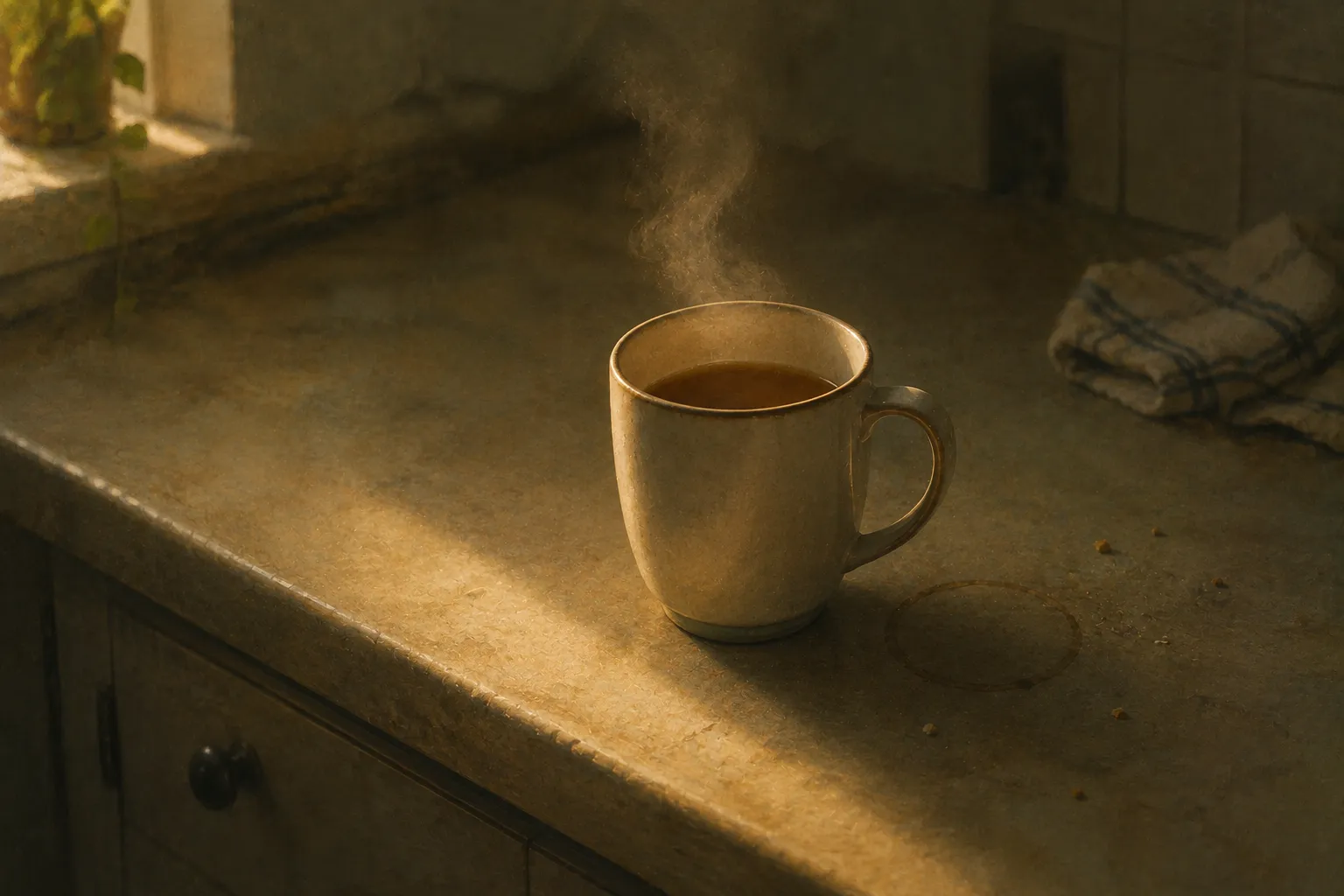 The material is usually this ordinary. The practice is staying with it past the point where you have already named it.
When the good thing summons the loss
You settle on something you are glad about, and the loss folded inside it arrives right behind. Your mother is recovering well, and the thought that everybody dies eventually turns up before the warmth has finished landing.
In the written form this reads as a spoiled entry, because you were producing something and now the thing you produced has gone wrong. Sitting, you are not producing anything, so nothing has been spoiled. The second thought is just the next thing to appear, and you can treat it the way you would treat any other arrival: notice it, decline to follow it, return to what you were with.
If it keeps taking the session, that is worth listening to instead of overriding. It usually means the thing you chose is load-bearing in a way that wants a different kind of attention first.
When you cannot picture anything
Read the standard gratitude meditation instruction closely and it is almost entirely visual. Picture a person. Bring to mind a place. See the moment again. It is quietly one of the most image-dependent practices in the whole category, and nobody flags it.
If you have aphantasia or very low mental imagery, that instruction has no target, and the usual conclusion is that you are doing it wrong, when the wording simply assumed something about you.
The images were never the point. They are a route to the feeling, and there are other routes.
| The instruction | What it is asking for | A version without images |
|---|---|---|
| ”Picture the person” | Contact with the relationship, not their face | Recall something specific they said or did, in words, and stay with what it meant |
| ”Bring the place to mind” | The atmosphere of a moment you liked | Name the facts of it: the time, the temperature, what you could hear |
| ”See the moment again” | Enough detail to make the feeling reappear | Ask what changed for you because it happened, and let that be the object |
The translation principle is the same one that works across the rest of practice: find what the instruction is actually asking for, then get there by whatever means you have.
It is not loving-kindness, and the difference matters
The two get conflated constantly, including by people who practise both, and the conflation costs something because they fail in opposite directions.
Gratitude is receptive. The good thing has already happened, and your job is to let it register. Loving-kindness is generative. Nothing has happened, and your job is to produce goodwill and send it somewhere.
| Gratitude | Loving-kindness | |
|---|---|---|
| Direction | Something arriving toward you | Something you extend outward |
| The object | A thing that actually happened | A person, including ones you find difficult |
| Its failure mode | Sliding into comparison and audit | Forcing warmth you do not currently have |
| Use it when | You want to feel what is already there | You want to soften toward someone specific |
They pair well and they are not interchangeable. If gratitude keeps turning into accounting, loving-kindness is often the better door that day, because it does not ask you to evaluate your own circumstances at all.
Gratitude has a running order
The most useful thing said about this practice comes from someone describing why it kept failing them: gratitude first was putting the cart before the horse, because what actually needed to happen was for the difficult thing to be acknowledged as difficult.
That reframes the question. It is not whether you are grateful enough. It is whether anything has to come first today.
Gratitude is not a mood you owe. It is a practice with a running order, and something usually has to be acknowledged before appreciation has anywhere to land.
Three things follow from that, and all three are permissions, not techniques.
Ambivalence is allowed. You do not have to be uncomplicatedly glad about the thing you chose. Most real relationships and most real circumstances are mixed, and a practice that requires you to pretend otherwise will feel false because it is asking you to be false.
Some days it is not the practice. If you know there are things you are glad of and cannot summon the energy to sit with any of them, that is information about the day rather than a verdict on you. Self-compassion tends to be the better fit when appreciation has turned into somewhere you go to be told off.
And bracing after something good is common enough to expect. Enjoying a thing and immediately waiting for the cost of it is not a failure of the practice. It is worth noticing as its own event, and it usually softens with time, not with effort.
Frequently asked questions
What is gratitude meditation?
Gratitude meditation is a practice of turning attention toward something you appreciate and staying with it long enough to actually feel it, rather than listing it. It differs from gratitude journaling in that it asks you to produce nothing: no items, no words, no record. You bring one thing to mind and remain with the specifics of it while the feeling has time to arrive, which is usually several minutes rather than several seconds. It can be guided or silent, and it tends to be described in physical terms, as warmth or lightness somewhere in the chest, rather than as a change of opinion.
How do you practise gratitude meditation?
Settle first with a few slow breaths, then choose one thing rather than several, and pick it by where any warmth already is rather than by what you think should matter most. Name it, which takes about two seconds, and then keep going past the naming: the temperature of the moment, where you were sitting, what was actually said. The specifics carry the feeling and the feeling takes time. Ten minutes is a reasonable floor and longer is normal. If your attention wanders, return to the same thing rather than searching for a new one, because the searching is what makes the practice tiring.
What are the benefits of gratitude meditation?
The reliable finding across the research is a modest lift in positive mood, and it is more modest than the popular claims suggest, so it is best approached as a practice rather than a treatment. What people describe most consistently is a physical rather than a cognitive result: warmth, a sense of lightness, and for some an effect that persists into the following day. The sitting form has one advantage specific to it, which is that it does not require you to produce or evaluate anything, so it avoids the comparison and self-marking that make written gratitude turn punitive for a lot of people.
When is the best time to practise gratitude?
Both morning and evening work, for different reasons: morning sets a tone before the day crowds in, and evening lets you end by staying with something that went well, which can also settle the mind for sleep. More useful than the slot is the condition you are in when you arrive. This practice needs something with a bit of charge still on it, so soon after the thing happened tends to work better than a scheduled review much later. If you find you are hunting for material rather than returning to it, the timing is probably wrong rather than the practice.
Is gratitude journaling the same as gratitude meditation?
They are close relatives with different mechanics. Journaling asks you to retrieve several things and put them into words, which produces a record you can read back and which suits people who think by writing. Meditation asks you to stay with one thing without producing anything at all, which suits people for whom a blank page reads as a demand. They fail differently too: journaling goes stale and slides into comparison, while sitting tends to fail by drifting or by boredom before the feeling lands. Many people use both, and it is worth knowing which one you are reaching for and why.