

Voice journal for meditation,
captured mid-breath.
The most profound realizations emerge when you're deep in practice. Voice journaling preserves those moments without breaking flow or reaching for a keyboard.
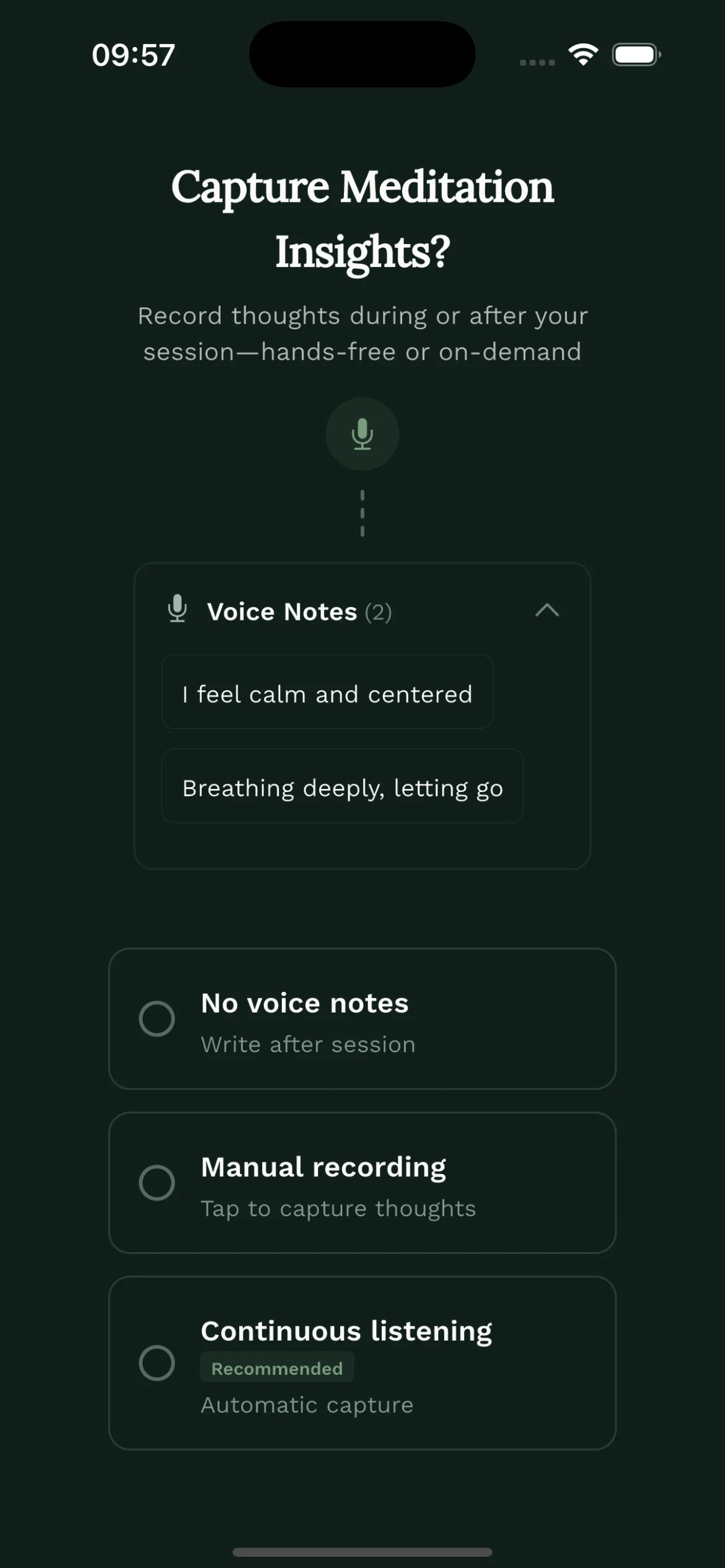
Fifteen minutes in. Breath is steady. Mind is quiet. And then: clarity. A realization about a relationship. An answer you've been carrying.
Opening your eyes and typing would shatter the state. You tell yourself you'll remember. You never do. By the time the bell rings, the edges have blurred. The insight is gone.
Three moments voice notes were made for.
"I stream-of-consciousness speak during practice. Patterns emerge that I never see in the moment."
Continuous recording mode captures every observation. Review later, extract what matters. Just speak. Edit never.
"On silent retreats, typing is disruptive. I speak quietly into my phone. Process later."
Voice notes capture retreat insights without disturbing others or breaking silence culture. Whisper your realizations, revisit when the retreat ends.
"Insights don't only arrive on the cushion. During walking meditation, voice notes let me preserve observations mid-stride."
Your hands stay free. Your gait unbroken. Tap once, speak, tap again. The moment is preserved, timestamped, and attached to your session.
Sit. Speak. Continue.
Sit
Start your meditation timer as usual.
Speak
When insight arrives, tap the voice note button and speak. No unlocking, no typing.
Continue
Return to your breath. The recording is saved and linked to your session automatically.
I used to lose 80% of my meditation insights between the cushion and my journal. Voice notes solved that completely.— Rachel T., noting meditation practitioner
Voice notes are part of the full meditation journal. Each entry can contain both typed reflections and voice recordings, creating a complete record of your session.
Frequently asked questions
Are voice notes encrypted?
Yes. Same AES-256-GCM encryption as written entries. Your voice is private.
Can I transcribe voice notes?
Yes, and it happens automatically. Your notes are transcribed as you record them, so your spoken insights are as searchable as written reflections. Nothing appears on screen mid-session, which is deliberate, and the full set of notes is waiting for you when the session ends.
How long can voice notes be?
No limit. Record for 2 seconds or 20 minutes, whatever your practice needs.
Is it better to speak or write my meditation journal?
Neither is better, they suit different moments and people. Speaking your reflections can feel faster and more natural, letting thoughts pour out the way they arrive, which is lovely right after a session when you do not want to break the calm by finding a pen. Writing can feel slower and more considered, which some people find clarifying. The best one is whichever you will actually keep doing. StillMind lets you capture a voice note or type, so you can reflect whichever way feels easiest that day.
Can voice journaling help if I find writing hard, like with ADHD?
Very much so. For a mind that finds a blank page or the effort of writing draining, speaking removes the friction, you just talk, and the reflection is captured. It suits the way many people with ADHD think out loud and move quickly, so insights get saved before they scatter. There is no pressure to be tidy or complete, a short spoken note counts. StillMind lets you voice journal straight after a session, making reflection feel doable rather than like one more task to keep up with.
I always forget my insights after meditating. How can I remember them?
This is really common, and it is one of the main reasons voice notes exist. The calm, open state of meditation is where quiet insights surface, but they fade fast once the session ends and daily life rushes back in. The fix is to capture them quickly, while they are still fresh, rather than trusting memory. Speaking a quick note the moment you finish is faster and less disruptive than reaching for a pen. StillMind lets you record a voice note right after a session, so the thought is saved before it slips away, and you can revisit it whenever you like.
Should I stop meditating to note a thought, or let it go and stay in the session?
This is a genuine dilemma, and you do not have to choose between losing the thought and breaking your practice. Usually the best move is to gently let the thought pass and trust that the important ones tend to return, keeping your attention on the session. If it feels too valuable to risk forgetting, a very brief note is fine. The trick is to capture it without fully pulling yourself out. StillMind makes this easy with quick voice notes, so if something really matters you can save it in a few seconds and settle straight back in, rather than getting up and hunting for a notebook.
How do I capture insights during meditation without breaking my focus?
The gentlest approach is to notice the insight, silently acknowledge it, and let it rest in the background while you return to the practice, trusting you can record it at the end. When you finish, capture it straight away before it fades. If a thought feels urgent, a short spoken note is far less disruptive than opening an app to type or finding paper. Speaking takes seconds and keeps you close to the calm you built. StillMind's voice notes are designed for exactly this, letting you save what surfaced without turning your meditation into a note-taking task.
Never lose another meditation insight.
Free forever. Unlimited voice notes. Encrypted end-to-end.