Meditation journaling guide: turn sessions into patterns
Your sessions feel disconnected. Journaling connects them. The science, methods, and structured approach that turns isolated sits into lasting insight.

Two meditators. One has 200 sessions under her belt. The other, maybe 50. The first meditator has been at this for two years. She sits most mornings. She’d tell you meditation is “good for her.” But if you asked what’s actually changed since she started, she’d pause. Struggle. Maybe gesture vaguely at “feeling calmer.”
The second meditator can tell you that her attention fractures on days after poor sleep. That body scans work on high-anxiety mornings when breath focus doesn’t. That a recurring thought about her mother surfaces every time she sits longer than 15 minutes. She knows these things not because she’s more talented. She knows them because she wrote things down. Not essays. Three sentences after each sit.
That’s the difference this guide is about.
James Pennebaker at the University of Texas ran the foundational study on expressive writing in 1986. Students who wrote about their thoughts and feelings for just four days visited the health center at roughly half the rate of the control group over the following six months. Two hundred follow-up studies have since confirmed the pattern (Pennebaker, 2018): structured reflection changes outcomes. Meditation journaling is that principle applied to your practice.
This is our complete guide to meditation journaling. For specific topics, prompts, the neuroscience, voice journaling, see the linked deep-dives throughout.
What meditation journaling actually is (and isn’t)
Meditation journaling is not a diary. It’s not a session log. It’s not a gratitude list.
It’s structured reflection designed to surface patterns across sessions.
The distinction matters because most people who “journal about meditation” are just recording. “I meditated for 15 minutes. It was nice. I felt calm.” That’s a log entry. It tells you nothing you didn’t already know the moment you stood up.
Reflection looks different. “My attention kept returning to the deadline. This only happens after poor sleep. Third time this month.” That sentence connects the present session to previous ones. It names a condition (poor sleep), links it to a symptom (attention fragmentation), and notices frequency (third time). That’s data you can act on.
Recording asks: what did I do? Reflection asks: what did I notice, and what does it connect to?
Contemplative traditions have understood this for roughly 2,500 years. Buddhist practitioners kept written records of their meditation experiences as early as the first century BCE. The practice wasn’t self-indulgent. It was diagnostic, a way to track the mind’s habits across time. For the full history, see our deep-dive on the ancient roots of meditation journaling. For how meditation journaling differs from regular journaling (the goals, the structure, the outcomes), see meditation journal vs. regular journal.
The science: why writing after meditation changes your brain
Two things happen when you meditate. Your default mode network (the brain’s autopilot rumination system) quiets down. And your attentional control networks become more active. Meditation creates a brief window where your brain is unusually receptive to encoding new information.
Journaling right after meditation exploits that window. Here’s the evidence for why it works.
Affect labeling
Lieberman et al. (2007) at UCLA published a study in Psychological Science (vol. 18, pp. 421-428) that changed how we understand emotional processing. Thirty participants viewed emotionally provocative images while undergoing fMRI. When they labeled the emotion they were feeling (“this makes me angry”), amygdala activity decreased and right ventrolateral prefrontal cortex activity increased. The two were inversely correlated: the more the prefrontal cortex activated, the more the amygdala calmed down.
Writing emotions in a journal is affect labeling, repeated. You sit with a feeling during meditation, then you name it on paper. Each time you name it, you’re running the same neural circuit that Lieberman’s participants activated in the scanner. Over weeks, this trains your brain to process emotions through the prefrontal cortex rather than getting stuck in amygdala reactivity.
The Pennebaker foundation
Pennebaker’s 1986 study launched an entire field. Since then, over 200 studies have examined expressive writing. A 1998 meta-analysis by Smyth in the Journal of Consulting and Clinical Psychology synthesized the literature and found a weighted effect size of d = 0.47. That’s a medium effect, comparable to some pharmaceutical interventions. Health center visits dropped. Immune function improved. Emotional processing became more efficient.
The key finding across studies: writing about experiences, especially with emotional content and causal reasoning (“this happened because…”), produces measurably different outcomes than writing about neutral topics.
Metacognition and reflection
A 2020 study in Reflective Practice compared students who reflected on their knowledge, goals, and learning processes with students who simply summarized activities. The reflective group showed stronger metacognitive control: better awareness of their own thinking, better ability to adjust strategies, and stronger skill transfer to new situations.
Summarizing (“I did a 15-minute body scan”) is passive. Reflecting (“I noticed my attention sharpened after I stopped trying to relax”) is active metacognition. The neural mechanisms are different. Reflection engages prefrontal executive function. Summarizing barely touches it.
The compounding effect
Meditation deactivates the default mode network and strengthens attentional control. Journaling activates prefrontal regions, triggers affect labeling, and consolidates memory through retrieval practice. They target complementary brain systems. Neither is complete alone. Together, the effects compound. For the full neuroscience deep-dive, see your brain on meditation journaling.
The pattern recognition thesis
Here’s the core argument of this guide: individual journal entries are data points. The value isn’t in any single entry. It’s in the dataset that emerges over weeks and months.
A 2023 study published in JMIR by Cearns and Clark analyzed 289,630 meditation sessions from 10,409 participants across 103 countries. The findings were striking. Consistency (practicing 4-7 days per week) and variety (using different meditation techniques) predicted improvement more than session length. For every 5 days of meditation, participants reported roughly 1 additional day of improved mood. Length of individual sessions? Not a significant predictor. We go deeper into that finding, and what the wider dose research shows, in a separate guide.
Journaling is the tool that makes consistency visible and variety intentional. Without it, you’re relying on memory. And memory is a terrible tracker.
What patterns actually look like
After three weeks of brief journal entries, you might notice: body scans feel qualitatively different on high-stress days. Afternoon sessions are consistently more scattered than morning ones. Loneliness spikes on Sunday evenings and turns out to be anticipatory, not situational. A recurring theme (a relationship, a career question, a specific fear) keeps surfacing when you sit longer than 10 minutes.
None of these patterns are visible in a single session. You only see them when entries accumulate. And once you see them, your practice changes. You stop treating every meditation as an isolated event and start understanding your own mind’s tendencies.
Why memory alone fails
You’ll think you’ll remember. You won’t. Cognitive biases erode meditation memories the same way they erode all memories. Recency bias means last Tuesday’s session overwrites last month’s. Hedonic adaptation means you stop noticing gradual improvements. Confirmation bias means you remember the experiences that match your beliefs about meditation and forget the ones that don’t.
A systematic review in JMIR Mental Health on self-monitoring found that tracking mood and emotional states improves emotional awareness and can help prevent relapse into depression. The act of recording forces accuracy. It pins down what your brain would otherwise smooth over or forget.
How to start (the minimum viable journal)
You don’t need a beautiful notebook. You don’t need 20 minutes. You need three sentences.
What happened. Not what you did (that’s logging), but what you noticed. “My mind kept circling the meeting. I felt tension in my chest that softened around minute eight.”
What surprised you. Anything unexpected. “I expected to be calm and instead felt irritable.” Surprises are the highest-signal data points because they reveal gaps between your assumptions and your actual experience.
What to explore next. One thing to pay attention to tomorrow. “Try a body scan instead of breath focus on a high-stress morning and see if the pattern holds.”
That’s it. Three sentences. Two minutes. Most days it will feel unremarkable. That’s fine. The value shows up at week three, not day one.
The research supports brevity
Smyth et al. (2018) published a randomized controlled trial in JMIR Mental Health studying Positive Affect Journaling (PAJ) with 70 adults experiencing elevated anxiety symptoms. Participants wrote for 15 minutes, three times per week, for 12 weeks. The results: reduced anxiety, lower mental distress, decreased perceived stress, and increased resilience. Improvements were visible after just one month.
A 2006 meta-analysis by Frattaroli, synthesizing 146 expressive writing studies (Frattaroli, 2006), found that outcomes improved with three or more writing sessions, durations of 15 minutes or longer, specific writing instructions (rather than open-ended “write about your feelings”), and a private setting.
Notice what those findings don’t say: they don’t say you need to write a lot. They say you need structure, consistency, and specificity. Three targeted sentences beat three rambling pages.
Timing matters
The 10-minute window after meditation is when your brain is most primed for reflective encoding. Default mode network activity is still suppressed. Attentional control is still elevated. Writing in this window captures observations that will blur or vanish within an hour. For why this timing window is so critical (and what happens neurologically when you miss it), see the missing step after meditation.
Permission to be imperfect
Here’s something the PAJ study revealed that doesn’t get enough attention: mean adherence was 47.8%. Nearly half the participants couldn’t stick to the protocol perfectly. And the intervention still worked. You don’t need a flawless track record. You need enough entries for patterns to emerge. Missing days is normal. Messy entries are normal. The perfectionism that makes you skip journaling because you “can’t do it properly” is the actual enemy, not the missed days.
What to write: structured reflection, not session logs
The most common journaling mistake is asking yourself “How do I feel?” after every session.
Here’s what happens: you write “calm” on Monday. “Peaceful” on Tuesday. “Good” on Wednesday. “Calm” again on Thursday. After 90 days you have 90 entries that all say roughly the same thing. Zero insight. You’ve confused journaling with labeling, and generic labels produce generic records.
The fix isn’t writing more. It’s asking better questions.
Diagnostic questions vs. generic prompts
Generic prompt: “How did your meditation feel today?”
Diagnostic question: “What did my attention do when it wasn’t where I placed it?”
The first invites a one-word answer. The second requires you to observe a specific cognitive behavior. It generates entries like: “Attention kept sliding toward the presentation. Not anxious exactly, more like rehearsing. This is the third time planning-mode has hijacked a session this week.” That’s an entry you can learn from.
For seven specific diagnostic prompts that surface practice patterns, see meditation journal prompts that reveal patterns.
Structured elements for pattern recognition
If you want your journal to function as a pattern recognition tool, include these elements most sessions:
Session context. Time of day, duration, technique. Not because the facts themselves matter, but because correlations appear. You’ll discover that 7am body scans and 7pm body scans are different practices for you, even though they’re nominally the same technique.
Emotional state, before and after. Not a generic label. Specificity. “Anxious about the review” before. “Still aware of the review but less gripped by it” after. That delta is the data.
What attention did. Where it went. How quickly you noticed it wandering. Whether the pattern of wandering was different from yesterday.
What surprised you. Always this. The thing you didn’t expect is the thing your existing mental model doesn’t account for. Surprises are where growth hides.
The “what was hard” question
Most people skip the difficult parts when they journal. They record the calm moments and gloss over the struggle. This is backwards. Discomfort, distraction, and resistance are the most valuable data points in a meditation journal.
When a session feels hard, that’s information. “The first five minutes were agitated and I almost quit” tells you something about your current state that “felt peaceful” never will. The 2020 Reflective Practice study found that students who reflected on challenges and confusion showed stronger metacognitive development than those who summarized successes. Difficulty is where the learning lives.
Four methods: find the one that sticks
There is no single correct way to journal about meditation. The best method is the one you’ll actually use consistently. Here are four approaches, each with different strengths.
Written journaling
Pen and paper, or a notes app. This is the highest-friction method and also the highest-depth one. Writing forces you to organize thoughts linearly, which triggers different cognitive processing than speaking or tagging. The physical act of handwriting appears to engage motor-sensory encoding that typing doesn’t replicate. Research from van der Meer et al. at the Norwegian University of Science and Technology (Frontiers in Psychology, 2017) demonstrated this difference using EEG.
The tradeoff: friction. You need a pen. You need a surface. You need to be willing to form coherent sentences right after meditation, when your mind may want to stay quiet. For some people this friction is a feature (it forces precision). For others it’s a barrier that kills the habit.
Voice journaling
Speak your reflections aloud, into your phone or a voice-capable app. This is the lowest-barrier method for capturing raw, immediate observations. You don’t need to compose sentences. You can ramble. The emotional texture of your voice carries information that written words strip out.
Peer-reviewed RCTs on voice journaling after meditation are still emerging. The clinical evidence is strongest for written expressive writing (Pennebaker’s lineage) and for talk therapy, which voice journaling resembles. In our experience building a voice journaling feature, people who resist written journaling often thrive when they can simply talk.
Emotion tagging and mood tracking
The minimum-effort approach. After each session, tag your emotional state and energy level. Pick from a set of emotions or use a simple scale. No sentences required. Over time, the tags reveal trends: which techniques correlate with which emotional shifts, whether certain times of day consistently produce different outcomes.
Self-monitoring research supports this. The JMIR Mental Health systematic review found that mood tracking alone (without narrative journaling) improves emotional awareness. You lose the richness of narrative reflection, but you gain consistency. And for pattern recognition, consistency matters more than depth.
Hybrid approach
Voice capture during meditation (when an insight strikes), structured reflection immediately after. This combines real-time observation with post-session synthesis. The voice note catches the thought before it fades. The structured reflection integrates it with the broader pattern.
For how to capture observations mid-session without disrupting your practice, see voice notes during meditation.
Write it, speak it, or tag it. Your call.
StillMind supports all four journaling methods in one place. Switch between writing, voice capture, emotion tags, or mid-session voice notes. Pick what reduces friction enough that you'll actually do it.
Try the meditation journalWhy most people stop journaling (and how to not)
The PAJ study’s adherence rate was 47.8%. In a controlled trial with weekly check-ins and researcher accountability, nearly half the participants couldn’t maintain the habit. Outside a study, without that structure, the number is almost certainly worse.
Meditation app retention tells a similar story. Industry data shows a median 30-day retention rate around 4.7%. More than 95% of people who download a meditation app stop using it within a month. Journaling faces the same gravitational pull. Knowing why people stop is the first step to not becoming one of them.
The pristine journal trap
You buy a beautiful notebook. You write a careful, thoughtful entry after your first session. It takes 12 minutes. The next day, you’re running late. You think, “I’ll write a proper entry tonight.” You don’t. By day four, the blank pages feel like an accusation. By day seven, the journal moves to a shelf.
Perfectionism kills more journaling habits than laziness does. The fix is simple and uncomfortable: write badly. Three messy sentences count. Bullet fragments count. “Distracted. Chest tight. Weird dream about work.” That counts. Lower the bar until it’s impossible to fail, then stay there until the habit is automatic.
The repetition problem
This one looks like boredom and is actually a retrieval problem. Entries flatten into the same handful of labels, entry after entry, and it starts to feel like your life has run out of material. It has not. Asking an open question with no cue attached makes memory return its most stable, highest-level headings, and there are only ever fifteen or twenty of those. Gratitude journaling that stays alive past week two works through the mechanism and the moves that reverse it, and it applies to any log you keep.
The homework problem
After a 15-minute meditation, the last thing you want is another task. Journaling can feel like an assignment, something you “should” do because a blog post told you to. This framing guarantees failure.
The reframe: journaling isn’t a second practice bolted onto the first. It’s the last two minutes of the meditation itself. The session isn’t over when the timer rings. It’s over when you’ve noticed what happened and written it down. Two minutes, not fifteen. Brief entries, not essays. The JMIR study of 289,630 sessions found that consistency predicted outcomes. Session length didn’t. Brief and frequent beats long and occasional.
The rumination risk
This one is real and under-discussed. Unstructured journaling after meditation can, for some people, become a vehicle for rumination rather than reflection. If your journal entries consistently spiral into self-criticism, replaying of painful events, or anxiety amplification, writing is reinforcing the pattern rather than breaking it.
Frattaroli’s meta-analysis found that structured writing instructions produced better outcomes than open-ended journaling. Structure acts as a guardrail. “What surprised me today?” redirects attention toward observation. “What’s wrong with me?” feeds the loop. If you notice journaling making you feel worse, add more structure and set a time limit. Five minutes, three specific questions, then close the journal.
Journaling as practice infrastructure
Here’s the reframe that changed how I think about meditation journaling: the journal isn’t a second practice. It’s infrastructure for the first one.
Think about what a good meditation journal does over three months. It shows you which techniques serve you and which ones you keep doing out of habit. It reveals correlations between your life circumstances and your meditation quality. It tracks whether you’re actually progressing or just accumulating sessions. Without this infrastructure, you’re practicing in the dark.
The JMIR study of 289,630 sessions found that variety of practice types predicted long-term adherence. People who used different meditation techniques stuck with it longer than people who did the same thing every day. But how do you know which techniques to vary toward? How do you know which ones are working? You need a record. You need the journal.
Meditation teachers have known this intuitively for a long time. The instruction to “keep a practice log” appears in nearly every serious meditation tradition. For why teachers consistently recommend this (and what they’ve observed in students who do it versus those who don’t), see why meditation teachers recommend journaling.
The strongest version of this infrastructure connects your journal to your practice tools. When your timer, technique library, and reflective journal live in the same system, connections that would be invisible in separate tools become obvious. Session context populates automatically. Patterns surface without manual cross-referencing. For more on why integration matters, see meditation timer and journal integration.
For app recommendations that support this kind of integrated journaling, see our review of the best meditation journal apps.
The infrastructure argument gets sharper when someone else is reading the record with you. If a therapist has given you something to practise between sessions, what you noticed while doing it has to survive several days before anyone hears it, and that return trip is where most of it goes missing.
Journaling also functions as a self-monitoring tool for nervous system state. If you’re working on nervous system regulation, your journal entries become a map of your autonomic patterns over time.
Frequently asked questions
How long should you journal after meditation?
Three to five minutes is enough for most people. The PAJ study used 15-minute sessions, but that protocol was designed for a clinical trial, not daily life. Structured brief entries (three sentences answering specific questions) consistently outperform long, unstructured writing. The goal is capturing observations while they're fresh, not composing essays. If five minutes feels like too much, start with one minute. One minute of targeted reflection still beats zero.
What's the difference between a meditation journal and a gratitude journal?
Different purpose, different focus. A gratitude journal records positive events and feelings from your day. A meditation journal tracks your practice: what your attention did, what emotions surfaced, how your inner experience shifted from beginning to end. Gratitude journaling is about cultivating a positive orientation toward life. Meditation journaling is about building self-knowledge through pattern recognition. They can coexist (you might note gratitude within a meditation journal), but they serve distinct functions.
Can you journal instead of meditating?
They're complementary, not interchangeable. Meditation trains attentional control, reduces default mode network activity, and activates the parasympathetic nervous system. Journaling activates prefrontal executive function, triggers affect labeling, and consolidates memory. Different brain mechanisms, different outcomes. Journaling without meditation is still valuable (Pennebaker's research proves that). But meditation without journaling, and journaling without meditation, each leave specific neurological benefits on the table that only the combination activates.
Does meditation journaling need to be written?
No. Voice journaling, emotion tagging, and mood tracking all produce usable reflection data. Written journaling has the strongest evidence base (it's what most studies have tested), and handwriting appears to engage unique motor-sensory encoding. But voice journaling captures emotional nuance that writing misses, and simple emotion tagging has the lowest barrier to consistency. The best method is whichever one you'll actually do after most sessions.
What if journaling makes me feel worse?
This can happen, and it usually means one of two things. First: you may be ruminating rather than reflecting. Unstructured journaling that spirals into self-criticism or replaying painful events reinforces the negative pattern. Frattaroli's meta-analysis of 146 studies found that structured writing instructions produced better outcomes than open-ended journaling. Add specific prompts ("What surprised me?", "What did my attention do?") and set a time limit (5 minutes maximum). Second: you may be processing difficult material that needs professional support, not just self-reflection. If journaling consistently increases distress, talk to a therapist.
How often should you journal about meditation?
Consistency matters more than duration. The JMIR study of 289,630 sessions found that practicing 4-7 days per week predicted improvement. Brief entries after most sessions will teach you more about your practice than detailed entries once a week. Aim for journaling after at least half your sessions. If you meditate five days a week, three journal entries is a solid baseline. Perfection isn't required. The PAJ study achieved meaningful results with a mean adherence of 47.8%.
Is a meditation journal app better than pen and paper?
Both work. They have different strengths. Apps offer automatic tracking, voice capture, pattern visualization over time, and integration with your meditation practice data. Paper offers depth of processing (handwriting engages motor-sensory encoding), no screen exposure after meditation, and zero notification risk. Some people use both: paper for deep sessions, an app for quick post-session captures. The deciding factor is usually what reduces friction enough that you'll actually journal consistently.
Related: Meditation Journal Prompts | The Science of Meditation Journaling | Voice Journaling After Meditation | Best Meditation Journal Apps | Journaling After Meditation: The Missing Step
The rest of the journaling cluster.
View all pieces →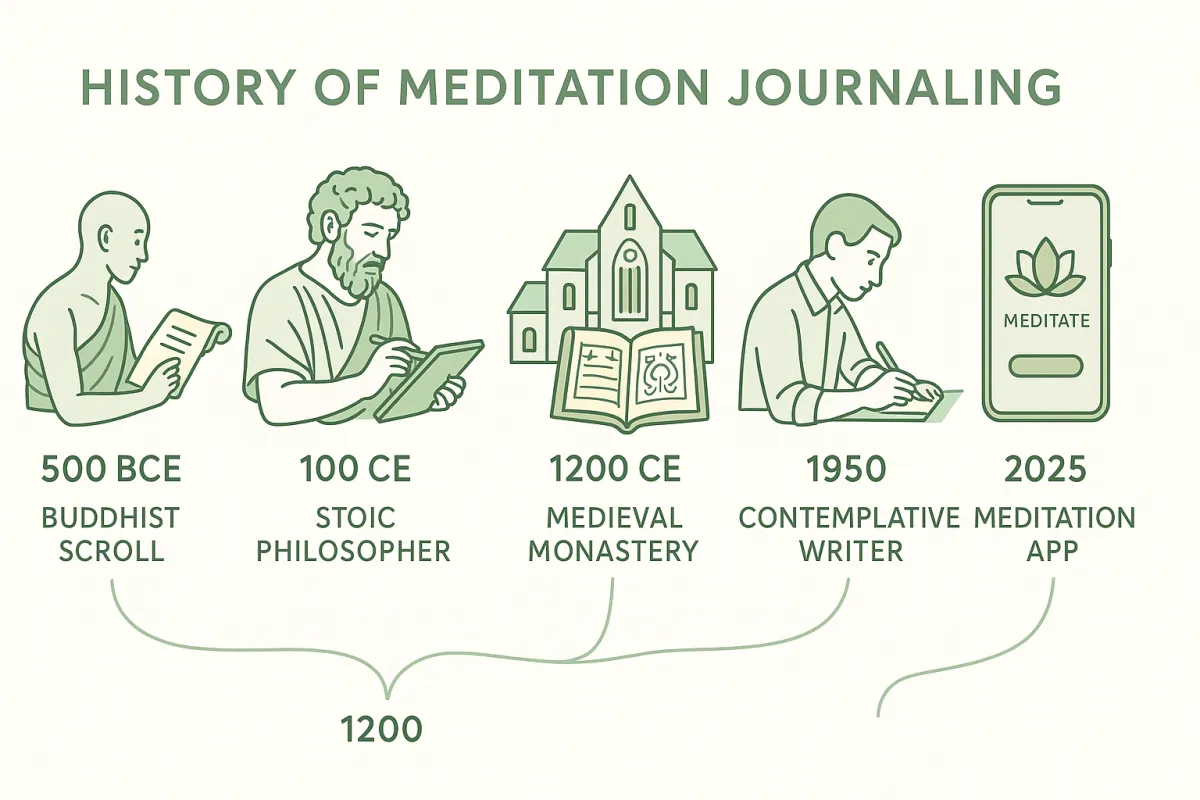
Ancient Meditation Journaling: 2,500 Years of Practice
Meditation journaling isn't a trend. For 2,500 years, contemplatives have written after sitting. Here's what ancient wisdom teaches modern practice.

Best meditation journal apps 2026: 5 honestly compared

Journaling after meditation: the step most people skip
7 Meditation Journal Prompts That Reveal Patterns
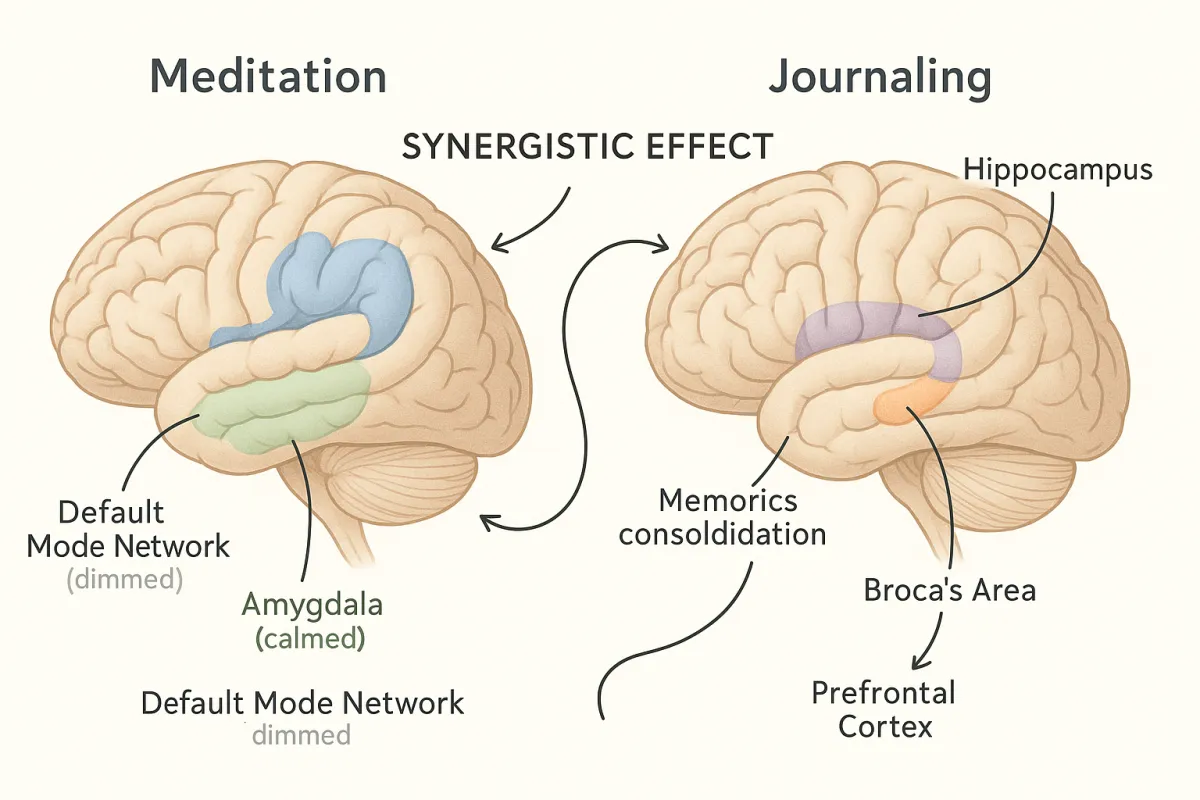
Meditation Journaling Science: Your Brain on Reflection
Turn isolated sessions into patterns you can see
StillMind pairs every meditation with a built-in journal and surfaces the patterns that emerge across your entries. Write, speak, or tag. Free to start.