Walking meditation: a guide for the walks you already take
Walking meditation, learned from the route I walk most. Four lineage forms to borrow from, what's on your feet, and AI guidance for the specific walk.
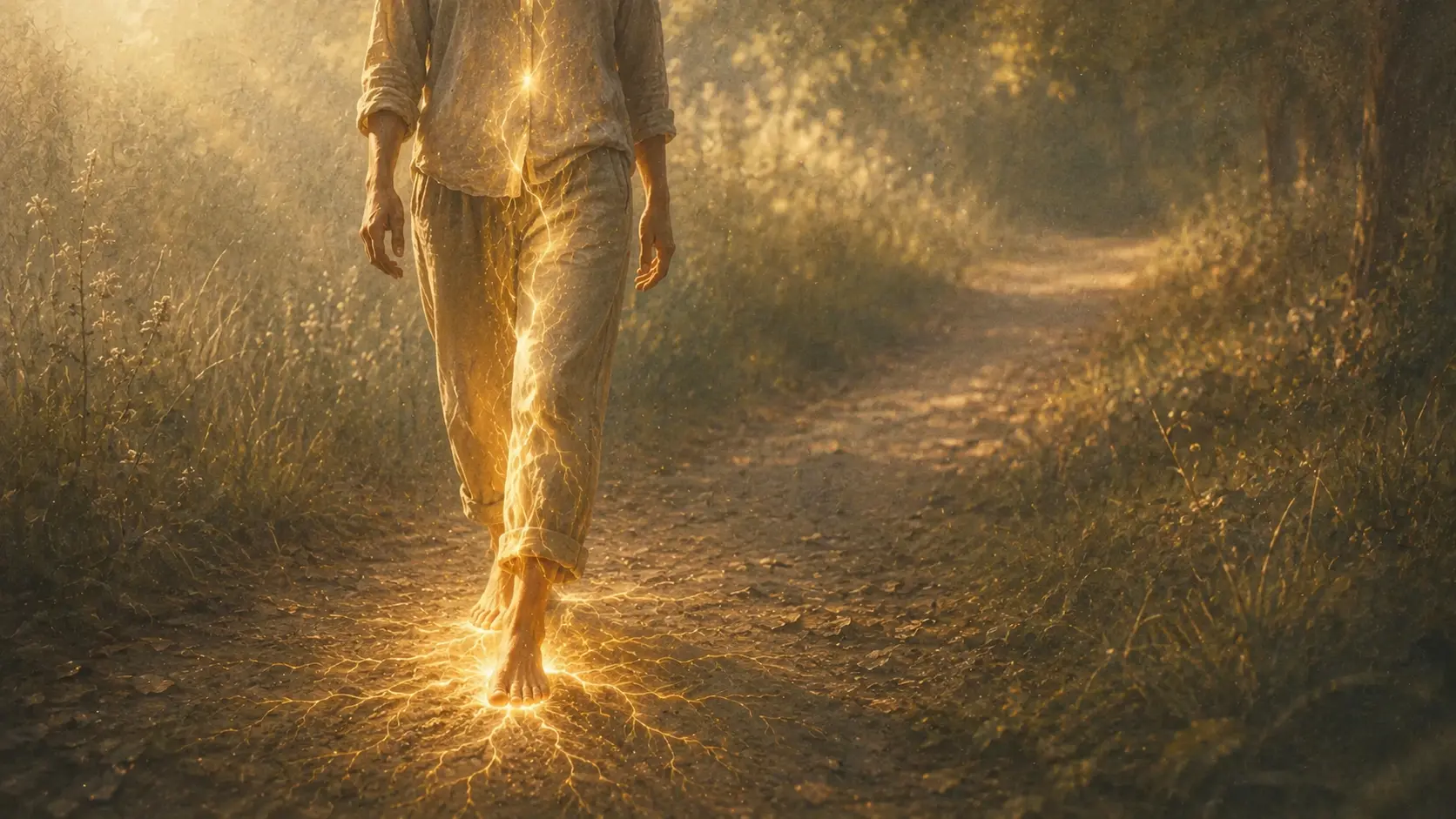
I do most of my walking meditation on the way home from school drop-off.
It’s a route I’ve walked enough times that I don’t have to think about it. I know the cracked bit of pavement, the corner where the wind always picks up, the gate the dog barks from. The walk is so familiar that my attention doesn’t have to do any of the navigation work. That leaves it free for the practice.
For a long time I treated that walk as wasted time. I’d spend it pre-running the day ahead, replaying the night before, half-listening to a podcast I’d forgotten the next day. The walk happened, my legs did the work, my mind went somewhere else entirely.
Walking meditation gives that walk back to me.
This guide is what I’ve learned from walking it. The four lineage forms worth borrowing from depending on what you want the walk to do. What’s on your feet, and how that changes things. The practical details that shape how the walk lands. And the small modern detail, voice notes during the walk, that lets you bring something home from it instead of losing it at the door.
What a walking practice can do
There are three things a walking meditation is especially good for, and once you’ve felt them you stop treating it as “the meditation you do when you can’t sit down.”
It makes a phase transition conscious. The school-drop-off walk home is one. The walk back from the corner shop is another. The walk to lunch and back. These are moments in the day when one role ends and another begins, and a walking practice turns the in-between into a real boundary instead of a blurry overlap. You get the chance to actually leave the morning before you start the next thing.
It works when sitting is hard. Some people bounce off sitting practice for years. Cross-legged on the floor feels wrong, the still body amplifies whatever’s restless underneath, the instruction to “just breathe” lands as an instruction to do nothing. A walking practice gives the same skills, sustained attention, body awareness, returning the mind when it wanders, in a form that lets the body do something. If you’ve tried sitting and bounced off, walking is a real door, not a consolation prize. (We have a longer piece on this in meditation for people who can’t sit still and a broader look at meditation and movement together.)
It integrates the practice with ordinary life. Sitting meditation is a thing you stop your life to do. Walking meditation happens inside walks you were going to do anyway. The bar to consistency is low, because the practice piggybacks on what’s already in your day. Over time, certain routes start to feel like practice spaces. The street home from school. The path round the block at lunchtime. The walk to the bus.
The forms below are all variations on those three uses. Some are quiet and ritualistic. Some are sharp and concentration-heavy. Some are casual enough that nobody around you would notice you’re doing anything different.
Where the practice gets personal: AI guidance for the walk you’re on
A regular walking meditation guide can tell you where to put your attention. It can’t know what you’re walking past or why you’re walking.
That second part is where AI guidance starts to do things a recorded session can’t.
You tell the AI two things: where you’re walking and what kind of walk this is. The guidance shifts to match.
Where you’re walking. If you’re on a tree-lined street, the prompts can rest on the trees: noticing how the canopy moves above you, the colour of the leaves at this time of year, the patches of sunlight that move when the wind does. If you’re walking through a city, the prompts can use buildings instead: the angle where the building meets the sky, the textures of brick or glass or render, the small details on doorways and windows you’ve passed a thousand times without seeing. If you’re on a footpath in a park, the prompts can move to the ground: feeling the give of the soil, the small stones through the sole of your shoe, the cracks between the paving slabs and the shapes they make. Each environment has its own anchors. The guidance picks the ones that match.
The audio environment, too. Some walks have wind and birdsong, and the practice can be listening to them: noticing how many different sounds you can hold at once, hearing the layers. Other walks have traffic, and the practice can go either way: letting the traffic become the rhythm you walk with, or the thing you let pass through without grabbing your attention. Either is valid. The AI can guide you to whichever you want.
What kind of walk this is. This is where it gets personal. The same route can be many practices depending on what you’re walking through.
If this walk is a phase transition (you’ve just dropped the kids off and you’re walking home before work; you’re walking from one meeting to another; you’re walking out of an argument), the guidance can support that: the first part of the walk is for letting the previous role go, the middle is for arriving in your body, the last part is for arriving where you’re going.
If this walk is for blowing off steam (you’re angry, you’re frustrated, something didn’t go the way you wanted), the guidance can use the walking itself: pace the steam out, let the body do the work the words couldn’t. The pace can be deliberately quicker, the breath fuller, the practice less about stillness and more about letting the charge move through you.
If this walk is for settling your nerves before something (a date, an interview, a conversation you’ve been putting off), the guidance can move the other direction: pace slowed deliberately, breath lengthened, attention rested on the parts of your body that feel steadiest right now.
A pre-recorded walking meditation does one thing for everyone. AI guidance can ask the simple question, “what is this walk actually for?” and shape itself to your answer. Once you’ve had that, the generic kind starts to feel like guidance that’s talking past you.
"What is this walk actually for?"
Phase transition from school drop-off, steam release after a hard call, pre-meeting settling. Tell StillMind where you're walking and the goal, and the guidance shifts to match instead of running a generic loop.
Try AI-guided walking meditation, freeWhat’s on your feet
The surface under your feet is part of the practice, and what’s between your foot and that surface shifts how much of the surface you actually notice.
Going barefoot, when you can. Grass, sand, soil, smooth stone. The first time you do a walking meditation barefoot on grass or soft ground, the attention does something different. You feel the give of the earth, the unevenness, the small textures. There’s nothing to translate. The sensation is right there. Anywhere safe to walk barefoot is worth trying at least once for a practice walk: a back garden, a quiet stretch of park, a beach.
Barefoot shoes, when you can’t. For most walks, going fully barefoot isn’t practical. Pavements, cold ground, broken glass, social context. Barefoot-style shoes (sometimes called minimalist shoes) keep your foot protected but let your sole sense the shape of the ground. You feel the change from smooth pavement to gravel to wood. The proprioceptive feedback is much closer to barefoot than a cushioned trainer. For walking meditation specifically, this matters: a thicker sole quietly removes the very sensation the practice rests on.
Grounding shoes, if you want both. A small newer category of footwear, sometimes called “earthing” shoes or grounding shoes, uses conductive material in the sole to maintain electrical contact with the ground while you wear them. Brands that make barefoot shoes are increasingly making grounding versions of the same models. Recent research on grounding suggests potential benefits for sleep, inflammation markers, and stress recovery, though the studies are still small and the picture isn’t fully settled. Worth knowing, not worth overselling.
The reason I mention any of this in a meditation guide: even if the bioelectric story turns out to be modest, the attentional effect of grounding is unambiguous. The sentence “I’m in direct contact with the earth right now” is a real anchor. If you’re walking a forest path and your shoes are letting you feel the ground through them, you have an extra place to put your attention any time the mind drifts. The shoes do some of the work that the practice would otherwise have to do alone.
You don’t need any of this to do walking meditation. A pair of normal shoes on a normal pavement is fine. But once you’ve walked a familiar path barefoot, or in barefoot shoes, the same path with thick cushioned soles feels muted. It’s worth knowing what’s quietly being filtered out.
Four lineage forms worth borrowing from
Walking meditation has been practiced for at least two thousand years, and several distinct traditions have shaped it. Each form is the answer to a slightly different question. Knowing them gives you a menu to borrow from depending on the walk you’re about to take.
Sōtō Zen kinhin
In Sōtō Zen, kinhin is the walking practice done between long sittings of zazen. After thirty or forty minutes on a cushion, the legs are numb and the mind has lost its edge. Kinhin brings the body back online without dropping the meditative quality.
The pace is famously slow. About six inches per breath. Step on the inhale, settle the weight on the exhale, step again. You hold your hands in shashu (right hand wrapped in left, both held lightly against the chest). The walking is in a circle or back along a line, with no destination.
The first time most people try it, it feels too slow to be doing anything. That’s part of the practice. The mind wants to speed up because speeding up is what minds do. Kinhin asks you to stay with a pace that has no productive function. Once you’ve stopped reaching for the pace you’d rather be at, the quality of attention from the sit you just finished carries through the walk, and you can return to the cushion without losing it.
Reach for kinhin when you want a ritual transition. When the walking itself should be the practice, with no separate sit on either side of it.
Mahasi labeling (Burmese vipassanā)
The Burmese Mahasi Sayādaw tradition uses verbal labels during walking meditation. As you lift your foot, you note silently to yourself: lifting. As the foot moves forward: moving. As it sets back down: placing. For very slow walking, the labels can subdivide further: intending, lifting, moving, placing.
The walking is slow, often along a defined path of about ten paces, back and forth. The labels give the discursive part of the mind a small job that ties it to the immediate present. Without them, the mind narrates the past or plans the future. With them, the narration has nowhere to go that isn’t the foot.
Practitioners in this lineage talk about the gradations of pressure as the weight transfers across the sole, the moment the toes lose contact, the small fall of the foot before it lands. Chanmyay Sayādaw used to say that the slower you walk, the faster you arrive. The slowness serves the detail. You walk that slowly precisely so you can notice that level of granularity, which is what the practice is actually after.
This form is the one to reach for when you want concentration. When the mind is scattered and you want to gather it back to a single point of attention that happens to be moving.
Thai forest cankama
In the Thai Forest tradition, cankama means the walking path. Monks in this lineage pace a defined stretch (often a worn line of beaten earth between two trees) back and forth for an hour or more. Each turn at the end of the path is a moment of distinct attention. The practice is sustained samadhi across many lengths of the same route.
What’s different about cankama is its endurance. The pace is comfortable rather than slow. The breath finds its own rhythm. The walk is long. The form trains the kind of attention that can hold steady across many minutes without needing the novelty that shorter sittings provide. Some practitioners in this tradition walk for hours at a time, the path so familiar that the route itself becomes invisible.
There’s something useful about a defined path in particular. A loop with corners and decisions costs attention. A straight line you turn around at doesn’t. If you have access to any quiet stretch (a garden, a long hallway, a footpath you can walk and re-walk), this is the form to try when you want a longer practice without the novelty-seeking that shorter walks invite.
Modern secular mindful walking
Outside the Buddhist traditions, walking meditation has its own modern form, often associated with Thich Nhat Hanh’s Plum Village tradition and with secular mindfulness teachers. The rules are looser. Pace is whatever’s comfortable. There’s no specific path. The practice is the quality of attention you bring to a walk you were going to take anyway. If you’re curious how that attention holds up across an ordinary day, a two-minute read on your everyday presence is a gentle place to check.
You walk at a natural pace. You feel each foot make contact with the ground. You notice when the mind has wandered into the day and gently bring it back to the next step. You can do this on a pavement, in a corridor, on a beach, in the supermarket carpark. It looks identical from the outside to ordinary walking. The difference is entirely inside.
This is the form that integrates best with the school-drop-off walk, the lunch loop, the walk between meetings. It’s also the form that does the most quiet work over time, because it lives inside walks that happen anyway. Reach for this form when you want the practice to disappear into your day rather than be a separate thing you do.
Practical details that shape the walk
A few things shape how a walking meditation lands, and they’re worth knowing about before you set off. None are rules. They’re just where the attention can helpfully rest.
Pace. Most people’s default walking pace is slightly too brisk for a walking meditation. A pace that supports attention is slower than a get-somewhere pace. If you find your breath getting ahead of you, the pace has lifted past where the practice fits comfortably, and there are two good moves: drop the pace and the breath settles, or let the breath itself become the practice. A faster walk with attention on the breath catching up to the body is just as legitimate as a slow walk with attention on the feet. Whatever pace you’re walking now is fine. The question is where the attention rests.
Breath. A useful starting structure is breath synchronised loosely to steps. Try three or four steps on the inhale, three or four on the exhale. Don’t force it. You’re letting the breath lock loosely to the rhythm of the body, without trying to control it. Once the synchronisation finds itself, you can stop counting and just notice that the breath and the steps are moving together.
The visual world. Walking meditation is mostly an eyes-open practice, and the visual field is going to pull at your attention. A bird flies past and you turn your head. A shopfront catches your eye and the mind goes off planning something to buy. That pulling is part of what the walk trains. The skill is exactly this: noticing the pull, choosing whether to follow it, returning the attention to the feet or the breath. Each pull-and-return is a rep. Over time, the pulls stop pulling so hard.
Terrain. A familiar route is easier than an unfamiliar one. A flat surface is easier than uneven ground. A quiet stretch is easier than a busy one. Start where it’s easiest, and let the practice get more robust over time. There’s no badge for doing a walking meditation through Oxford Street at rush hour on your first day.
Bringing the walk home
The most frustrating thing about walking meditation has always been this: something comes to you in the middle of a walk, an insight, a connection, a thing you’ve been trying to see for weeks, and by the time you sit down to write it down, it’s gone. The walking state and the writing state don’t communicate.
Voice notes during the walk solve the oldest part of this practice.
You can speak a sentence into a voice note without breaking stride. You can keep walking. The thought lands, you say it out loud (six words is enough), and the walk continues. When you sit down later, the note is waiting in the exact phrasing you used in the moment, before memory has time to water it down.
This is different from journaling after a walk, which is also worth doing. The voice note captures the thing as it surfaces. The journal entry afterwards is where you sit with it. Both are useful. The voice note is the one that stops the insight from evaporating in the first place.
A few practical notes. Keep the voice note short. Use it for the small specific thing that came up. The walk doesn’t need narrating. Speak the note once, in your own words, and keep moving. If you find yourself wanting to elaborate, save that for the journal entry afterwards. The walk should still feel like a walk, not a podcast.
The thing this slowly does, over weeks and months, is build a record of what comes up during walking practice specifically. Patterns emerge that you’d otherwise miss: certain thoughts that always surface on the home stretch, decisions that resolve themselves between minute four and minute seven, the kind of question that only arrives when the body is moving. See voice notes during meditation and journaling after meditation for more on how the recording-and-reviewing loop works.
How to start
If you’ve never done a walking meditation, here is the lowest-friction version that still counts.
Pick a route you already walk. The walk home from somewhere you go often. The walk round the block. The walk to the corner shop and back. Don’t invent a new route for the practice. Use one that’s already in your life.
Pick a duration that fits the walk. Five minutes is enough. Ten is generous. Twenty is luxurious. The walk itself is the duration. You’re changing the quality of time that’s already in your day, rather than adding new time to it.
Pick one of the forms, and don’t overthink it. Modern secular mindful walking is the easiest start. Walk at your natural pace. Feel your feet make contact with the ground each step. When the mind wanders, bring it back to the next step. That’s the whole instruction. Over the next few walks, try kinhin’s slowness if you want a ritual quality, or Mahasi’s labels if you want concentration. The right form is the one that fits the walk you’re on today. (For a broader sense of which technique fits which situation, see meditation techniques: which one to use when.)
That’s it. Walk a familiar route. Put the attention on the feet. Come back when the mind drifts. The practice does the rest.
FAQ
What makes a meditative walk different from an ordinary walk?
The walk itself looks the same from the outside. The difference is where your attention is. On an ordinary walk, attention is usually somewhere other than the walk: replaying a conversation, planning the afternoon, listening to a podcast. On a meditative walk, attention rests on the body doing the walking: the feet, the breath, the rhythm. When the mind wanders (it will, often), you notice it has wandered and bring it back. That noticing-and-returning is the practice. Same route, same pace, completely different fifteen minutes.
How slow should a walking meditation be?
It depends on the form. Sōtō kinhin is famously slow, about six inches per breath, which feels almost unnaturally measured at first. Mahasi labeling is also slow, slow enough to notice the moment the toes lose contact with the ground. Thai Forest cankama is comfortable rather than slow. Modern secular mindful walking is whatever pace fits the walk you're on. The most useful rule: if your breath is catching up to your pace, you've lifted past where the practice fits comfortably. Either drop the pace, or let the breath become the practice.
Should I walk with eyes open or closed?
Open. Closing your eyes is a sitting-practice instruction. For walking, you need your visual field for the obvious reason that you're moving through space. Some practitioners soften their gaze and let it rest a metre or two ahead of them, which prevents the eyes from grabbing onto every passing detail without losing the awareness you need to navigate. The visual world will pull at your attention sometimes. That pulling, and your noticing of it, is part of what the walk trains.
Can walking meditation replace sitting practice?
For many people, yes, walking can be the main form of practice and still build all the same skills: sustained attention, body awareness, returning the mind. For other people, walking and sitting do different things and both have a place. Traditional Buddhist training generally uses both. The honest answer is that the question matters less than the consistency: a walking practice you actually do is worth far more than a sitting practice you keep postponing. Start with what you'll keep returning to.
What's the best route for walking meditation?
A familiar one. The route you walk most often is usually the best route for the practice, because your attention doesn't have to do any of the navigation. You already know where the kerbs are, which way the path bends, where the slope picks up. That frees your attention for the actual walking. New routes are interesting, but interesting is the opposite of what the practice wants. Save unfamiliar walks for ordinary walking. Use familiar ones for the practice.
How long should a walking meditation last?
As long as the walk you're already doing. Five minutes is enough to be a real practice. Ten is comfortable. Twenty is generous. If you're walking a familiar route, the duration is given by the walk, not by a clock. It changes the quality of time that's already in your day, rather than adding new time to it. A five-minute walk you actually practise on is worth more than a thirty-minute walk you keep meaning to.
Going deeper
Walking meditation is deceptively simple. Walk a route you know. Put your attention on your feet. Return when the mind drifts. That’s the practice.
What changes over time is how much of your ordinary walking starts to soften into practice. The instructions stay the same. The walk home from school stops being a wasted fifteen minutes and starts being one of the most reliable practice windows in your week. The walk to lunch stops being a gap between things and starts being its own kind of transition. The route round the block, the corridor between meetings, the path to the bus stop. They were always there. The practice just lets you actually be on them.
If you want to take this further, the meditation techniques: which one to use when guide is a useful map of when walking fits among the other techniques. The meditation and movement: hybrid practices guide covers the wider family of practices that walking belongs to. And for the modern affordance the post keeps pointing at, see voice notes during meditation for why mid-walk capture changes what you can keep.
If you want guidance shaped to your specific walk (where you’re going, what kind of walk this is, what you want it to do for you today), that’s what StillMind does. The same five-minute walk can be a different practice depending on what you tell it.
Related: Meditation + movement: hybrid practices | Meditation techniques: which one to use when | Voice notes during meditation | Body scan meditation guide | Meditation for people who can’t sit still