Meditation for people sick of being told to meditate
You have tried it. The specialist suggested it anyway. What meditation honestly offers a body in chronic pain, and how to take it back on your own terms.
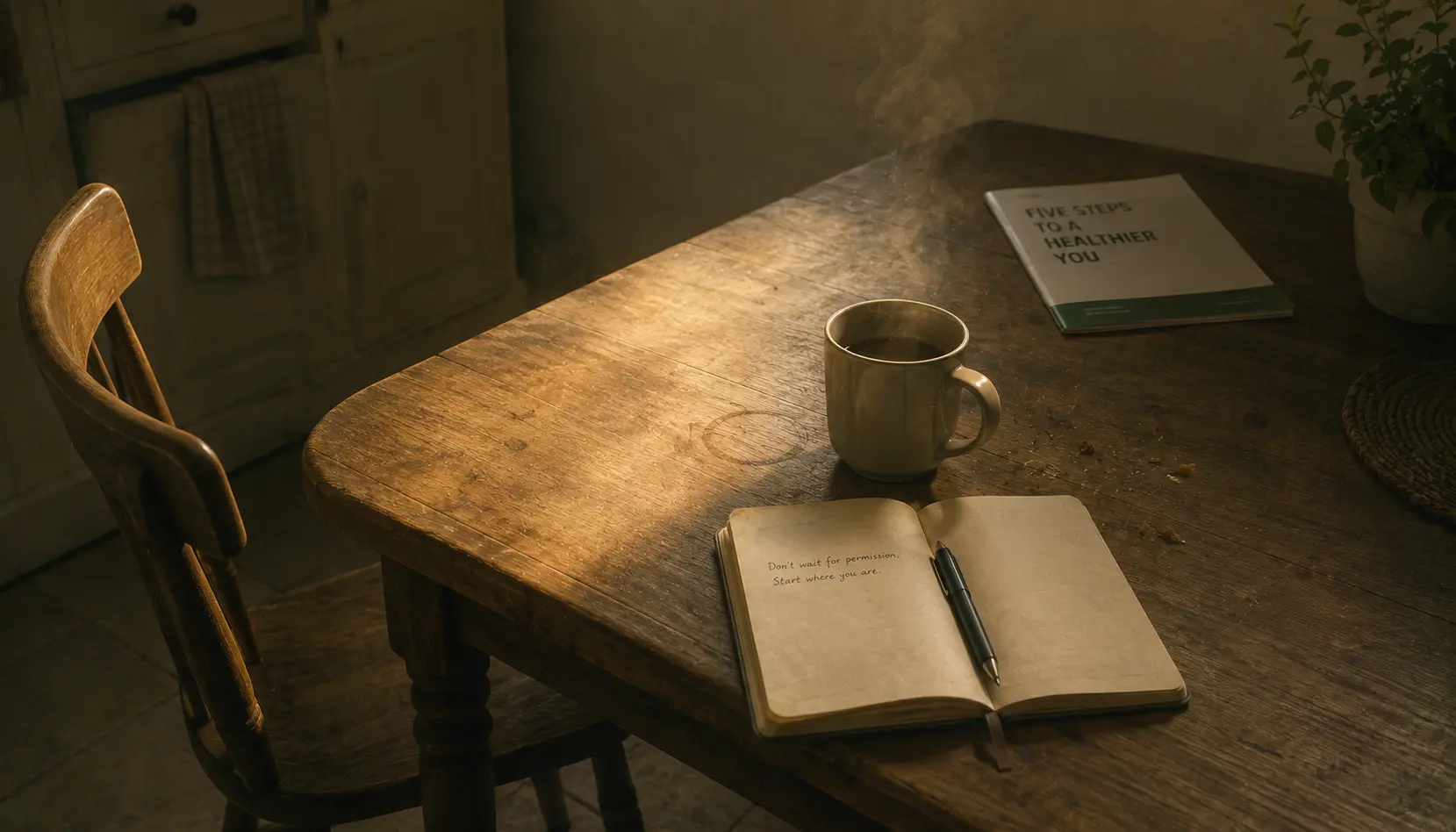
The referral took eleven months.
By the time you get into the room you can recite the list in order, because you have recited it in enough rooms. The over-the-counter painkillers. The gabapentin. The amitriptyline you came off because of the fog. Two rounds of physio. The CBT course you actually finished. And yes, meditation. You know there is more than one kind of it.
The specialist listens. Writes something. Looks up and says the plan is to try meditating.
You say the thing everyone says. “Oh, that’s a good idea, I’ll give it a go.” You go and sit in the car.
Then it keeps arriving. From the GP. From your aunt across the Thanksgiving table. From somebody you have not spoken to since school, who found your post and typed “have you tried meditation?” underneath it, two comments below the one about essential oils.
This is not a post telling you to try meditation. You have. It is about why the question lands the way it does, what meditation for chronic illness honestly offers, and what changes when you pick the same technique up yourself instead of being handed it.
Part of our work on practice troubleshooting. If attention to a symptom is the thing making it louder, start with does meditation make pain, tinnitus or anxiety worse?
Why the question lands so badly
The suggestion is rarely a tool. It is a verdict on your effort, delivered by someone who has not asked what your effort has consisted of.
Sometimes it stands in for the investigation. Eighteen years of pain, no imaging ever ordered, and meditation recommended on the way out of the room. Sometimes the workup quietly stops and the next referral goes to psychiatry instead. A postpartum appointment ends with lose weight and get more sleep, which is two impossible things and no plan. The advice is not the injury. Being redirected is.
Then there is the sentence that contradicts itself inside a single breath: your pain is not in your head, but if you do not stop thinking about it you will never get rid of it. Both halves cannot be true. You are expected to nod at both.
So you perform the script, because it costs less than the conversation that follows honesty.
None of which means unsolicited health advice is always unwelcome. People living with chronic illness are precise about this, and the same words land completely differently depending on three things: who is saying it, what they want from you, and how specific it is.
| When it lands | When it stings | |
|---|---|---|
| Source | Someone with the same condition, saying what they personally do on a bad week | Someone whose worst pain was a bad back in 2011 |
| Intent | Offered as one option among many, with no follow-up quiz | Offered with the energy of a correction, as though you have been doing something wrong |
| Specificity | Weirdly specific, learned the hard way, and new to you | Drink more water. Get some fresh air. Give up coffee. Get a piercing |
Yes. Water has been tried.
What meditation is and is not for chronic illness
Meditation is not a pain reliever, and everybody inside these communities already knows it.
The evidence is real and it is modest. Meditation can lower the distress wrapped around pain. It can loosen the loop where pain raises stress, stress raises guarding and sleeplessness, and those raise pain again. It can change how much of a day gets spent braced. What it does not do is act on the underlying condition, and a suggestion built on the implication that it will is wrong about the evidence, not merely tactless.
Naming the claim makes the gap obvious.
| What the suggestion implies | What the evidence supports |
|---|---|
| It will bring the pain down | Effects on pain intensity are modest and inconsistent between people and between conditions |
| It treats what is actually wrong with you | Nothing about it acts on the disease. It sits alongside medical care and never in place of it |
| It works because the pain is psychological | Distress and pain influence each other in both directions. Reducing one is not a confession about the other |
| You have not given it a fair go | Plenty of people practise consistently for years and still have exactly the condition they had before |
There is a sharper observation that circulates among people with long-term pain, and it explains most of the friction. If you have hurt for years, you already have the mental management of pain down to a science: redirecting attention, pacing, negotiating with your own nervous system, holding a face together in public, all of it since before anyone suggested a body scan. Meditation astonishes people whose pain is temporary because they are meeting that skill for the first time. You are not. Being handed the beginner version of your own daily expertise is a strange thing to be grateful for.
Which is why “meditation doesn’t help my pain” is not a confession of bad technique. It is an accurate report.
None of this replaces medical care. If your pain is being managed with suggestions rather than investigated, asking for a second opinion is a reasonable thing to do.
Why the standard instructions backfire on a body in pain
Start at your toes and work up. Notice each sensation without judgement.
What actually happens is an inventory of misery. You reach your hips and find three aches you had successfully not noticed all morning, and there are twenty minutes of recording left. The instruction assumes a neutral body with interesting signals in it. Yours is not neutral and the signals are not interesting.
Visualisation goes the same way. You imagine a beach, you get there, and you are on the beach in horrible pain. The scenery changed. Nothing else did.
Then there is the instruction to quiet the mind, which your condition has already revoked. Pain is loud. Five minutes into a jigsaw puzzle your back is already talking, and it is never not in the forefront. Asking for a quiet mind asks you to succeed at the one thing the condition prevents, then calls the failure your practice.
This is the collision we look at in why generic pain meditation fails people with fibromyalgia: guidance built on hyperfocus on the body, aimed at a body that is the problem. Check too whether the barrier is the technique at all or the voice delivering it. A serene whisper telling someone mid-flare to relax has its own effect.
What tends to work instead points outward. Sound rather than sensation. An object in the room, eyes open. Counting the exhale, because a number gives attention somewhere to sit that is not tissue. Forms short enough that nothing has time to escalate. The question of whether paying attention makes a symptom worse is the longer answer on why that direction matters.
A tool you pick up is not a prescription you were handed
Same technique. Completely different object. Being told to meditate and deciding to meditate are not the same activity, whatever they look like from outside.
Often what crossed the desk was not even a technique. It was a word, and which word it was decides what you were actually being sent to do.
Handed to you across a desk, by someone with fifteen minutes and no plan, it is homework with your credibility attached. If it does not help, the failure has your name on it, and the next appointment starts from the assumption that you did it wrong. That is not a practice. That is an exam.
Picked up by your own hand, on a day you chose, it is a tool. Nobody is grading it. Nobody has to be told it did not work today. The framing I keep hearing from people who live with this is about agency: doing a thing not because you expect it to make you better, but because you want to. It is a large part of why meditation fails the first time, in a way that says nothing about now.
A prescription you were handed is one more thing to fail at. A tool you picked up is yours, and it does not report back to anyone.
One woman with a long-term condition described giving up on meditation as treatment and using it as a barometer instead. She sits. If the internal noise is too loud to stay there, that is information about the day, not a verdict on her. It stopped being something she could fail at the moment it became something that reports the weather.
What a practice on your terms can look like
Meditation on your own terms is rarely impressive to describe. Small, unglamorous, and shaped around the hours you actually have.
- Two minutes of counted exhales at three in the morning. Not to make the pain stop, because it will not. To have something to do at that hour other than lie there alone with it. Count to six or eight on the way out and let the in-breath look after itself.
- Square breathing as a job for your attention. Four in, four held, four out, four held. A shape is easier to hold onto than an instruction when thinking is expensive.
- The practice as data-gathering. A journal entry straight after: what state you were in, what you tried, whether it went anywhere. Two lines is plenty. After a few weeks it is a record of your own patterns, and the most useful thing to bring to a ten-minute appointment.
- Flare rules, decided in advance. On a flare day the practice shrinks to one minute, moves to lying down, or does not happen. Write the rule while you are steady, so it is not decided by the version of you at the worst point of the week. A practice that pauses on purpose is intact. A practice abandoned in guilt is not.
- An outward-anchor sit. Eyes open, attention on sound: the fridge, traffic, the neighbour’s television. Nothing asks you to inspect your own tissue, which on some days is the entire point.
None of this is a treatment plan. It is a set of things you may or may not want, on days you may or may not have. Our meditation for chronic pain page has more on what to ask for and when.
A practice built from what you actually live with
Tell StillMind what today really is: the flare, the fog, the three in the morning. It builds the session around that, and momentum is designed to survive the days you cannot sit at all.
Try StillMind, freeIf someone hands you the question again
You do not owe anyone a debate about your own body. Having something ready means the answer costs you nothing.
- In the appointment. “I’ve tried meditation, and I still practise. What I came in about today is my hip and whether it has been imaged. Can we start there?” Name what you have already done, then steer back to the thing you waited eleven months for.
- With the relative who means well. “Thanks, I’ll bear that in mind.” Then change the subject. The polite close-out is not dishonest, it is a door. Save the long version for people who have earned it.
- With yourself. You are allowed to never meditate. Not as a rebellion, as a preference. Pacing, journaling, walking, strength work started at a level that sounds ridiculous, music, a craft for your hands: people build whole workable lives out of these without ever sitting still on purpose. A practice is only worth having if it is yours, and part of owning it is being free to put it down.
If you do decide to pick it up again, pick it up on a day nobody suggested it.
Questions people actually ask
Does meditation actually help chronic pain?
Not as a pain reliever, and anyone promising that is overselling it. The evidence is real but modest, and it points at distress rather than at pain intensity: meditation can loosen the loop between pain, stress, guarding and sleeplessness, and change how much of a day is spent braced. It sits alongside medical care and never replaces it.
What if focusing on my body makes the pain worse?
That is real, common, and not a sign you are doing it wrong. Scanning a body that hurts can turn into an inventory of every ache you had managed not to notice. Outward anchors work better: sound, an object in the room, eyes open, counting the exhale, and forms short enough that nothing escalates. Never push through a practice that is making things worse.
Do I have to meditate to manage a chronic illness?
No. Plenty of people manage well and never meditate. Pacing, journaling, walking, strength work started ridiculously small, music and absorbing crafts all do similar work, and they count. The practice is only worth having if you want it.
How do I respond when someone tells me to try meditation?
In a clinical setting, say you have tried it and steer back to what you came in for. With a well-meaning relative, “thanks, I’ll bear that in mind” and a change of subject costs you the least. And with yourself, the honest answer is that you are allowed to never meditate at all.
If the next stretch you are facing is a scan or a set of results rather than a flare, the wait itself is its own problem and worth treating separately.