Waiting for test results: meditation for the not knowing
Your biopsy was on a Friday and the result lands Wednesday. Nothing you do changes what it says. Here is what a meditation practice is for in between.
Part of our work on nervous system regulation. If attention to a symptom is the thing making it louder, start with does meditation make pain, tinnitus or anxiety worse? instead.
The biopsy was on a Friday.
That detail matters more than it should. The lab that will decide the shape of your next year keeps office hours, and it does not work weekends. So when someone says the result takes three business days, what they have described is Monday, Tuesday, Wednesday. What you will live is six days, and two of them are the ones where nothing can happen and you know it.
Somewhere in that stretch, a person you have never met reads the slide and knows. You do not. The only thing between you and the answer is scheduling.
That shape is specific, and it is not quite the same thing as anxiety. Most of what has been written for you assumes a worry you can work with: a prediction to test, a step to take, a habit to build over months. None of those fit a sealed envelope. The answer is already written. What is not yet written is the week.
This is about that week.
Three things are true at once, and the usual advice is built for none of them
Pull apart what makes waiting for test results its own thing and you get three properties. Any one of them on its own is manageable. It is holding all three together that breaks the standard toolkit.
| What is true | What the usual advice assumes | Why it misses |
|---|---|---|
| The threat is real and external. There is an actual answer sitting in a file | That the fear is a distortion, and examining the evidence will shrink it | Examine the evidence and you find there is some, it is real, and it is not yours to see |
| Nothing you do moves it | That there is an action, and taking it will help | There is no step. Advice that implies otherwise quietly hands you the blame if the news is bad |
| It ends on a date | That you are building something over weeks | You are not building a practice. You are getting through until Wednesday |
Researchers have a name for this. In a 2024 paper in Emotion, Ella Moeck and colleagues call it an uncertain waiting period, and they open by defining it almost exactly as the paragraph above does: waiting for an important outcome you have minimal control over. Medical results and job offers are the two examples they reach for first.
The distinction matters because some strategies behave differently inside this window than outside it, which is the subject of a later section.
The result probably reaches you before your doctor does
Here is what has quietly changed about the shape of a wait.
Until recently, the wait ended with a phone call. Someone who had read your result, and knew what it meant, told you what it said. That is not how it works now. Under the information-blocking provisions of the 21st Century Cures Act, US health systems release electronic results to patients as soon as they are finalised, rather than holding them for review.
A study of 1,188,692 imaging examinations across 388,921 patients at one large multicampus health system measured what that did. Before the change, reports sat behind a 36 hour embargo. After it, the median time from a report being finalised to appearing in the patient portal was 0.4 hours. The median time until the patient first opened it fell from 45 hours to 5.5 hours. And the share of reports read by the patient before the ordering doctor had looked at them went from 18.5% to 44.0%.
Close to half. A notification on your phone, wherever you happen to be standing, rather than a call from someone who has read it.
The gap between the two brackets is the part nobody schedules for you. And when the report does arrive, it was written for a radiologist. One person waiting on a scan put it plainly: their portal uploaded the summary but not the images, and they were not sure reading the report would mean anything to them anyway.
So you can end up with the answer in your hand and still not have it.
The decision nobody warns you about
Because results now arrive on their own schedule, the wait contains a choice that did not used to exist. Do you look?
Spend an hour reading people who are in it and you find two camps, both certain, both articulate.
One person waiting on a CT put the case for not looking about as well as it can be put. Once you know bad news, they said, your whole life changes, and you miss the time before you knew. Waiting for the doctor to tell them buys more of the time that still counts as normal. They had access to everything the moment their doctors did, and had decided, once, not to use it.
The wait is not only something to be got through. For some people it is the last stretch of ordinary life, and they are guarding it on purpose.
Someone else in the same conversation was equally clear the other way. They always read results the moment they land, they google the words they do not know, and they know that the longer they are made to wait the worse they get. Their advice to the person who asked was simply to work out which one costs them more, waiting or not waiting, and then pick.
That is the honest answer, and it is better than any tip. There is no correct choice here. There is only your choice, and the thing that makes it work is making it before the wait starts rather than during it.
Because during it, the decision gets made at eleven at night by the most frightened version of you, with a phone already in your hand.
One person had been given exactly this by a therapist who worked with oncology patients. The rule was that she was allowed to look at the results when they came in, and she was not allowed to google anything. A hard rule, set in advance, with the edge cases already decided. She said it helped enormously, and that when she did look she could not tell what she was seeing anyway.
A rule you set while you are steady is worth more than any amount of willpower applied at the moment it is tested. Which is a fair description of what a practice is for.
What actually helped, and what quietly made it worse
Moeck and colleagues followed 101 university students in Belgium for nine days, across the stretch where they were waiting for consequential exam grades and then the stretch after they received them. Experience sampling, 8,275 observations, six emotion regulation strategies measured against how people actually felt.
Two strategies behaved the same in both periods:
- Acceptance helped throughout. Letting the feeling be what it was, without arguing with it, was consistently good for short-term wellbeing before and after the result.
- Expressive suppression hurt throughout. Holding it in and presenting a normal face was consistently costly, in the wait and afterwards.
Three behaved differently depending on whether the outcome was still unknown, but only two changed direction outright. Rumination hurt in both periods and hurt more during the wait. Social sharing and reappraisal, both helpful once the result was known, were harmful while it was still uncertain.
Read that twice, because it runs against the usual instinct, and against how meditation for anxiety is normally approached. Talking it through and looking for the brighter framing are the two things people reach for hardest during a wait, and in this study they were the two that backfired specifically then.
Some scope on this, because it matters. These were exam grades, not biopsies, and 101 university students in Belgium are not a cancer clinic. It was a secondary analysis of an existing dataset. Nobody has run this study on people waiting for a scan, and until somebody does, treat it as the best available signal rather than a settled fact.
But the direction it points is worth taking seriously, partly because it fits what people in the wait already report. Someone describing her second mammogram said she got through it by repeating to herself that she would cope and move through whatever the outcome was. Not that it would be fine. That she would cope either way. She added that it helped, and that she still cried on the ultrasound table.
That gives you a usable test. Meditation for uncertainty is not the practice that makes you feel better today. It is the practice that will still make sense on the day you find out. Acceptance passes that test. Picturing a good outcome does not, because if the news is bad it converts into having failed to want it hard enough, and you did not.
What to ask for
If you use StillMind, the session is built from what you type in, which means the useful move is describing the actual hour you are in rather than the topic. These are drawn from the situations people in the wait describe most often.
| Where you are | What to ask for |
|---|---|
| You have decided to wait for the appointment, and the phone keeps pulling at you | "I have decided not to open my results until my appointment on Monday. Help me leave my phone alone tonight." |
| You have decided to read them, and you want to be steady when you do | "My test results land in the portal today and I have decided to read them. Help me get steady before I open them." |
| You genuinely do not know which you would rather do | "I cannot work out whether I want to read my scan results before my appointment or wait to be told. Help me get quiet enough to know which I actually want." |
| The night before the scan | "I have a scan in the morning and I am already worn out from dreading it. Help me get through tonight." |
| Mid-wait, at work, and nobody there knows | "I am at work waiting for biopsy results and I have not told anyone here. I need ten minutes before I go back in." |
| One in the morning, and you have been searching the words in your own report | "It is the middle of the night, I have been searching the words in my own test results, and I cannot stop. Help me put it down." |
| The result came, and it was not the one you wanted | "I got the result I was afraid of this morning. I do not want to be talked round. I just do not want to be on my own with it for ten minutes." |
That last row is the one that matters most, and if it is where you have landed, what grief does to the nervous system is the more useful page than this one. If it is heavier than that, a crisis line or your medical team is the better first call, and no app is a substitute for either. A practice you can still open on the day the news is bad is the one worth choosing in the days before you know.
A session for the hour you are actually in
Type what is happening. StillMind writes the session around it, whether that is the night before a scan or ten minutes in a car park before you go back inside.
Try StillMind, freeThe specific hours
Waits are not uniform. They have peaks, and the peaks are predictable enough to plan for.
The night before. People describe arriving at the scan already worn out by anticipatory anxiety, before anything has been measured. This is the one where meditation before a scan earns its place, and where what actually helps with sleep is more relevant than anything aimed at the scan.
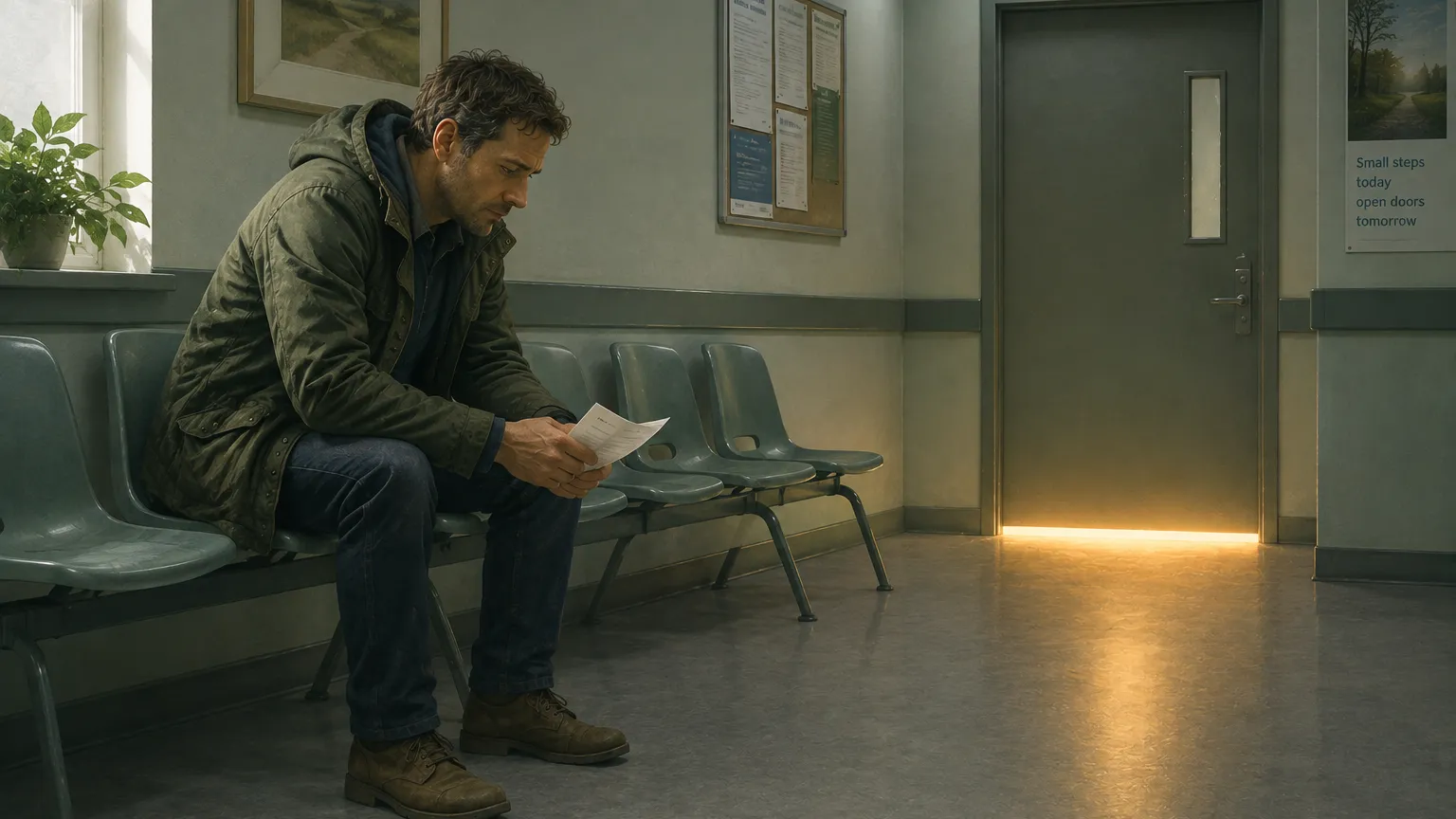
The waiting room. Twenty minutes in a chair, with the appointment where you find out on the other side of a door. One person described being certain she was going to be sick. Another mentioned that her blood pressure reads high every time she checks in, which is its own small indignity. Four minutes is the whole window here, so treat it as a four minute problem.
 The most common way this week is spent: entirely normally, in front of people who have no idea.
The working day in the middle. The loneliest part, and the one the research speaks to most directly. People go to work and tell nobody. One woman said she masked and pretended everything was fine on the outside, and that the people around her had not understood her anxiety anyway. Suppression was the strategy the study found costly in both periods, which does not mean announce it to your team. It means the version where nobody at all knows is expensive, and one person who knows is not the same as talking it through on a loop.
One in the morning. Searching the terms in your own report, which is the specific trap the portal created. It is the overthinking loop with fresh material to work on, and ordinary meditation for racing thoughts at night is a reasonable place to start. Somebody built a rule for this, and the rule is better than resolve: look if you are going to look, do not search what you find.
A few things people in these communities actually do, which no article seems to print:
- Hand over the opening. More than one person has their partner open the email and tell them. If reading it cold is the part you cannot face, that is a job someone else can do.
- Pre-load the branches. Knowing what happens next in each case, rather than what the case will be. People describe this as steadying in a way that reassurance is not, because it is true regardless of the answer.
- Set the rule while you are calm. Whether you look, and whether you search. Both decided in advance, ideally written down.
- Take the walk anyway. Less to clear your head than because the week still has hours in it and they are yours.
One caution. If your wait is about a symptom you can feel, be careful with practices built on sustained attention to bodily sensation. Meditation with health anxiety needs care here specifically: body scanning is excellent for a lot of things and it is a poor fit when the question in your mind is whether the ache is the thing. We have written about why attention sometimes makes a sensation louder, and it applies here more than usual.
When the wait comes back around
For some people this is not an event. It is a rota.
Surveillance means the next scan is already booked, which does something strange to good news: the relief has a shelf life, and part of you never fully unclenches because you know the cycle restarts. People in that position talk about clear results that somehow do not land. Between scans the worry tends to arrive through the body instead, as a twinge that asks whether it is back, and fear of recurrence between appointments covers the plan and the practice for that moment.
If that is you, the framing shifts. You are not getting through a week. You are working out how to have the months in between actually belong to you, which is a different and larger question, and closer to ordinary practice than to crisis practice. The habit built between scans is the thing you draw on during them.
Where this does not apply
Two boundaries, stated plainly.
Waits with no end date are a different problem. Waiting to hear after a final interview, or waiting while somebody else decides whether a relationship continues, breaks the third property: there may be no verdict at all, just silence that gradually becomes the answer. Almost everything above assumes a date. Without one, “get through until Wednesday” has nothing to attach to, and what helps is different enough that it deserves its own treatment.
If the waiting has stopped being waiting. Some people describe scan anxiety that behaves less like dread and more like something closer to trauma, particularly after a first diagnosis. If the wait is producing intrusive images, or you are not sleeping across the whole stretch rather than the last night of it, that is worth saying out loud to your medical team. It is a treatable thing and it is not a character flaw. If you are in crisis, contact your local emergency services or a crisis line.
The result is already written. The week is not, and the week is the only part of this you get any say over.
Common questions
Should I look at my test results before my appointment?
There is no right answer, and people who have been through many rounds of this land firmly on both sides. What matters more is deciding in advance rather than in the moment. Pick which costs you more, waiting or not waiting, set the rule while you are calm, and include whether you are allowed to search what you find. It is also worth asking when the test is ordered whether the result can be held until you are seen: the same rules that require prompt release do allow a delay the patient has asked for.
Why does waiting for results feel worse than knowing?
Research on uncertain waiting periods suggests it is the uncertainty itself doing the work, not the size of the bad outcome. In a 2024 study following students across an exam wait, several coping strategies that helped once the result was known were actively unhelpful while it was still unknown. People in medical waits describe the same thing, often saying the days before the call were harder than the diagnosis that followed.
Does meditation help with scanxiety?
Most advice on coping with scanxiety starts here, so it is worth being blunt: it will not change what the result says, and anything promising otherwise should be treated with suspicion. What a practice can offer is a way through the hours, and specifically a way of letting the fear be there without either arguing with it or hiding it. Acceptance helped both during the wait and after results in a 2024 study of students waiting on exam grades, which makes it the sensible thing to practise if you are choosing one. That population is not a clinic, so treat it as the best available signal rather than a settled fact.
What can I do at three in the morning when I cannot stop searching my symptoms?
The searching is the loop, so the useful move is interrupting it rather than winning it. A short guided session gives attention somewhere else to go, which is more achievable at that hour than deciding to stop. The stronger fix is the rule you set earlier: you may read the result, you may not search the words in it. Set that while you are steady and it does the work for you later.
Is it better to keep busy or to sit with it?
Both, and the balance is personal. People in waiting communities describe deep-cleaning the flat, long naps and packed schedules, and these are reasonable. What the evidence cautions against is the two extremes: holding it in entirely so nobody knows, which measured as costly, and running the situation over and over in conversation or in your head, which measured as worse during a wait than after it.
Why do people say talking about it helps when it makes me feel worse?
Because they are probably right about afterwards and wrong about now. In a 2024 study following students across an exam wait, social sharing was beneficial once the outcome was known and harmful while it was still uncertain. That does not mean carrying it alone, which was also costly. It suggests a difference between one person knowing where you are and repeatedly working through the possibilities out loud before there is anything to work through.
Sources
- Moeck, E. K., Greenaway, K. H., Bianchi, V., Gross, J. J., Koval, P., & Kalokerinos, E. K. (2024). Uncertainty moderates the emotional consequences of reappraisal, social sharing, and rumination in daily life. Emotion, 24(8), 1962-1974.
- Pollock, J. R., Buckner Petty, S. A., Schmitz, J. J., Varner, J., Metcalfe, A. M., & Tan, N. (2024). Patient access of their radiology reports before and after implementation of 21st Century Cures Act information-blocking provisions at a large multicampus health system. AJR American Journal of Roentgenology, 222(6), e2330343.