Mindfulness vs meditation: does AI weaken your practice?
AI built the session, then suggested where to notice during the day. Somewhere in there you wondered whether the practice was still yours. Both sides, fairly.
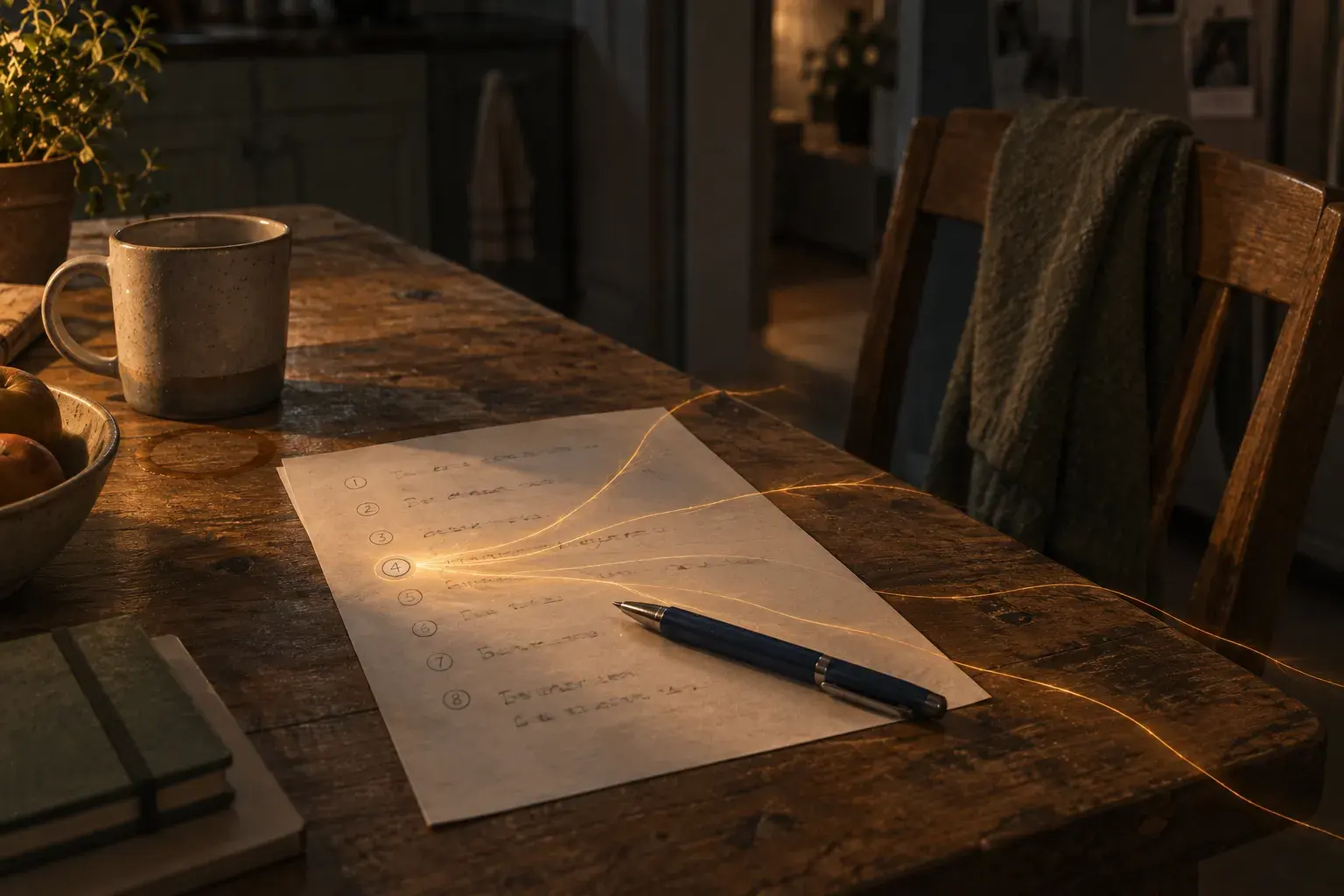
You stood on the balcony and typed it out. Wired before the day had started, the street already going below you, this Tuesday and not a generic one. A meditation about this exact moment, please. What came back was specific, and yours. You went inside, sat down and pressed play.
Somewhere around minute four you wondered whether that still counted.
Counted as what, though. The session did what a session does. You sat, your attention wandered off and came back, ten minutes went by. The doubt is about where it came from. Nobody wrote it for you. No teacher picked those words, nobody sat across from you and decided this was the thing you needed on a Tuesday. Something read four sentences about your morning and produced a fit, and the fitting is the part that makes you suspicious of it.
There is a sharper version of the same worry, and it is the one going around about everything else at the moment. If a machine can draft the email, plan the trip, do the task, then handing it your practice looks like one more handoff on the pile. Only this was supposed to be the part you did yourself. Nobody outsources a walk because they wanted the distance covered.
That suspicion is worth taking seriously, because underneath it is a real argument, and it runs across both halves of a practice: the session you sit down for, and the noticing you do in between. One side says help you did not have to think about is help that skipped the part where you thought, and that a practice leaning on it is a thinner practice. The other says the guidance has finally started fitting the person it is for. What settles it is one line in a clinical guideline, filed under homework.
This sits in the how to meditate cluster, alongside picking a technique for the state you are in.
Nobody is handed the same thing
People arrive at this question routed. A therapist slides a worksheet across the desk, numbered skills down the left, and two of the numbers are words you could not act on if you were paid. A friend says the answer to feeling flat, and to a thin social life, is to be present. You can do that on demand, and nobody has explained why it should make your life mean more. Or you read about a six-week programme for insomnia, want to start it, and cannot picture what you would actually be doing for six weeks.
So before asking whether a machine did your practice for you, it is worth knowing what it was. Almost nobody types mindfulness vs meditation out of curiosity about categories, but the same two words get handed over in at least five different rooms, and what turns up is not the same object.
| Who handed it to you | What actually turns up | Is anyone else in the room? |
|---|---|---|
| A clinician, for depression relapse | A group course run by practitioners, over a couple of months | Yes |
| A therapist, mid-session | A worksheet of numbered skills to take home | Yes |
| A therapist working in ACT | Your own values first, then the present moment | Yes |
| An app, or a friend with an app | A session, tonight | No |
| A strand of psychology running since the 1970s | Noticing what is new while you do something else | No, and nothing can deliver it |
Read the last column. Most of what gets called mindfulness arrives with a person attached, and no machine is within reach of it. One row does not: the session you can start alone tonight on a phone. That row is the whole argument, and it is the row nearly everyone reading this is standing in.
If the word reached you on a worksheet, the homework half of that arrangement is its own problem. If you are tired of being told to do any of this at all, that is its own conversation.
Maybe AI does make the session less mindful
Take it seriously for a minute, because there is something in it. You open something, type “help me relax”, and sit through whatever comes back. You did not ask what state you were in, or whether tonight was a body scan night or a breath night. You decided nothing, and deciding was part of it: noticing you are wired rather than tired and choosing accordingly is already an act of attention. Hand it over and the practice starts a step later than it used to.
There is a sharper version. Something built to fit you is built to be easy to stay inside, and meditation has always involved some amount of not enjoying it: the fifteenth minute, the restlessness you sit through rather than around.
Both happen. I am not going to pretend otherwise.
None of this started with AI
You can recite “in, out, in, out” for ten flawless minutes while the back half of your head runs what is for dinner and what time the alarm is set. No model involved. Perfect execution of the simplest instruction in the practice, and not one second of it mindful.
Passivity did not arrive with generated audio. Hold the lazy AI session against what people already did: opening the app you have and tapping the same default as every other night, or letting whatever comes up next in a library run. Same absence of choosing. All that changed is who made the recording.
And on that comparison, the personalised version has something the tapped default does not. A session built from what you wrote today, or from what you have been practising all month, can catch you: naming the thing you have been circling, arriving on the night it applies. That is most of what a good teacher does, and the mechanics behind it are worth knowing. Something addressed to you is harder to be absent from.
One improvisation goes further. People have the model write the script, then record it themselves, in their own voice, at their own pace. Hearing yourself say the words is what makes them land. Still a recording, but the instruction is no longer coming from outside.
The other half: is AI mindfulness cheating?
The second half of the question is stranger, and it has nothing to do with the generated session. This is AI in the part that has no session at all. A tracker. A journal you write into afterwards. Asking for ideas about how to be mindful during a particular Tuesday, then asking how it went.
The problem is obvious the moment you say it out loud. Noticing is the entire skill, and you just outsourced it to something that notices on your behalf, swapping a skill for a record of a skill. The failure mode is comfortable: the entry becomes the satisfying part rather than the ninety seconds at the kettle it describes, and you get better at describing attention while getting no better at paying it. Which looks exactly like progress.
Feedback was never the thing there was too much of
Mid-panic-attack, someone tells you to find a rock and notice how pretty it is. Still anxious afterwards, so next week: try harder. At an intake appointment you get a ten-minute guided meditation, you are asked how you feel now, you say “the same, I guess”, and no follow-up is offered.
 You feel something once, and then the appointment ends. When to reach for it, and what counts as it working, were never the thing being delivered.
None of that is instruction. Each is a demonstration followed by an assumption: that having felt it once, you will work out the rest. Which is how people end up here. I do not understand it, how to do it, or what it is meant to do for me. People swear by it. I have tried. I think my mind is not capable of it.
What was being tested was a ten-minute demonstration with no bridge attached to it. Your mind never came into it. If paying closer attention has been making things louder rather than quieter, that has its own mechanism too.
Set the cheating worry against that and it changes shape. What gets handed over is the second opinion nobody was offering: something that has read the material, reading your practice back and saying what to try on Thursday. The attention stays where it was. Used carefully, that is a teacher in the room on a Tuesday night. Used lazily, on the evenings you have nothing left to bring, it is still more than the silence.
Two things protect the part that is yours.
- Write what is actually going on before you ask for anything. The description is where your attention goes. “Rough day” gets a session for nobody. The argument you are still replaying at 11pm gets one that knows where you are.
- Stop expecting the session to be the whole of it. Teachers split this into formal and informal meditation practice, and informal mindfulness practice is the half with nothing playing. Pick that moment in advance: the walk to the car, the second half of the shower. If nobody has shown you what each instruction inside a session is for, that recognition never gets built.
Describe the situation and the session gets built around it
StillMind takes what you write about today and builds the guided practice around it. That is the session half, honestly: the carry into your day is still yours, and a teacher-led course is still a teacher-led course. Free to start.
Try StillMind, freeWhat cannot be handed over
A session has four properties: a start, a voice, a duration and an end. Every one can be manufactured, which is why this half of the question got solved so fast.
The other half is defined by the absence of all four. Nothing announces it. Nothing is running. Nothing sets a duration, because sometimes it is the few seconds you spend waiting for a kettle. Nothing marks the end.
That is the last row of the table, the one that says nothing can deliver it. The most a model can do there is remind you, and a reminder is a doorbell, not a practice.
The room cannot be handed over either. NICE guideline NG222 covers depression in adults. For people who have remitted on antidepressants alone and been assessed as at higher risk of relapse, recommendation 1.8.5 says to consider “a course of psychological therapy (group CBT or mindfulness-based cognitive therapy [MBCT]) for people who do not wish to continue on antidepressants”. Consider, not offer: different strengths in NICE’s vocabulary. The stronger word belongs to 1.8.6, which puts the shape at 8 sessions over 2 to 3 months focused on relapse prevention skills. Nothing you start alone tonight is that.
What this makes of the two words
Elsewhere in the same guideline is the line that settles it, and almost nobody quotes it. NICE’s treatment-options table for less severe depression carries a row titled “Group mindfulness and meditation”. One row, both words, one intervention. That table covers treating a current episode rather than preventing relapse, so the figures below belong to it and not to the recommendations above.
The address this word lives at, when a guideline gives it one: a room booked eight times, preferably with two practitioners.
Then the line itself. The person, the row says, will need to be willing to complete homework assignments, “including using mindfulness recordings at home in between sessions”.
Recordings are homework. The intervention is the group and the practitioners. The recording was never the thing, which deflates most of the case against generated audio: better scaffolding is still scaffolding. Nobody has ever worried that the tape sounded too good.
The row carries a caution too, better read before week two than after: the format “may be difficult for people experiencing intense or highly distressing thoughts, or who find focusing on the body difficult”. How large the benefits are is a separate argument, had out in two kinds of meditation myth.
The other half of the resolution is that the line you are worried about blurring was never sharp.
These conceptions, meditative and socio-cognitive, have been built from different foundations and have been argued to be quite distinct.
That is Lakatos, Turcotte and Oddson, in a bioRxiv preprint, so treat the specifics as provisional. One is the meditative conception, the one usually associated with Jon Kabat-Zinn, where sitting is the route and a session is the unit. Most courses and apps work in that tradition. The other is the socio-cognitive one, Ellen Langer’s, built from the 1970s around noticing what is new in the situation in front of you, with no sitting in it at all. They do not share a ruler: the Five Facet Mindfulness Questionnaire measures one, the Langer Mindfulness Scale the other. The paper describes the two views as leading to distinct types of practices, research interests and measures. One word, either way.
Then the complication. The same paper found the two scales correlate, in a convenience sample of 208 people, with self-regulation of attention partially mediating between them, and the authors note no clear conceptual basis for that mediation running either way. A sample that size suggests rather than proves, and even within it nobody can say which end causes which. Not two unrelated ideas sharing a label by accident, then. Two programmes reaching for something that overlaps, along a line the field has argued about for decades. Blurring it further is not desecrating something that was ever crisp.
What the tool does instead is join the two ends up. You describe a Tuesday in words, which is already the informal half, because you had to notice the Tuesday to describe it. Something gets built from that, which is the formal half, the block with its four properties. Afterwards you say how it went, which drags the block back into the day it came from. The prompt and the reflection are mindfulness. The ten minutes between them are meditation. Sequenced like that, the two words stop being rival categories and start being two ends of one loop.
Questions people actually ask
What is the difference between mindfulness and meditation?
The difference is where each word sends you, not what either one means. Meditation almost always points at a formal sitting session with a start, a length and an end. Mindfulness points at three destinations depending on who said it: a quality of attention, an eight-session clinical group course, or a numbered line on a therapy worksheet.
Is mindfulness a type of meditation?
Not quite, and the field itself is split. The tradition most courses and apps descend from treats sitting practice as the main route to the quality the word names, which is why the two are usually taught together. A separate tradition, developed by Ellen Langer from the 1970s, uses the same word for noticing novelty while doing something else, with no sitting at all. Their scales correlate in one small preprint study, but the two were built from different foundations.
Can you practise mindfulness without meditating?
Yes, and one of the two research traditions is about nothing else. The Langerian version has no session attached. It is attention to what is new in a situation, the context around it and the other readings available, while you are doing an ordinary thing. It is harder to learn cold, because a session is where most people first find out what the quality feels like.
Which is better for anxiety, mindfulness or meditation?
Mindfulness for anxiety is a routing question in disguise, and the honest answer starts by admitting that the guidance quoted on this page is not about anxiety. NICE names mindfulness-based cognitive therapy for relapse prevention in depression specifically. Its description of the group format, roughly eight sessions with preferably two practitioners, sits in a separate table about treating less severe depression, which is also where it cautions that the format may be difficult for people experiencing intense or highly distressing thoughts, or who find focusing on the body difficult. If someone pointed you at either word for anxiety, the useful question is still what kind of help they meant: a course with other people in it, a skill out of a therapy protocol, or a session you run on your own.
The question was never whether the recording counts. It was whether anything happened either side of it.