How to meditate: what every instruction is actually for
You are sitting alone, wondering whether your posture looks wrong. Every meditation instruction does one of three jobs. Here is how to tell which.
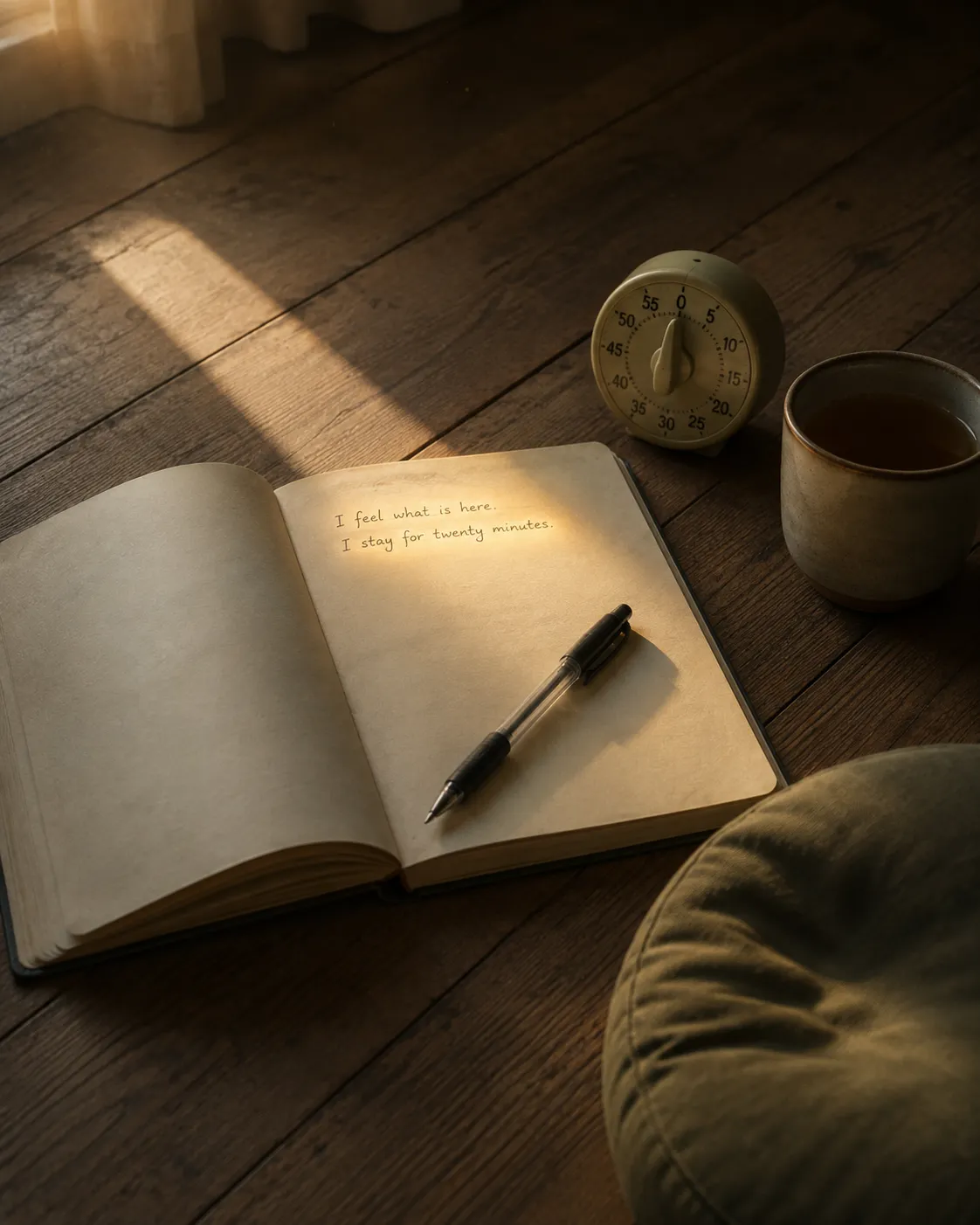
Key things to know before you read.
Every instruction does one of three jobs.
It is buying you stability, alertness, or feedback. Once you can name the job, the right answer for your body stops being a guess.
Some postures are instruments, not etiquette.
Insight Meditation Center gives three ways to catch yourself drifting when lying down. One is a thumbs-touching mudra it says can work as a feedback device: the thumbs pull apart as you go, and that is what wakes you.
The useful answer is a range with an edge.
Numb legs are normal. Numb legs that take more than a minute to come back are the edge. A boundary is usable in a way that whatever feels comfortable is not.
The real question is whether it is working.
Meditation gives you almost nothing to check against from inside a session. The signal is downstream, across days.
Part of our meditation techniques cluster. For how long a session should run, see how long should you meditate. If you are here because somebody told you to try mindfulness, the two words send you to different places.
Somebody sat down to meditate last year, alone in their own room, and caught themselves worrying that their posture looked stupid.
Nobody was watching. They said so themselves, in the same sentence. It was a throwaway line inside a longer list of things their brain threw at them the moment they closed their eyes, and it went past almost unnoticed under a thread that collected nearly five hundred votes.
It is the most revealing thing in the whole thread.
Because that is not really a question about posture. You cannot see yourself. There is no observer to look stupid in front of. What that sentence is actually carrying is a much older worry, one that tends to arrive within the first minute or two of almost everybody’s first attempt: am I doing this right?
And here is the thing about meditation that makes that question so hard to put down. Almost everything else you have ever learned gives you something to check against. The code compiles or it does not. The note is flat or it is not. The bread rises. Meditation gives you nothing. You sit, some time passes, you get up, and the practice offers no opinion whatsoever on how that went.
So the question goes looking for something it can actually check. And the only parts of meditation that are checkable from outside are your body: your back, your legs, your hands, your eyes.
It is also why almost every guide on how to meditate ends up walking you through the body. The mechanics questions never stop being asked. They are easy questions. They are also the only place the real question has to go.
Nobody is really asking what to do with your hands. They are asking whether any of this is working, and the hands are the only part they can see.
Why the reassuring answer misses the question
Ask a good teacher about meditation posture and you will get an honest, generous answer. Any stable position works. Chair, cushion, kneeling bench, floor. Insight Meditation Center, a serious dharma centre that has been teaching this for decades, puts it about as plainly as it can be put: what matters most is what you do with your mind, not what you do with your feet or legs.
That is true. It is also, on its own, strangely unusable.
Watch what happens when people receive it. On one of the biggest threads on this question, somebody offered exactly that reassurance to somebody else, and then added, about themselves, that it was hard for them to accept too, because the mind wants something to happen. They knew the answer. They had given the answer. It still did not settle anything.
Reassurance fails because it answers the wrong question. “Any position works” is a response to how should I sit. Nobody is actually asking that. They are asking whether they are getting it right, and being told the thing they were worried about does not matter is not the same as being told what does.
There is a better answer available, and it has been sitting in the traditional instructions the whole time. Each instruction about your body is doing a specific job, and once you know which job, you can work out the answer for your own body without asking anyone.
The three jobs every instruction is doing
Read enough posture instructions from enough traditions and the same three purposes keep surfacing under different vocabulary. Every instruction about your body is buying you one of these.
| The job | What it is buying you | How you know it is working |
|---|---|---|
| Stability | A body that stops asking for attention, so your attention is free for something else | You forget about your legs for minutes at a time |
| Alertness | Enough tone to stay awake and present rather than sliding into daydream | You are still there at the end, and you know roughly what happened |
| Feedback | A physical signal that tells you when you have drifted, since nothing else will | Something changes in your body and you notice, and you come back |
Hold onto the third one. Almost nobody talks about it, and it is where this page ends up.
Naming the job converts every mechanics question from a rule you have to obey into a problem you can solve. You are no longer asking “is this the correct hand position.” You are asking “what is this hand position for, and does my body get that from this arrangement or a different one.” Those are very different questions, and only one of them has an answer you can find on your own.
It also explains why traditions genuinely disagree with each other about some of this. They are optimising for different jobs.
Your seat, and the job of stability
Your seat is doing one job above all others: getting the body quiet enough that it stops filing complaints.
Everything in the traditional sitting instructions serves that. Sitting on the front third of a round cushion tips the pelvis forward so the spine stacks instead of slumping. Getting the hips slightly higher than the knees does the same thing on a chair. Two knees on the ground plus your seat makes a tripod, and a tripod is stable in a way that a two-point contact is not. Sit towards the front edge of a chair and hold your own spine up rather than leaning back, and the same physics applies.
None of that is about looking correct. It is about how long the arrangement can hold before your body starts negotiating with you.
And that gives you the actual answer to the chair question. A lot of people sit on a dining chair because the floor genuinely hurts, and then spend the session half-convinced this does not count as real meditation. It counts. The floor and the chair are two ways of buying the same stability, and the one that buys you more of it is the better one for you. If your hips are tight, the floor buys you less. That is a fact about hips, not about commitment.
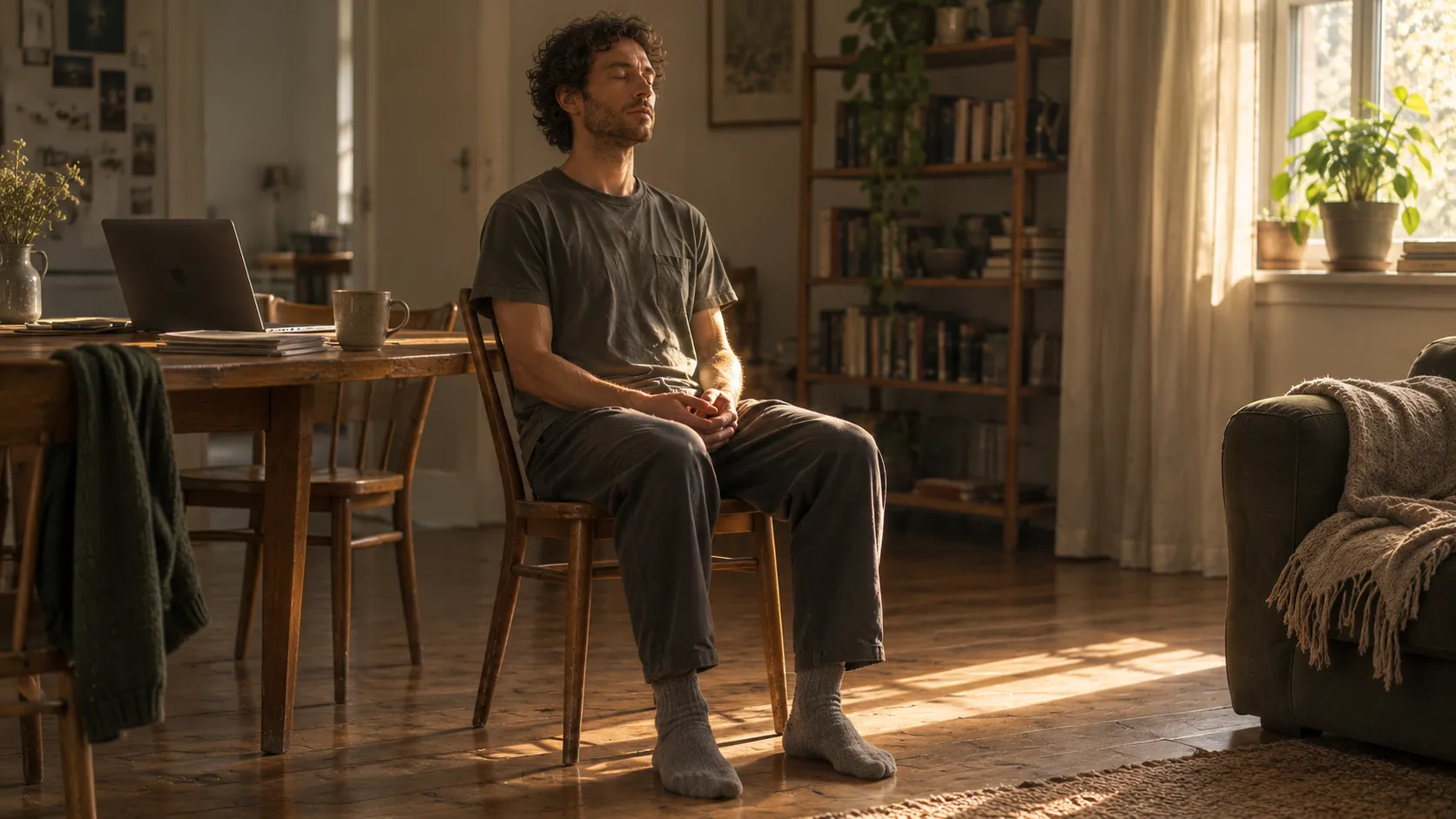
| Your seat | Stability comes from | Where the edge is |
|---|---|---|
| Cushion, cross-legged | Tripod base, pelvis tipped forward by the cushion height | Knees floating well off the floor means no tripod, so add height or change position |
| Kneeling bench or seiza | Weight off the feet, spine stacked with almost no effort | Ankle or knee pain that persists after you stand up |
| Chair | Feet flat, hips above knees, spine self-supported rather than leaning | Sliding into the backrest, which turns the spine into a curve and the session into a nap |
| Lying down | Full support, nothing to hold at all | Stability is total, alertness is the problem, so this needs the tricks in the next two sections |
The single most-asked question in this whole category is what to do when your legs go numb during meditation, and the useful answer is a boundary rather than reassurance. Insight Meditation Center gives one: legs going numb is common and normal, as long as it does not take more than a minute or so for the circulation to come back. Longer than that is the signal to change something: cushion height, leg position, or a chair.
That is what a usable instruction looks like. Not permission, and not a rule. A range, and the edge of the range, so you can tell which side of it you are on.
The same applies to the burning that shows up between the shoulder blades a few minutes into cross-legged sitting. Usually it is postural muscles doing work they are not conditioned for, which fades as they condition. It is worth adjusting for, slowly and deliberately, not by fidgeting. It is not worth enduring in silence because you think enduring is the practice. If paying close attention to a sensation seems to be amplifying it, that is a real and separate question, and we have taken it apart in does paying attention make it worse.
Your eyes, and the job of alertness
Here is where the traditions openly disagree, and where the three-jobs frame earns its keep.
Ask on any meditation forum whether to keep your eyes open or closed and you will get a genuine split, with real teachers on both sides and threads running to sixty comments. Zen and much of the Mahayana world sit with eyes open or half open, gaze lowered to the floor two or three feet in front. Most Hindu-yogic instruction goes the other way and teaches eyes closed. Much of the modern secular teaching says close them. Both camps are emphatic.
The two camps are protecting different things, which is why both of them can be right.
| Eyes | The job it serves | What it costs you |
|---|---|---|
| Closed | Concentration. Removing the largest stream of sensory input makes a single object easier to hold | Drift. Closed eyes tilt towards daydream and towards sleep, and neither announces itself |
| Open, gaze lowered | Alertness, and transfer. You stay in the room, and the state you build is closer to the one you want in daily life | Distraction. More input to be pulled around by, which is harder early on |
The traditional argument for open eyes is sharper than it first sounds. One version that gets repeated in Buddhist forums runs roughly like this: if you need to shut your eyes to avoid being distracted, why stop there, why not block your nose and cover your ears too. The point being that the goal is a different relationship to input, and you cannot train that relationship by removing the input.
The counter-argument is equally fair. Beginners have limited attention to spend, and spending it on filtering a room is spending it on the wrong thing.
So the useful question is: which job is failing you today? If you keep surfacing twenty minutes later unsure whether you meditated or napped, you have an alertness problem, and eyes open with a lowered gaze about two or three feet in front of you is the direct fix. If you sit down and cannot find the breath at all for the visual noise, you have a concentration problem, and closing them is the direct fix. You are allowed to change your mind on a Tuesday.
Falling asleep, incidentally, is the other symptom of the same problem, and it comes up constantly. The standard advice given to people who keep nodding off is not “try harder.” It is structural: sit up rather than lying down, and open the eyes. Both are alertness instructions. Both work because they change what the body is doing, not what you are willing.
Your hands, and the job of feedback
The hands question comes up constantly and always slightly embarrassed. Palms up feels like you are asking the universe for something. Palms down feels like you are hiding. Most people settle for clasped and feel self-conscious about it. And a lot of people quietly assume the whole business is decoration, or worse, that the thumb-and-finger arrangement in every stock photograph is a piece of religion they did not sign up for. One of the more honest comments on the subject, from somebody who had been practising a long time, was that their hands had ended up in that position naturally and it had conferred no superpowers whatsoever.
They are right that it is not magic. They are wrong that it is decoration.
Insight Meditation Center’s posture instructions give three ways to stay alert when you lie down, which is where drift is hardest to catch. Knees up with the feet apart, so that if you go under, the knees bump or fall away and wake you. One forearm held upright from the elbow, so that when muscle tone drops, it drops. And holding the hands in a mudra with the thumbs touching, which the page says can work as a feedback device: as you begin to lose consciousness and drift off, the thumbs pull apart, and that is what brings you back.
Read that third one again. The tradition understood perfectly well that meditation gives you no signal from inside. So it engineered a signal into the body. A contact so light that it survives attention and fails without it. Your thumbs are a tell.
Those three are given for lying down, and that is worth being precise about, because it is the position where you most need an external check. But nothing about the mechanism is confined to lying down. Any contact light enough to depend on muscle tone will break when tone goes, whatever position you are in.
Each one holds on light muscle tone, and tone is the first thing attention loses. A tell is a contact or a position light enough that it fails before you notice you have gone.
Once you see the hands this way, the religion question mostly dissolves on its own. A great many people want meditation without religion, and say so plainly: one thread titled almost exactly that ran past three hundred comments. The reason the mechanics feel loaded is that they look like ritual. A specific hand position, held deliberately, in silence, does look like devotion. But a drift detector is not a devotional object. You do not have to believe anything for a light contact to break when your muscle tone drops. It is closer to a spirit level than a prayer.
You can hold your hands however you like. Palms down on the thighs is fine and common. One hand cradled in the other, both palms up with the knuckles overlapping, is another common arrangement, and Insight Meditation Center notes that a similar one is used in Zen. It also happens to bring the thumbs close enough to touch, which is how you would carry the lying-down tell into sitting if you wanted it. That last step is ours rather than theirs. If you have never wanted a tell, you have not been missing anything you knew about. If you have ever surfaced from a sit with no idea where you went, it costs nothing to try.
What to put your attention on
The other half of the beginner question set leaves the body behind altogether and asks what to focus on. Three beliefs about that cause almost all of the trouble. Each one sounds reasonable. None of them is true.
You are meant to stop thinking. You are not, and this is the single most-corrected error in every beginner thread there is. When somebody described spiralling because they kept thinking about not thinking, the sharpest reply in the thread was a question: who told you that you were not supposed to think? Meditation is not the absence of thought. It is noticing that you have gone, and coming back, and the noticing is the repetition that trains the thing. A session with fifty departures and fifty returns is fifty repetitions. It is not a failed session.
Observation is something you perform. Somebody described trying to control their breathing to a count, failing to hold it, getting furious, and giving up. The instruction was to watch the breath, and it got read as an instruction to do the breath. Those are different activities and only one of them is the practice. If a breathing pattern is stressing you, that is a signal to stop patterning it. Let it happen and watch it happen.
There is a correct place to watch from. This is the location question. Nostrils, chest, or belly, and people switch between them and suspect the switching is itself the failure. It is not. Narrower objects, like the sensation right at the nostrils, train concentration harder. Broader ones, like the whole body rising and falling, are more forgiving and easier to stay with. Pick one for the session, not for life.
| What you put attention on | What it trains hardest | Reach for it when |
|---|---|---|
| Breath at the nostrils | Concentration. A small, precise object leaves little room to wander | You want the sharpest training and you have the attention to spend |
| Breath in the belly or chest | Steadiness. A large, obvious movement is easy to find again | You keep losing the object entirely and getting frustrated |
| Sound in the room | Receptivity. Nothing to hold, only something to receive | Watching the breath makes you start controlling it |
| A contact point, hands or seat | Continuity. The sensation never stops or changes speed | Breath feels loaded, or breathing patterns make you tense |
| A repeated word | Occupation. It gives the verbal part of the mind a job | Your mind talks constantly and the breath cannot compete |
This table answers what to watch. It does not answer what you came to sit with, which is a separate question and the one people more often get wrong: a practice picked for a broad word like “stressed” can miss a state it was never aimed at. Finding the more specific word first is ninety seconds well spent.
If the breath is loaded for you, and for some people it genuinely is, the object does not have to be the breath. Sound in the room works. A physical contact point works. A mantra works. One practitioner put the whole matter better than most teaching materials manage: counting the breath is a scaffold, not a fundamental, and scaffolds are useful. That is exactly the right relationship to have with every technique on this page. If you want help choosing, we have a guide to picking a technique for the state you are actually in.
So how do you know it is working?
Back to the question underneath all the others.
You cannot know if meditation is working from inside a session, and you should stop waiting for a verdict that is not coming. The tells in your hands and knees report on one narrow thing, whether you have drifted, and they report it in the moment. They do not tell you whether the practice is doing anything for your life. Nothing inside a session does.
Which means the honest answer is uncomfortable and also freeing: the evidence is downstream. The thread that asked, in as many words, am I meditating correctly got its most upvoted answer in the form of three questions, and not one of them was about the sit. Are you more aware of your thoughts, even though they are still there. Are you more patient while you are sitting. Are you reacting less in daily life.
The session is only where the reps happen. The result shows up somewhere else entirely.
That is a genuinely awkward measurement problem, because the changes are slow, they are comparative, and human memory is terrible at comparison. You cannot remember accurately how reactive you were three weeks ago. You will reconstruct it from how you feel today, which is precisely the wrong instrument.
The traditional answer to no-feedback was to build a tell into the body. The modern extension of the same idea is to build one that outlasts a single session: write down what you noticed, right after, before it evaporates. Two lines about what your attention actually did, and what state you got up in, rather than a diary of events. Then the comparison stops depending on memory, because there is a record, and the pattern turns up across weeks in a way it never turns up inside one sit.
The tell that outlasts the session
StillMind pairs each session with a journal and voice notes you can leave in seconds, so what you noticed survives the bell and the pattern shows up across weeks.
Try the meditation journalWe have written elsewhere about why the minutes after a session are the part most people skip, and about what a meditation journal is actually for. The short version, for here: the check you are looking for exists. It is just not where you have been looking for it.
What to actually do this week
- Pick your seat by stability, not by authenticity. Chair, cushion, or bench. The test is whether you can stop thinking about your body for a few minutes at a stretch, not whether it looks like the photograph.
- Set the alertness dial before you start, not after you fail. Tired, late in the day, or lying down means eyes open with a lowered gaze. Wired and distractible means eyes closed. Change it whenever it stops working.
- Give yourself one tell. One hand cradled in the other, thumbs lightly touching. You are installing a drift detector, not adopting a tradition, and you will find out within a week whether it catches anything.
- Choose one object and stay with it for the session. Breath at the nostrils, breath in the belly, sound, or contact. Switching between them mid-sit is the only version of this that does not work.
- Expect to leave constantly and come back constantly. That is the exercise. The departures are not interruptions of the practice.
- Write two lines afterwards. What your attention did, and what state you got up in. This is the only part of the whole routine that will still be telling you something in a month.
- Leave the length question alone for now. Start with whatever you will genuinely repeat, and read what the research actually says about session length when you are curious. It is a more interesting answer than the numbers everyone repeats.
None of this is advanced. It is meditation for beginners in the most literal sense, and if you have done it all before and stopped, that is common and not a character problem. Starting again after a long gap has its own set of obstacles, most of which are about the story you are carrying, not the sitting.
Questions people actually ask
How do I start meditating as a complete beginner? Sit somewhere you can be still. A chair with your feet flat and your hips slightly above your knees works as well as a cushion, and for a lot of bodies it works better. Pick one thing to put your attention on and stay with it for the whole session, usually the breath at the nostrils or the movement in your belly. Then expect to lose it constantly. Noticing that you have gone and coming back is the exercise rather than an interruption of it, so a session with fifty departures is fifty repetitions. Start at a length you will genuinely repeat tomorrow, and write two lines afterwards about what your attention actually did, because meditation gives you almost no signal from inside a session.
Do I need to clear my mind to meditate? No, and this is the single most-corrected error in every beginner discussion there is. Meditation is not the absence of thought. It is noticing that your attention has wandered and bringing it back, which means the wandering is what gives you something to practise on. A session in which you left fifty times and returned fifty times is fifty repetitions, not a failure.
Why does meditation feel so hard at first? Partly because sitting still and paying attention reveals how busy your mind already was, which is a sign you are noticing rather than a sign you are bad at it. The other reason is structural: meditation returns almost no signal from inside a session, so there is nothing to check yourself against while you are in it. That absence is what sends the question toward your posture and your hands, which are the only parts you can actually observe.
How should I sit if I cannot sit cross-legged? Use a chair, and set it up properly, not apologetically. Feet flat on the floor, hips slightly higher than the knees, and sit towards the front edge holding your own spine up rather than leaning into the backrest. A kneeling bench is the other good option if the floor is fine but your hips are not. Your seat is buying stability, and whichever arrangement buys you the most is the correct one for your body.
Should I meditate with my eyes open or closed? Both are traditional, and they protect different things. Closed eyes remove the largest source of distraction and make concentration easier. Open eyes with the gaze lowered to the floor two or three feet in front keep you alert and make the state easier to carry into ordinary life. Pick by which one is failing you: if you keep drifting or falling asleep, open them; if you cannot settle at all, close them.
What do I do with my hands when I meditate? Resting on the thighs, palms up or down, is fine. Another common arrangement is one hand cradled in the other, both palms up with the knuckles overlapping. If you bring the thumbs together so they just touch, that contact can act as a tell. Insight Meditation Center describes a thumbs-touching mudra as something that can work as a feedback device, because the thumbs pull apart as you drift off. Its instructions give that for lying down; using it seated is an extension rather than something the page recommends.
Is it normal for my legs to go numb when I meditate? Yes, and it is one of the most commonly asked questions in meditation communities. The boundary worth knowing is how quickly it resolves: normal numbness clears within about a minute or so. If circulation takes longer than that to return, treat it as a signal to change the arrangement: a different cushion height, a different leg position, or a chair.
How do I know if I am meditating correctly? You mostly cannot tell from inside a session, and waiting for an in-session verdict is what makes the question so persistent. The signals are downstream: whether you notice your thoughts sooner, whether you are more patient while sitting, whether you react less during the day. Because those changes are slow and comparative, a short written note after each session is far more reliable than memory.
Do I have to be religious or Buddhist to meditate? No. The mechanics look ritual because a deliberate hand position held in silence looks like devotion, but the ones on this page are functional. A light contact between the thumbs breaks when your muscle tone drops whatever you believe. Secular instruction is widely available, and wanting the practice without the belief system is an extremely common position rather than an awkward one.
What should I focus on if the breath does not work for me? Sound in the room, a point of physical contact such as your hands or your seat, or a repeated word all work as the object of attention. The breath is the default because it is always present, not because it is required. If patterned breathing makes you tense, stop patterning it and simply watch it, or change object entirely.
Why do I keep falling asleep when I meditate? Usually because the arrangement is buying too much stability and not enough alertness. Sit up rather than lying down, open the eyes with a lowered gaze, and try the thumb contact as a drift detector. If you are lying down by necessity, keep your knees up with feet apart or hold one forearm upright from the elbow, so that losing tone produces a movement that wakes you.
How we sourced this
Where the instructions came from. The seat descriptions, the two-to-three-feet gaze distance, the one-minute guideline for numb legs, the three anti-drift devices and the phrase "feedback device" are traced to Insight Meditation Center's posture instructions, written by Ines Freedman. Two things that page does not say, and which we have not attributed to it: it gives the three anti-drift devices for lying down rather than for sitting, and its own recommendation is to keep the eyes closed, with open eyes offered as perfectly acceptable rather than preferred. The three-jobs framing, and carrying the thumb contact into seated practice, are ours. Where traditions differ on eye position, we have described the disagreement instead of resolving it, because both positions are defensible and they optimise for different things.
Where the questions came from. The beginner questions on this page are the ones that actually recur, drawn from public meditation communities, not from keyword research: seven separate discussions about numb legs, seven about eye position, seven about falling asleep, and four asking in different words how to tell whether any of it is working. Community posts are described in aggregate and paraphrased; we have not reproduced anyone's words as our own.
What we have deliberately not claimed. We have made no claim about clinical outcomes, no claim that any particular posture produces a measurable physiological effect, and no claim about how quickly benefits appear. There is research on all three and it is less settled than most beginner guides imply. Session length is covered separately in our review of the duration evidence, which found that the most-repeated numbers in modern mindfulness have weaker origins than their confidence suggests.
More from techniques.
View all pieces →
Mindfulness vs meditation: does AI weaken your practice?
AI built the session, then suggested where to notice during the day. Somewhere in there you wondered whether the practice was still yours. Both sides, fairly.

Mantra meditation: does the word you choose matter?
Why You Can't Meditate Without Your App (And How to Fix It)

How to restart meditation when you've already quit

Meditation Techniques Explained: Which One to Use When
Keep the tell that lasts longer than a session
Meditation gives you almost no signal while you are in it. StillMind pairs every session with a journal and voice notes, so the pattern shows up across weeks instead of vanishing at the bell. Free to try.