Parental anxiety: why you picture your child getting hurt
Your kid is up a climbing frame and a film of them getting hurt starts playing in your head. Why parental anxiety tracks control, not risk, and what helps.
I don’t often stress about my own death. I don’t have this fear about myself, or about anyone else. It’s my kids.
When they’re out in the car and I’m not the one driving, I worry there’ll be an accident. When they get sick, I always worry it could go bad, even though logically I know there’s no risk. I don’t understand why.
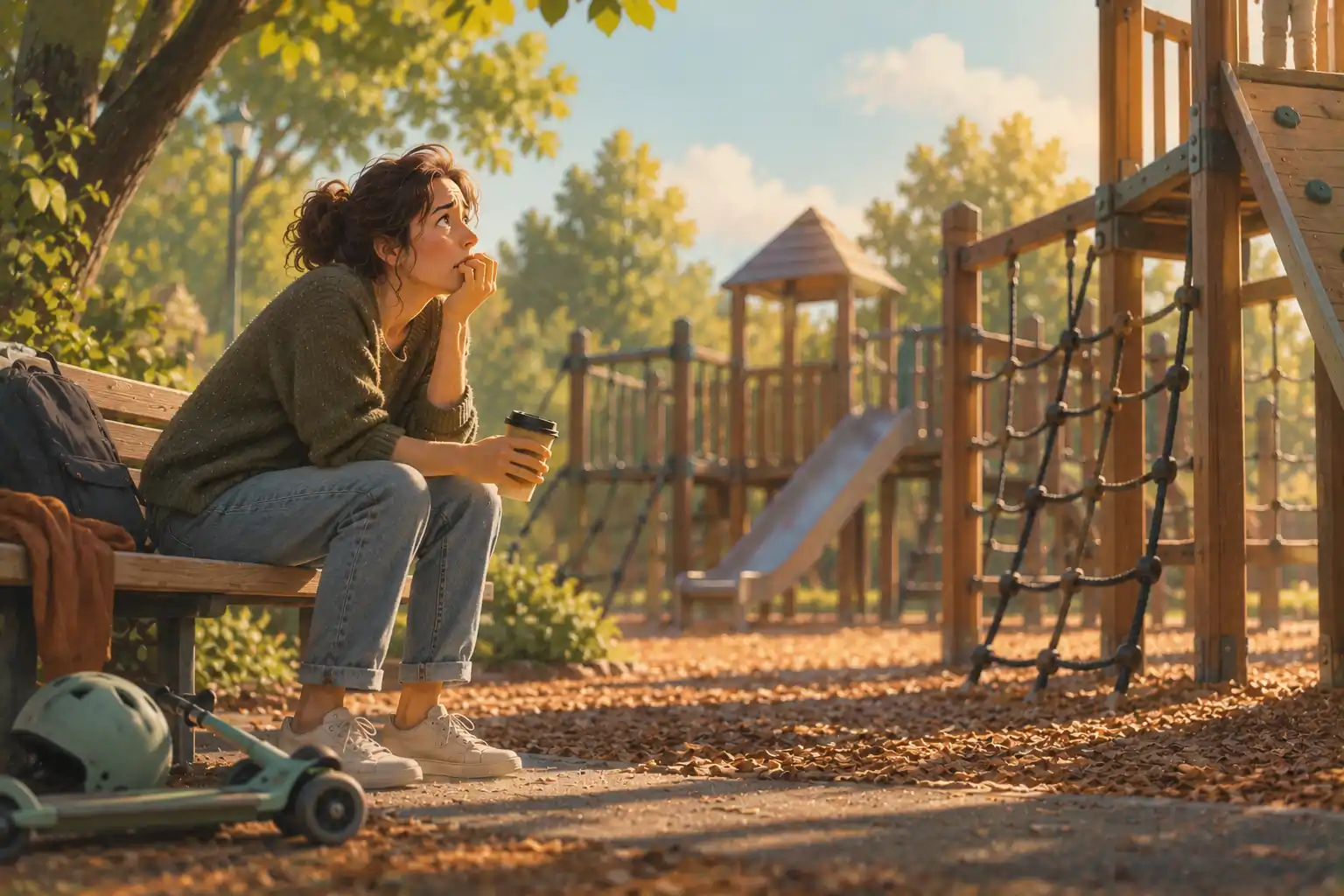
When I see them climbing somewhere, I imagine they’ll fall. Or a leg will slip and snap a bone. Or they’ll fall and hit their head, or a million things like this.
It isn’t always death. It’s fear for their safety and wellbeing, and it’s a big cause of anxiety for me. I wish I could deal with it better. This is written from inside it.
So why only them? And why only then?
Part of our life roles series, alongside meditation for parents.
It arrives as a film, not a number
Nobody lies awake over a small chance of a road accident. You lie awake over a scene: the slip road, the brake lights, the phone ringing at an hour it never rings. Parents call the pictures so clear and so real. They play out as whole scenes. It’s a film, and it starts without asking.
That’s why the odds bounce off. One mum asked a forum about a school coach trip and got a thread full of statistics. It didn’t help. Another mum’s healthy seven-year-old laughed in his sleep, and she’d once read this can be an early sign of a rare brain tumour. She knew it was almost certainly nothing. She was still in tears.
A number is an argument. The film isn’t arguing, so it can’t lose.
The pictures themselves are ordinary. In a 2014 study by Radomsky and colleagues, 93.6% of 777 university students across 13 countries reported at least one unwanted intrusive thought in the previous three months. The sample wasn’t parents, and the thoughts were of every kind. Minds just make them.
New parents have them too. In 2008, Fairbrother and Woody followed 100 women from pregnancy to 12 weeks after the birth, and unwanted thoughts of accidental harm to the baby were universal. In Abramowitz and colleagues’ 2006 study of 85 new parents, most mothers and most fathers had intrusive thoughts about their baby.
Having the film is normal. Where it starts is the interesting part.
It fires where your control ends
Look at my list again. The car I’m not driving. The climb I’m watching. The illness inside them, where I can’t see. Every item is a place where my hands stop reaching.
In a 1993 study, F. P. McKenna found the “it won’t happen to me” feeling showed up when people had personal control over the outcome. Without control, it didn’t. His reading: an illusion of control, not general optimism. In 2025, Nae and colleagues summarised it in driving terms: people see accidents as less likely when driving than as passengers. McKenna’s participants weren’t parents. Same mechanism, I think, pointed at someone you love.
The clearest case: a mother whose teenager rides an indoor BMX park every week. Bad landings have meant several hospital trips. The car journeys, none. Yet she worries most about the lift there with another teenager. On the ramps, her kid is in control. In the car, neither of them is.
A five-year-old’s first night at the grandparents’, two hours away: will they forget the fireguard? Her mum was made to feel silly. A teenager’s text goes unanswered, and half an hour later “hello??” gets “I’m fine, stop worrying”, long after the parent pictured the worst.
In every row below, the same thing happens: your control runs out, and something fills the gap.
| Where the film starts | What you can see | What the film fills in |
|---|---|---|
| The car you’re not driving | Taillights, then an empty road | The junction, the late-night phone call |
| The climbing frame across the playground | A small figure near the top | The slipped foot, the snapped bone, the head |
| The fever at night | A number on a thermometer | What’s happening inside, out of sight |
| The sleepover | A front door closing | The fireguard nobody remembered |
| The unanswered text | ”Delivered”, and nothing | Every reason they can’t reply |
The fear isn’t measuring the danger. It’s measuring how far your child is from your hands.
The climb is theirs
The film wants them down. There’s a real case for the top. A 2015 systematic review by Brussoni and colleagues of 21 studies found overall positive effects of risky outdoor play on children’s health. Mostly that meant physical activity. It can’t tell you the climb is safe: only one injury study qualified.
The fear is yours to hold. The climb is theirs.
Why it’s only them
Responsibility changes what a frightening picture means. In his 1997 cognitive theory of obsessions, Stanley Rachman proposed that troubling thoughts persist because of catastrophic misinterpretations of what having them means. They fade as those interpretations weaken. On his view, the meaning you give a thought does the damage.
A stranger’s kid falling slides straight past. Your own child falling lands on the biggest job you have, and “I’m responsible for them” becomes “so this is a warning, and ignoring it would be careless.”
A second meaning is almost superstitious: it can feel like thinking it makes it more likely. Psychologists call that likelihood thought-action fusion (Shafran, Thordarson and Rachman, 1996). One standard questionnaire item asks, roughly, whether thinking of a relative being in a car accident makes the accident likelier. And there’s the voice that sounds like wisdom: my brain is preparing me.
All three turn a picture into an instruction. That’s a mechanism at work, and it would also explain why the film so rarely stars you.
Why checking makes the next film longer
Checking brings real relief, as every anxious parent knows. It’s short, and that’s what brings you back.
One mum took her child’s temperature every ten minutes, got thermometers that didn’t agree, and heard her partner call it ridiculous. It wasn’t. She’d had a newborn with meningitis, and vigilance like hers has a basis. Even so, a thermometer gives a number, and the film was never asking for one.
Others look in on the sleeping child once a scene has played out. One checked her son’s breathing so often he started dreaming someone was poking his back. The seven-year-old’s mum went back to other parents’ stories online. Another calls herself a stalker about the location app, and finds it calming. For her it ends the loop.
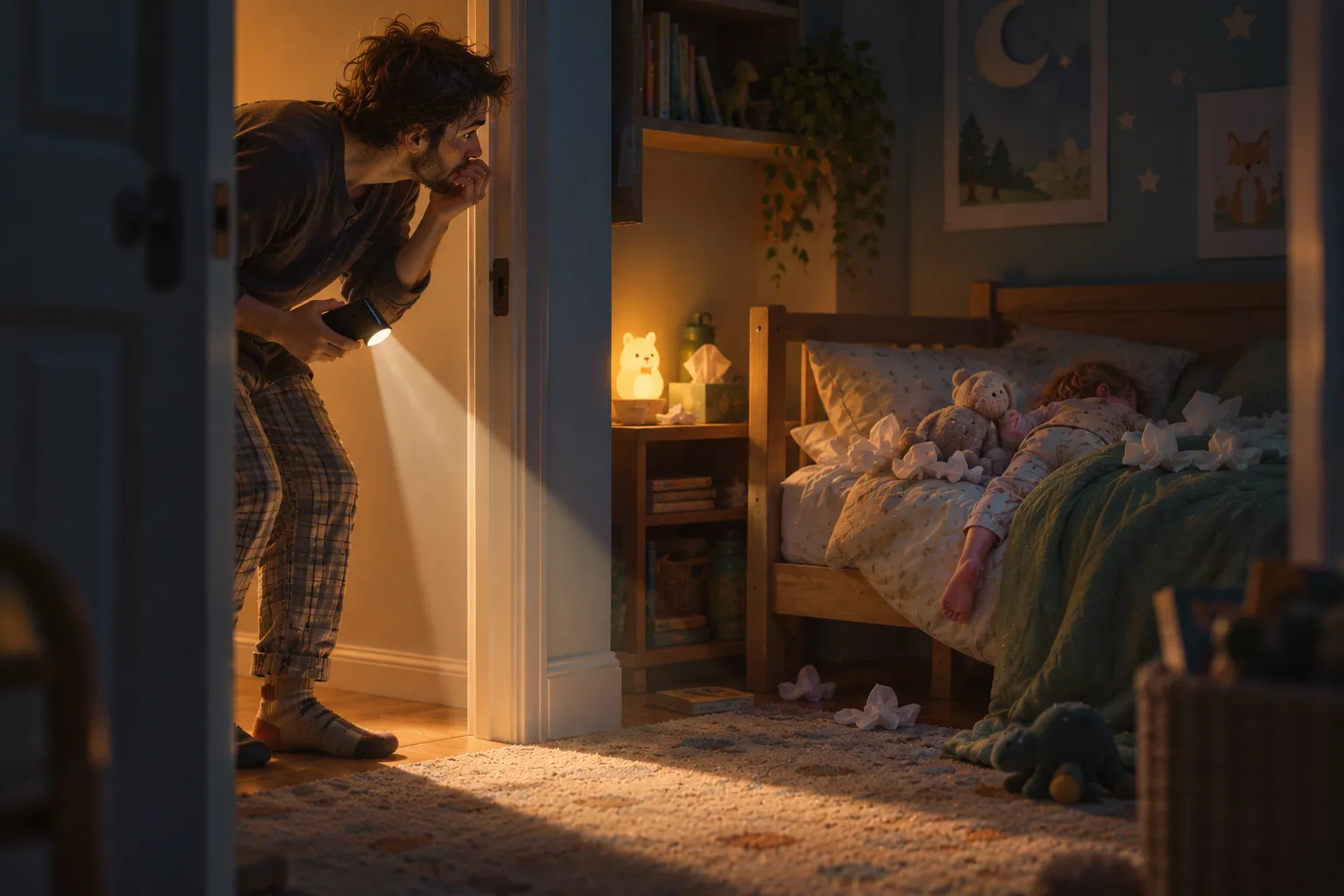 One look, then back to bed. That’s a check that ends in a full stop.
In people with OCD and panic disorder, Salkovskis and Kobori found reassurance brought short-term relief, then the discomfort returned, and so did the urge to seek more. Healthy controls didn’t show that rebound. The same researchers warn that simply telling people to stop seeking reassurance can be harmful. Nobody here is banning checks.
What matters is how a check ends, and our piece on whether paying attention makes it worse puts it in punctuation. A check that ends in a full stop is finished: you looked, you saw, you went to bed. A check that ends in a question mark is still asking. The answer buys a few minutes, then the question returns, because the answer was never the point. It’s a rewind.
| A check that ends in a full stop | A check that ends in a question mark |
|---|---|
| Looking in on them asleep, then going to bed | Checking their breathing again an hour later |
| One temperature reading, acted on | A reading every ten minutes |
| A location app glanced at once | The same app refreshed until they’re home |
| Asking your partner once, and taking the answer | Asking again in different words |
The same act can land in either column. What sorts it is whether you can stop after one.
What meditation can do here, and when
Different parent states need different practices, which is the argument of our guide to meditation across life roles. Being touched out or noise-overloaded calls for something else. This one needs its own timing.
Most meditation for anxiety assumes you can sit with the feeling while it’s happening. Not during a spike. One parent tried it mid-spike and wasn’t “calm enough to get into the zone”. Mid-film is the worst moment to learn anything.
Meditation won’t stop the film starting, either. What it can train is the moment after: recognising a film as a film, and looking up at the actual child. A 2015 review by Gu and colleagues found mindfulness programmes appear to work partly by reducing worry and rumination. In a small 2015 trial in generalised anxiety disorder, Hoge and colleagues found improvements were partly explained by increased decentering: seeing a thought as a thought. Neither study was about parents or intrusive images.
So practise between spikes. Four moves:
- Name the film. When a scene starts, label it: the car one, the climbing one. Naming isn’t arguing. It moves you out of the scene and into the seat.
- Come back to the actual child. Not a picture of them safe. The sound of them in the next room, the weight of them on your lap.
- Notice the gaps. One parent compared it to a tongue finding a loose tooth: you start noticing when the thought isn’t there. Hours without it, then days.
- Let a scene end unfinished. No need to finish it or check it. Let it run out like a trailer you didn’t choose, and look up.
One parent found the opposite. A mum, home while her partner drove the kids on the motorway, became convinced of a crash, played the scene to its end, and only then settled. Deliberately rehearsing frightening scenes is work to do with a therapist, not alone.
A course for the pattern, not the film
A course gives those moves somewhere to live. In StillMind you can build a personal meditation course, and a Self-discovery meditation course explores your patterns, emotions and sense of self.
Self-discovery asks three questions of its own. For this pattern, the answers look like this:
| Setup question | What to choose |
|---|---|
| What’s drawing you to look inward? | A feeling or pattern I want to understand |
| What should the sessions focus on? | My emotions, or My patterns and habits |
| A question or theme to sit with? (optional) | The pattern, not the scene: why the fear starts when they’re out of my hands |
Parents say even typing the scene is distressing. You never need to.
Short, Standard or Deep means 4, 6 or 8 sessions, every one named before you begin. Each script is written fresh when you press play. A few seconds of reflection afterwards (what settled, what didn’t, whether the pace was right) shapes how much guidance the next session gives and how it’s framed. It doesn’t move the course’s focus.
A course never sends your journal text: what leaves your phone is a short list of derived labels, each capped at 64 characters. Building a course uses no sessions, but you need at least one guided session left to start. Each session you play uses one from your monthly allowance, which StillMind Plus raises.
Use it between spikes, for the pattern (when it fires, what it seems to guard), not for replaying scenes. It isn’t treatment.
Build a course around the pattern
Choose Self-discovery, pick a feeling or pattern you want to understand, and write the pattern in one line. Four to eight sessions, between spikes.
Try StillMind, freeWhen it’s more than this
Talk to a GP if any of these sound familiar:
- It takes hours. It’s eating real parts of your day.
- It shrinks their world. You’re stopping them doing ordinary things.
- It turns into rituals. Checks you can’t stop after one, or reassurance you need to hear again.
OCD-UK lists constant reassurance-seeking and repeatedly checking that your child is safe, healthy or happy among the ways OCD can affect mothers.
The NHS says therapy for OCD is usually a type of CBT with exposure and response prevention, and medication is also an option. Our section on OCD covers the NICE guidance.
Health anxiety about your child has a research name: health anxiety by proxy. In a Danish study by Thorgaard and colleagues, mothers with severe health anxiety reported significantly more of it than healthy mothers or mothers with rheumatoid arthritis. For health anxiety, a GP may refer you for a talking therapy such as CBT.
If the thoughts are about you causing harm to your child, that’s a different pattern: see a GP or a therapist who works with OCD. New parents: postnatal anxiety and OCD are treatable, so tell your midwife, health visitor or GP. In a crisis, contact local emergency services or a crisis line.
Frequently asked questions
Is it normal to constantly worry about my child getting hurt?
Unwanted pictures like this are very common. In one study that followed 100 women through pregnancy and birth, thoughts of accidental harm to the baby were universal. In another, of 85 new parents, most mothers and most fathers had intrusive thoughts about their baby.
Why do I only worry about my kids and not about myself?
Two things meet in your children: responsibility and limited control. Feeling responsible makes a frightening picture read like a warning. And the fear tends to fire where your control ends, in the car you are not driving or on the climb you cannot reach.
Why doesn’t knowing the risk is low make the worry stop?
Because the worry is not an estimate. It arrives as a vivid scene, and a number cannot argue with a picture. What helps more is recognising the scene as a scene and bringing your attention back to the child in front of you.
Can meditation help with parental anxiety?
It will not stop the thoughts arriving, lower any real risk, or treat an anxiety disorder. Practised between spikes, it can train you to see a thought as a thought and come back to what is happening. Mindfulness programmes appear to work partly by reducing worry and rumination, though those studies were not about parents.
When is worrying about my child a sign of something more?
When it takes hours of your day, stops you letting them do ordinary things, or turns into rituals like repeated checking. Talk to a GP. CBT, including exposure and response prevention for OCD, is an evidence-backed route, and medication is another option for OCD. New parents can also tell a midwife or health visitor.
Their world will keep growing past your reach, which is the job going right. The film will keep starting at that edge. You can keep looking up.