Meditation for parents: what actually works when nothing's quiet
Parenting and meditation feel like a contradiction. Here's how to keep a real practice alive through every phase, from newborn nights to toddler chaos.
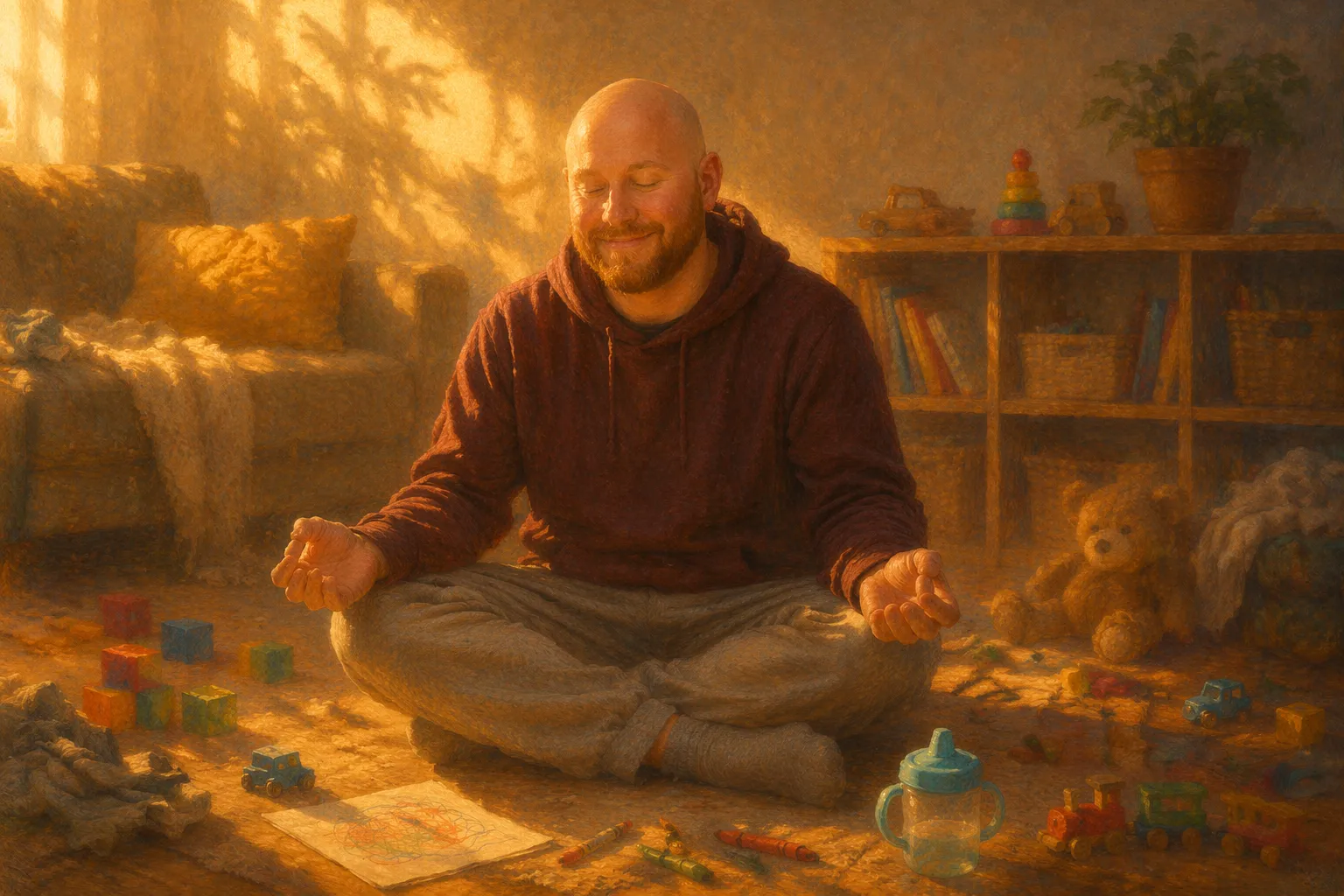
Meditation asks for quiet. Parenting offers screaming, banging, and someone smearing yoghurt on the dog.
I’ve been meditating through 4.5 years of fatherhood now, and these imperfect, interrupted, frequently ridiculous years of practice have changed me more than any silent retreat ever did. Not because I figured out the secret to meditating with kids. Because I stopped trying to meditate despite them and started letting the chaos reshape what practice looks like.
This post isn’t about meditating with your kids. It’s about keeping your practice alive when everything conspires against it.
This is one of five role-deep posts in our Life Roles series. The pillar, Meditation for the life you actually have, covers the cross-role framework. Sibling posts: Meditation for caregivers, Meditation for therapists, Meditation for students, Meditation for leaders.
Everything with kids is phases, and so is your practice
When my first son was born, I discovered something by accident. I was rocking him to sleep in the dark, swaying back and forth, and I realised the motion was doing something to my own nervous system too. The repetitive rocking became my focus anchor. Not the breath, not a mantra, just the rhythm of trying to get a baby to close his eyes.
That phase lasted about a year and a half. Then he moved out of the crib and into his own bed, and suddenly the rocking chair meditation was gone. I had to find something new.
My kids are 2.5 and 4.5 now, and we’ve got a third arriving in November. I’m about to reset the whole cycle. New baby, new sleep deprivation, new version of practice I haven’t figured out yet.
Here’s what nobody tells you: as your kids get older, finding quiet moments gets harder, not easier. A newborn sleeps around 16 hours a day. A toddler sleeps 12 and spends the other 12 testing whether gravity still works by throwing things off tables. A 4-year-old has opinions, questions, and an uncanny ability to detect the exact moment you close your eyes.
Stop waiting for conditions to stabilise. They won’t. Your practice isn’t something that happens alongside parenting. It lives inside it, shapeshifting through every phase. That’s not failure. That is the practice adapting.
Broken practice is still practice
Last week I sat down to meditate at 8:45 PM. By 8:47, there was screaming from the bedroom. Someone had taken someone else’s stuffed rabbit. I went upstairs, sorted it out, came back down, sat again. Got maybe four minutes before my wife needed help with bath cleanup.
This happens constantly. Practices get cut short. Someone gets hurt. Your partner is overwhelmed and needs you right now, not in ten minutes.
I’ve had to adopt a mindset that would horrify any meditation purist: broken practice counts. A session that gets interrupted three times still did something. Five minutes before the chaos resumes is five minutes your nervous system got to downshift.
The last 4.5 years since my first child was born have been the hardest stretch for consistency in my entire meditation life. But the fragments add up. Even the interrupted sits, the two-minute resets, the practices where I spent more time getting up and sitting back down than actually meditating. They’ve had a bigger cumulative impact than I expected.
This reframing is what keeps you coming back. If you need perfect conditions, you’ll quit within a month. If broken practice counts, you’ll keep showing up. And showing up imperfectly over years beats a perfect streak that snaps.
You need a partner in this (and they need you)
My wife and I don’t have a rigid schedule for meditation. There’s no “your slot is 7 PM, mine is 8 PM” arrangement pinned to the fridge. Life with two small children doesn’t respect schedules like that.
What we do have is a standing agreement. When one of us is overwhelmed (and you can usually see it building before the person even says it), either of us can ask: “Can I take a short meditation break?” The answer is always yes.
Sometimes it’s ten minutes. Sometimes it’s twenty. Sometimes it’s five because that’s all the situation allows. The point isn’t the duration. It’s that the request is never questioned. We both know that the person who comes back from even a short practice is more patient, more present, and less likely to snap at a toddler for doing normal toddler things.
This goes both ways. I take breaks, and I give them. When I can see my wife hitting her limit, I’ll take the kids so she can have space. Whether she meditates, reads, or just sits in a quiet room and stares at a wall, the reset matters more than the method.
I know not everyone has this. Single parents, or parents whose partner doesn’t understand why sitting still for ten minutes matters: the “broken practice” mindset becomes even more essential. Two minutes during nap time. A five-minute reset in the car after drop-off. Practice doesn’t require a meditation room and a supportive co-parent. It helps, but it’s not the price of entry.
Overstimulated is not the same as overwhelmed
Parents cycle through several distinct nervous system states every day, and most meditation advice treats them all as one thing. They’re not.
Noise overload is what happens when the screaming, the banging, the TV, and the fighting all hit at once. Your ears feel full. Your jaw tightens. You need quiet.
Touched out is different. You’ve been climbed on, pulled at, had someone’s sticky fingers in your hair for six hours straight. You need space. Physical space. The idea of someone guiding you to “bring gentle attention to your body” makes your skin crawl because you need less body awareness, not more.
Emotional overwhelm is different again. That’s the weight of juggling a full-time job with being a present parent, maintaining your relationship, staying healthy, and somehow keeping the house from descending into chaos. You don’t need quiet or space. You need to feel like you’re not failing at everything simultaneously.
There’s a fourth that isn’t about load at all: the picture of them falling, or in a crash, or getting sicker, that starts the moment they’re out of your hands. It runs on control rather than noise, touch or overwhelm, and the fear of them getting hurt needs a different approach.
Generic “close your eyes and breathe” guidance doesn’t know which of these you’re dealing with. And the wrong guidance for your state can make things worse. A body scan when you’re touched out. An emotional reflection when you’re noise-overloaded.
This is where AI-guided meditation makes a real difference. When you can tell it “I’m touched out and overstimulated from noise and I just need to feel like my body is my own again,” it builds guidance for that. Not a generic wind-down. Not a sleep meditation. Something that actually addresses the specific state your nervous system is stuck in.
A session for the parent you are tonight
Tell StillMind whether you're touched out, noise-overloaded, or running on emotional fumes. The guidance shapes around that, not a generic "parent stress" script.
Try StillMind, freeAnd there’s real science behind this: a regulated parent helps regulate their child. Your practice isn’t selfish. It’s one of the most useful things you can do for your kids.
The meditation that almost made me cry
A few months ago I sat down and typed everything into the prompt. All of it. The full-time job. Trying to be present for two small kids. Wanting to give my wife the time and attention she deserves. Trying to stay fit. Needing downtime that never comes. And building StillMind as a side business on top of all of it, because I believe in what it can become.
I wasn’t looking for a specific technique. I was just venting into a text field.
The guidance that came back didn’t try to fix anything. It started by simply recognising how much I was carrying. It told me it’s okay to take time and space, and that with that time and space, I could show up better for everything I was trying to be. It acknowledged how hard it is to hold all of those roles at once without letting any of them slip.
Then it did something I didn’t expect. It asked me to imagine a future where I’d achieved what I was working toward. Financial freedom from the side business. The ability to leave the full-time job. The space to focus on what actually matters.
“How would that feel?”
I felt a weight come off my chest. I felt freedom. I nearly cried.
I’ve done hundreds of guided meditations. I’ve used every major app. Nothing has ever landed like that, because nothing had ever been that personal. It wasn’t generic encouragement. It was my life, my specific pressures, reflected back with a clarity I couldn’t create for myself.
The insight I keep coming back to: it felt like the meditation was coming from within me. The AI just gave it the words I couldn’t find.
What I’ve actually gained
More patience. That’s the most obvious one, and it’s real. I react less. When my 2-year-old throws his dinner on the floor for the third time, there’s a beat now. A tiny gap between the impulse and the response that wasn’t there before.
More conscious choices. I used to sit up mindlessly until midnight, scrolling, watching things I didn’t care about, then feeling wrecked the next morning. Now I notice when I’m doing it. Going to bed early doesn’t feel like sacrifice when you’ve given yourself even a short practice that evening. It feels like the right call.
The counterintuitive truth about parenting and meditation: the less time you have, the more it matters. When you’re running on four hours of sleep and your patience is a thread, even two minutes of practice is the difference between responding and reacting. Between being the parent you want to be and the one running on autopilot.
These benefits compound. Four and a half years of wildly inconsistent practice. Missed days, broken sessions, entire weeks where I forgot. And I’m still a fundamentally different parent than I would have been without it.
Frequently asked questions
How do you meditate when you have kids around?
You stop waiting for perfect quiet. Short practices, even two to five minutes, during naps, after bedtime, or while your partner takes over. When my son was a newborn, I meditated while rocking him to sleep, using the motion as my focus anchor. That was one of the most effective phases of my entire practice. A free meditation timer is all you need for those in-between moments.
What type of meditation is best for parents?
It depends on what you’re experiencing right now. Overstimulation from noise needs a different approach than being touched out or emotionally overwhelmed. AI-guided meditation adapts to your specific state instead of offering the same relaxation script regardless of what’s actually going on.
Is 2 minutes of meditation enough?
Yes. Two minutes is enough to notice a shift. Enough for your breathing to slow, your shoulders to drop, your nervous system to register that the crisis is over. Once you feel that difference, you come back for more. The practice isn’t about hitting a time target or maintaining a streak. It’s about giving your brain and body time to process.
Meditation and parenting is possibly the biggest contradiction I’ve ever experienced. But 4.5 years in, with a third on the way, I’m more certain than ever: some practice is always better than none. And broken practice? That still counts.