

StillMind and Headspace, compared
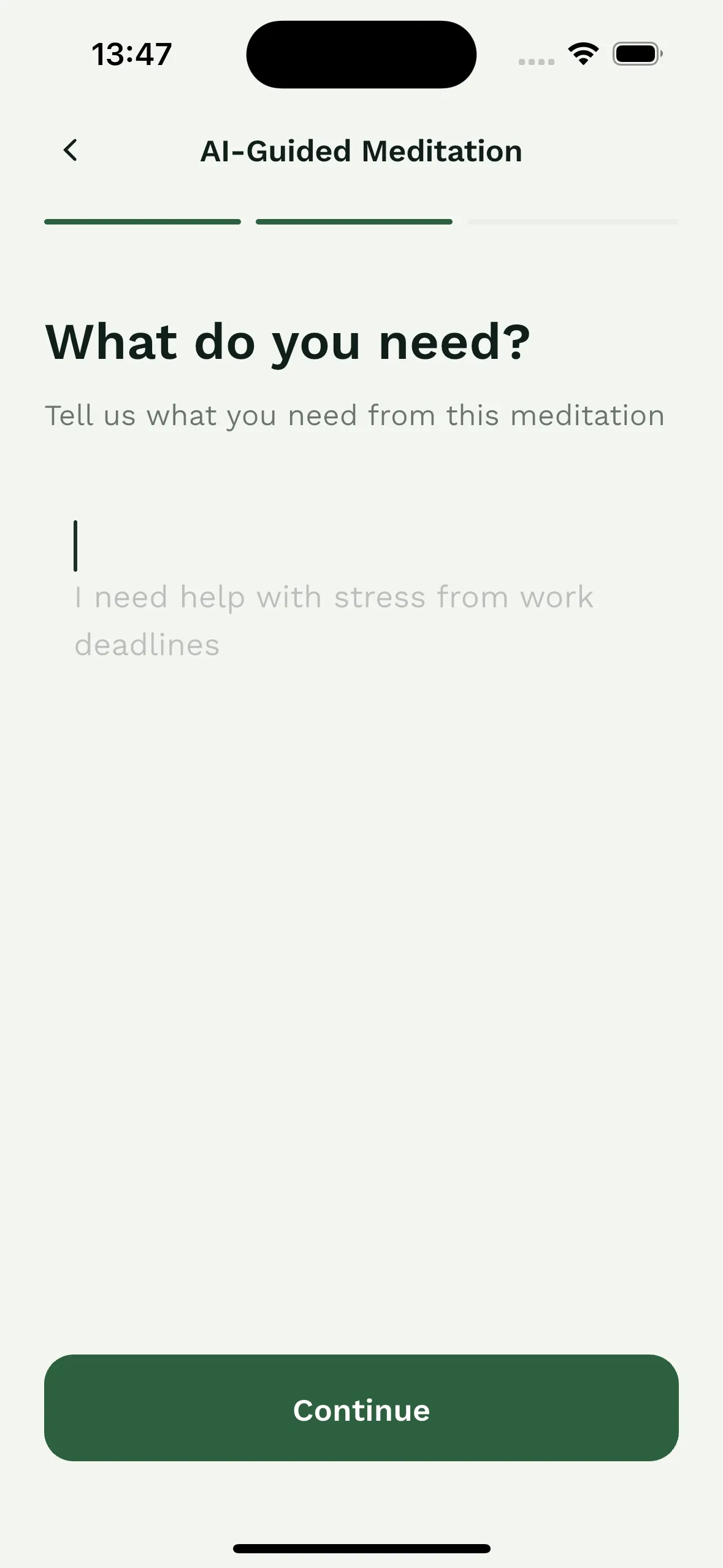
Headspace is a well-known name in learn-to-meditate courses. StillMind builds you a course of your own, around a goal you describe, with journaling built in.
If you are weighing up StillMind and Headspace, you are probably deciding between two genuinely different ideas of what a meditation app should be.
One gives you a produced library and a structured path through it. The other builds each practice around what you bring to it that day.
StillMind and Headspace, side by side
Objective factors that shape day-to-day practice. Each app is strong at something different.
| Feature | StillMind | Headspace |
|---|---|---|
| Personalization | Each session generated with AI for your situation that day | Curated library and structured courses everyone shares |
| Course structure | You describe a goal, the app composes the whole sequence around it | Professionally produced courses with a set progression |
| Journaling | Built in, private and encrypted, written or voice | Focused on guided audio content |
| Session length | Flexible and short-friendly, works well for ADHD and busy days | Range of lengths across a produced catalog |
| Content style | Generated fresh for the moment you are in | Structured courses with a warm voice and friendly animations |
| Learning to meditate | A Techniques course that starts at your level and adapts as you go | Structured beginner courses, a widely loved on-ramp |
| Consistency | Momentum and gentle streaks, without pressure | Streaks and reminders |
StillMind and Headspace questions
Is StillMind a good alternative to Headspace?
StillMind is a strong alternative if you want a course built around a goal you describe, and if built-in journaling matters to you. You choose the kind of journey, the tone and how far to go, and each session is written fresh and anchored to what you said. Headspace remains a great fit for people who want professionally produced courses with a consistent guiding voice and a path many others have walked. The right choice depends on whether you want a curriculum of your own or a produced one.
What is the difference between StillMind and Headspace?
The main difference is where the structure comes from. Headspace offers a produced library and structured courses that everyone works through, with a recognizable house style. StillMind builds a multi-session course around a goal you describe, writes each session fresh and anchored to it, and includes private, encrypted journaling in written or voice form. Both give you a path. Headspace's is produced in advance for everyone, and StillMind's is composed for you.
Is StillMind cheaper than Headspace?
StillMind is free to begin and does not require a subscription to start practicing, so you can meditate before deciding on any paid plan. Headspace uses a subscription model. Exact pricing changes over time and by region, so check each app's current plans directly. The clearest difference is the starting point: StillMind lets you begin without a subscription.
Which is better for beginners, StillMind or Headspace?
Both work well for beginners in different ways. Headspace offers structured foundation courses that teach the basics step by step, which many new meditators find reassuring. StillMind builds you a Techniques course that starts at your level and works through one technique at a time, adjusting as you tell it how each session landed. If you want a proven path many people have walked, Headspace suits that. If you want one shaped around where you are starting from, StillMind does.
Does StillMind have courses like Headspace?
Yes, and it builds them around you. You pick the kind of journey, the tone and how far you want to go, describe your goal in your own words, and StillMind composes the whole sequence, naming every session and setting its technique focus and length. Each session is then written fresh and anchored to that goal. Headspace offers professionally produced courses with a set progression and a consistent voice. Both are courses. One is made in advance, the other is made for you.
More meditation app comparisons
Meditation made for your moment
Start with a session built around what is actually on your mind today, journaling included. StillMind is free to begin, no subscription needed to start.