Does Calm use AI? What each meditation app actually does
Does Calm use AI? Does Headspace? Some people ask to find it, some to avoid it. Here is what each app's AI actually does, checked against their own sources.
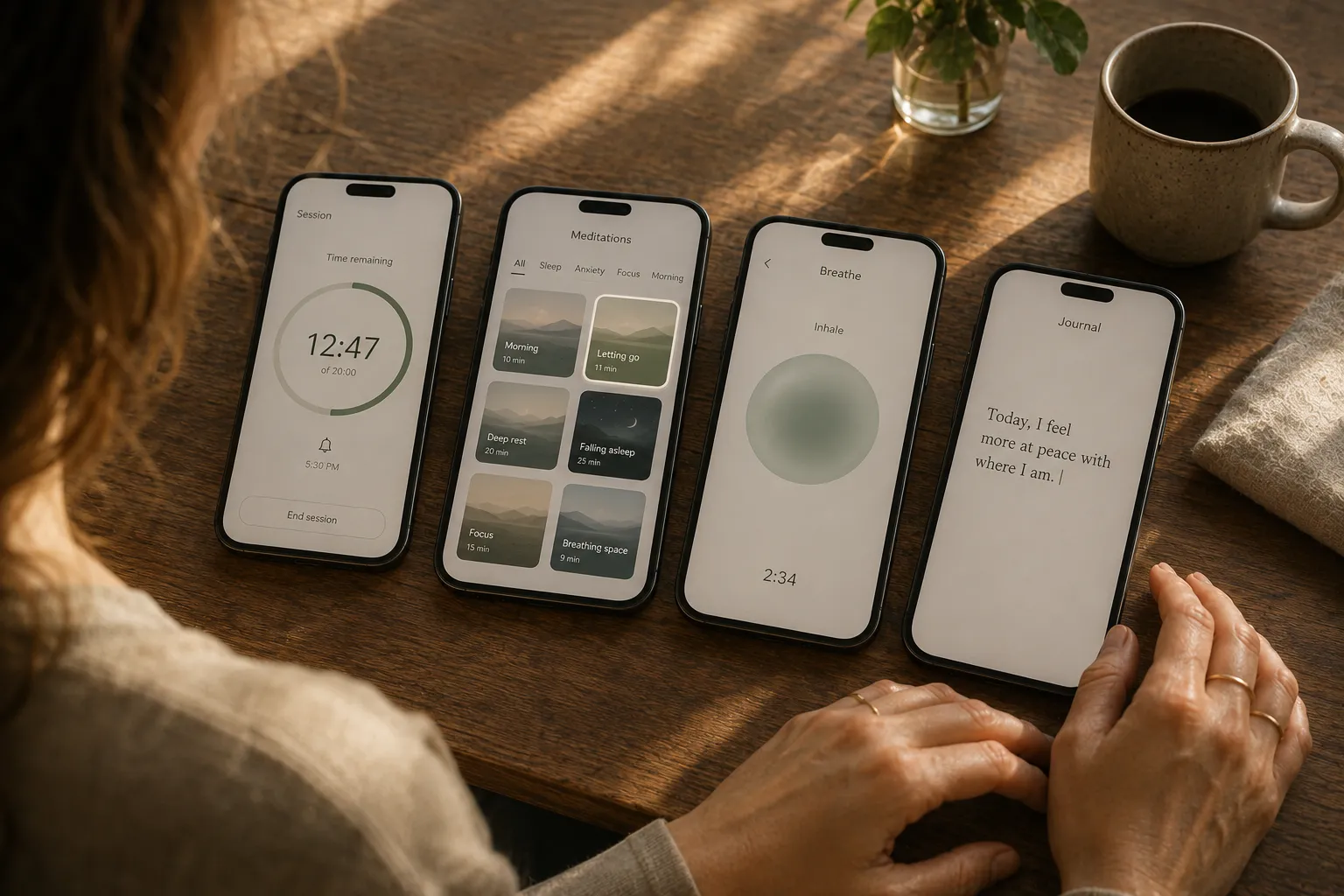
Two people type “does Calm use AI” into Google an hour apart. One of them is hoping the answer is yes, because they want a session that responds to what is actually happening in their life. The other is hoping it is no, because they have paid for that app every month for three years and they have started noticing things.
Both deserve a straight answer, and neither gets one easily, because almost everyone writing about this is selling something.
Including me. StillMind is my app, this is our blog, and StillMind uses AI in the deepest sense on the list below. It also has a plain timer for self-guided practice, which becomes the home screen for people who tell us that is what they came for, so nobody ends up on the AI who did not want it. I would rather tell you all of that in the first paragraph than have you find out in the last one. Everything about the other apps here comes from their own published material where they publish it, and from dated press announcements where they do not, with the date I checked each one.
The short answer
Calm: yes, to decide what to show you. People do the talking. Its Recommended for You feature runs on Amazon Personalize, documented by AWS in a case study on 23 September 2021. Calm’s own published AI disclosure covers first drafts of blog articles, not meditations and not narration. Its US App Store listing (version 6.101.1, updated 24 July 2026) and its Google Play listing (updated 30 July 2026) mention AI nowhere in their own descriptions, checked on 3 August 2026.
Headspace: yes, and it has a name. Ebb is an AI companion you talk to. It launched in text form on 10 October 2024, arrived in the UK on 3 April 2025, and gained a voice mode on 8 December 2025. In Headspace’s own words, Ebb “recommends relevant content” and “draws from Headspace content”. It does not generate meditations or audio. Human teachers still record those.
Meta AI: a general assistant that can talk about meditation. Meta’s published capability descriptions list no meditation, mindfulness or wellness feature anywhere. Its voice mode is real and generates speech directly rather than reading text back to you (announced 29 April 2025). It can write you a script and say it out loud. It is not a meditation player.
StillMind: yes, generation, and also no. When you ask for guidance, the script does not exist until you ask: you describe the situation, and it gets written for that description and voiced, instead of selected from a shelf. That is what most people mean when they worry about AI in meditation, so it gets its own section below. The timer for self-guided practice has no AI in it at all, and for a lot of people it is the whole app.
All dates above are the dates I checked, and that matters more here than in most comparisons. Ebb went from text-only to voice in fourteen months. Any answer without a date on it is already decaying.
Related: the full guide to AI meditation.
Why it got hard to tell
The industry stopped drawing the line itself.
In March 2026, a16z published the sixth edition of its Top 100 Gen AI Consumer Apps report and said, plainly, that the distinction between “AI-first companies and everything else” no longer holds. That was a description of how thoroughly generative features have spread. Read from the consumer side, it is an admission that the label on the box stopped carrying information.
The same edition names no meditation app at all, which tells you something about how loudly this category talks about AI compared with how much of it there is.
So “does this app use AI” has quietly become the wrong question, because every answer is yes and the yeses mean four different things. The useful question is which kind, doing what, and at which point in your practice.
Four things “AI” can mean in a meditation app
| What you get | Where the AI sits | Who does this |
|---|---|---|
| A better shortlist | Around the practice | Calm’s Recommended for You; Aura Health recommends across thousands of human-recorded tracks |
| Something to talk to | Around the practice | Headspace’s Ebb; Meditopia’s SOUL companion, which sits over 1,000+ pre-recorded human meditations |
| A synthetic voice speaking the words | Inside the practice | Insight Timer publishes a policy governing this; StillMind uses it |
| A script written for this moment | Inside the practice | StillMind, plus small independents including ELYND, SYLO and ZenGen |
Here is the whole thing in one line. Everything in the “around” rows changes how fast you get to a practice. Only the “inside” rows change what the practice is.
That is why someone perfectly fine with Netflix-style recommendations can still feel uneasy about a synthetic voice, and why lumping it all together as “AI” leaves nobody able to decide. A recommendation engine picked a human being’s recording for you. A generated script means no human wrote those particular sentences.
There is a fifth meaning, which is the word itself appearing on the listing. Meditopia lists itself as “Meditopia: AI, Meditation”, and its SOUL companion is a conversational layer over more than a thousand pre-recorded human meditations. Balance’s personalisation assembles each session from an audio library of thousands of files. Both labels accurately describe a real feature. They describe the “around” column, and the word by itself cannot tell a shopper that.
Calm: AI that picks, people who speak
Calm is the best-produced audio in this category and it is not particularly close. Matthew McConaughey, Stephen Fry, P!nk and Bob Ross have all narrated for it. Apple named it iPhone App of the Year in 2017. If what you want at 11pm is a story read beautifully by a famous voice over composed music, that is a genuine craft and Calm has more of it than anyone.
The AI is upstream of all that. Amazon Personalize powers Recommended for You, per the AWS case study from September 2021, which is a recommendation system of the same family that decides what a streaming service puts on your home screen. Calm’s published position on AI (calm.com/blog/how-we-use-ai) covers first drafts of blog articles. Not meditations. Not narration.
For anyone screening in order to avoid: as of my check on 3 August 2026, there is no mention of AI in either store listing, and no published claim that any narration is synthetic.
Two practical notes. On pricing, Calm’s US in-app purchase tiers on 3 August 2026 showed $16.99, $79.99 and $69.99 all live at the same time, while the listing text still said $14.99. Regional and cohort pricing make a single canonical number meaningless, so check what your own device offers you. On data, its App Store privacy label on the same date declared 10 data types across 7 categories, and declared both data linked to you and data used to track you across other companies’ apps and websites.
Headspace: what Ebb is, and what it isn’t
Headspace is the strongest structured teaching in the category. The courses build in a deliberate order, they are written to be someone’s first ten hours of meditation, and the company invests visibly in peer-reviewed research and in integrated care, with licensed therapists and coaches alongside the app.
Ebb is a conversational companion, not a meditation generator. Headspace says it “recommends relevant content” and “draws from Headspace content”, and the company is unusually straight about the boundaries: Ebb is not a substitute for human care, does not provide clinical services, and is not monitored in real time by a human. It is limited to paid members aged 18 and over, in English, in the US, UK, Canada and Australia. Text launched 10 October 2024, the UK followed on 3 April 2025, and voice mode arrived 8 December 2025.
Let me be precise, because it would be easy to be cheap here. Of everything I looked at, Ebb is the most clinically careful AI companion shipping in this category. Crisis detection, explicit disclaimers, a narrow scope it does not oversell. Whoever fought for those constraints inside that company won an argument that a lot of people lose.
And some subscribers still cancelled over it. In the r/Headspace threads I read on 3 August 2026, several people said Ebb was the deciding factor, and one dropped the app on mere suspicion that a sleepcast voice was synthetic, without ever confirming it. That is a self-selected community primed to notice product changes, so do not read it as the whole market. But the shape of the complaint is worth naming exactly: almost nobody argued the output was bad. They objected to arriving in an app they already paid for, without being asked.
Which is a disclosure problem, not a capability problem. It is also the reason this post exists.
Headspace’s own listing gives $12.99 a month and $69.99 a year in the US. Its App Store privacy label on 3 August 2026 declared 14 data types across 9 categories, all in the “Data Linked to You” bucket, and declared no data used to track you across other companies’ apps.
Meta AI: a general assistant, not a meditation player
Meta AI reaches you in more places than any meditation app ever will: WhatsApp, Instagram, Messenger, Facebook, Threads, a standalone app, the web, and Ray-Ban glasses. The base tier is free with usage limits. Its voice mode is the technically interesting part: Meta describes it as generating speech directly instead of reading generated text back (about.fb.com, 29 April 2025), which is why it sounds less like a screen reader than you expect.
Ask it for a ten-minute body scan and it will write one and say it aloud. That is real.
What it is not is a player. Meta documents no meditation, mindfulness or wellness feature anywhere in its capability descriptions, and everything a meditation app quietly does for you sits in that gap: the timed silences between instructions, background sound, a track you can save and repeat, a bell at the end. I am reasoning here from what Meta publishes, not from a session I sat through, and I would rather say so than dress it up.
If you like the idea of describing your situation in words and getting guidance shaped around it, that instinct is sound. A personalised AI-guided meditation does the same interpretation and then behaves like an audio session. So does asking a friend who teaches. The prompt is the good part.
StillMind: what generation changes
Here is my actual history with this, since it explains the bias.
I have subscribed to Calm, Headspace, Balance and Insight Timer over the years, and tried at least a dozen other meditation apps. I used Balance for a long time, largely because I loved Ofosu’s voice and teaching style.
StillMind did not start as an AI app at all. I built it a year ago for my wife, who wanted an honest timer for her self-guided practice, because that was the thing that put her at ease when she sat down. No voice, no library, just the sit.
The AI came later, and it came from a problem of my own. I was unhappy in a job I had been unhappy in for a long time. I liked the people, which made it harder rather than easier, and I could not work out what to do about any of it. So I built something that would write me a meditation for that, specifically that, and I sat with it.
It was not like any meditation I had done before. It did not tell me what to do and it did not offer me an answer. It acknowledged the thing, and then it framed the practice so I could bring ordinary meditation technique to bear on it. Something came loose. I made a decision not long after and changed roles.
That has happened enough times since that I stopped treating it as a one-off. When I burned out, a session helped me feel acknowledged about why rather than just talked down from it. When money was the thing keeping me up, it kept me on the actual reasons instead of generic financial stress. So it became a design philosophy rather than a feature.
The common thread is specificity. Not “anxiety”, but the conversation you are dreading on Thursday. That instinct shows up in the numbers too: in our first-party usage report, 53% of AI-guided practices start from a custom prompt the user wrote rather than a preset. Given the option, most people reach for their own situation.
So StillMind generates. You describe what is going on, the app selects techniques for it, writes the script and voices it. Prompts are used to produce your session and are not stored, and the journal is encrypted, which I go into properly in the privacy guide. The three tiers of personalised meditation breaks that distinction down further.
Now the honest part.
Generation needs a connection at the moment of creation, and a downloaded library does not. A thirty-day progressive curriculum, where session nine assumes session eight, is genuinely better served by a fixed sequence somebody designed as a sequence. And nobody has matched Calm’s celebrity sleep audio, including us. Those are three real reasons to choose something else, and I would rather you choose the right thing than the thing I made.
A session written for the moment you're in
Describe what's actually happening. StillMind selects the techniques, writes the guidance and voices it, then gives you a private place to write about it afterwards. Prompts are used for your session and not stored. Free to start.
Try StillMind, freeIf you would rather avoid AI entirely
This is a reasonable position, badly served by the current writing on the subject, so let me do it properly.
The clearest published stance I found belongs to a competitor. Insight Timer’s teacher policy, updated 30 July 2026, does not permit AI-generated voices or voice-cloned versions of real people as the primary narration, while allowing AI for brainstorming, outlining and drafting scripts. That is a company drawing the script-versus-voice line in writing, in a document teachers must agree to, before anyone made them. It does the taxonomy above better than my table does, and the credit is theirs.
Smiling Mind and Medito come up repeatedly alongside Insight Timer in threads where people are actively looking for AI-free options. I have not audited them, so treat that as a report of what people recommend to each other, not a verification. Check them the way you would check any app, which is the next section.
The other route, and the one nobody mentions: a plain timer removes the question entirely. Sit, set a duration, use your own attention. Every technique in the tradition predates all of this by a couple of thousand years. Our meditation timer is free and has no AI in the path, there are others, and the point is the practice, not which one you pick.
One more thing worth holding onto. The strength of feeling in those threads was almost never about output quality. It was about being told. An app that generates half its content and says so plainly sits better with most of these people than an app that quietly swaps in a synthetic voice and hopes nobody notices.
How to check any app yourself
Somebody asked this outright in one of those threads and got no reply, which is a small failure I would like to fix. Four checks, in order of speed.
Search the store listing for “AI”. Companies advertise features they are proud of. Calm’s iOS and Android listings contain no mention of it. Headspace’s App Store description names Ebb directly. A listing that says nothing is weak evidence, not proof, but it is the fastest signal you can get and it takes ten seconds.
Read the App Store privacy label. Tap the app, scroll to App Privacy, and look at two buckets: “Data Linked to You” and “Data Used to Track You”. This does not tell you whether there is AI, and it does tell you what a conversational feature would have access to if there is. On 3 August 2026, Headspace declared 14 types across 9 categories with no tracking bucket, and Calm declared 10 types across 7 categories including a tracking bucket.
Look for a published AI policy or teacher policy. This is where the real answers live. Calm publishes one at calm.com/blog/how-we-use-ai limiting AI to blog drafts. Insight Timer’s teacher policy governs narration. A company that has thought about the question tends to have written the answer down somewhere findable.
Check whether the narration is credited to a named human. Every meditation in a human-recorded library has a teacher attached to it, with a bio and usually a photo. Content with no named narrator anywhere in the interface is the thing to look at twice.
And date whatever you conclude. Write it in a note if you care about it. Fourteen months separated Ebb’s text launch from its voice launch, and nothing about the app’s name changed in between.
The question underneath the question
Nobody actually wants to know whether an app uses AI. They want to know whether they are being levelled with.
If you are hunting for generation, the honest map is short: it exists, a handful of apps do it, and most of the ones with AI in the name are doing something else that is also useful. If you are screening it out, Insight Timer’s policy is the clearest published position in the category and a plain timer is the clearest position of all.
Either way, the thing worth knowing is that the voice matters more than the technology behind it. In our first-party usage data from around 2,500 StillMind users, compassionate-toned practices complete at 70% while spiritual-toned practices complete at 32%. Same app, same generation, more than double the completion rate, decided by tone. Whichever app you land on, that is the variable doing the heavy lifting, and it is not the one anyone is arguing about.
For the wider picture, our guide to AI meditation covers the ground properly. And if generation is the part you want to try, StillMind is free to start.
Frequently asked questions
Does Calm use AI?
Yes, for recommendations. Calm’s Recommended for You feature runs on Amazon Personalize, which AWS documented in a case study published on 23 September 2021. Calm’s own published AI disclosure covers first drafts of blog articles, not meditations and not narration. Its US App Store listing (version 6.101.1, updated 24 July 2026) and its Google Play listing (updated 30 July 2026) contain no mention of AI in their own descriptions, checked on 3 August 2026. The meditations and sleep stories are narrated by people.
Does Headspace use AI?
Yes. Headspace built an AI companion called Ebb, which launched in text form on 10 October 2024, reached the UK on 3 April 2025, and gained a voice mode on 8 December 2025. In Headspace’s own description, Ebb recommends relevant content and draws from Headspace content. It does not generate meditations or audio. The meditations themselves are recorded by human teachers.
Is Headspace AI?
No. Headspace is a meditation app built on a library of courses recorded by human teachers, with an AI companion called Ebb alongside it. Ebb is available to paid members aged 18 and over, in English, in the US, UK, Canada and Australia. Headspace states plainly that Ebb is not a substitute for human care, does not provide clinical services, and is not monitored in real time by a human.
Can Meta AI guide a meditation?
It can write a meditation script and read it aloud in voice mode, which Meta describes as generating speech directly rather than reading text back, announced on 29 April 2025. It is not a meditation player. Meta’s published capability descriptions list no meditation, mindfulness or wellness feature, so there are no timed pauses, no background sound, no saved track and no timer. That is reasoned from what Meta documents rather than from a session I sat through.
How can I tell if a meditation app uses AI?
Four checks cover most cases. Search the App Store or Google Play listing text for the word AI, since companies advertise features they are proud of. Read the App Store privacy label to see what is collected and whether any of it is used to track you. Look for a published AI policy or teacher policy on the company’s website. Then check whether the narration is credited to a named human teacher. Write down the date you checked, because these answers change with releases.
Which meditation apps do not use AI?
Insight Timer publishes the clearest position I found. Its teacher policy, updated on 30 July 2026, does not permit AI-generated voices or voice-cloned versions of real people as the primary narration, while allowing AI for brainstorming, outlining and drafting scripts. Smiling Mind and Medito also circulate as recommendations among people looking for AI-free options, though I have not audited either myself. Any app can change its position in an update, so check the listing and the policy yourself before you subscribe.