Stage fright: why calming down is the wrong target
You are fine in the show and blank in the audition room. Same nerves, same body. Performance science says the level of arousal was never the right question.
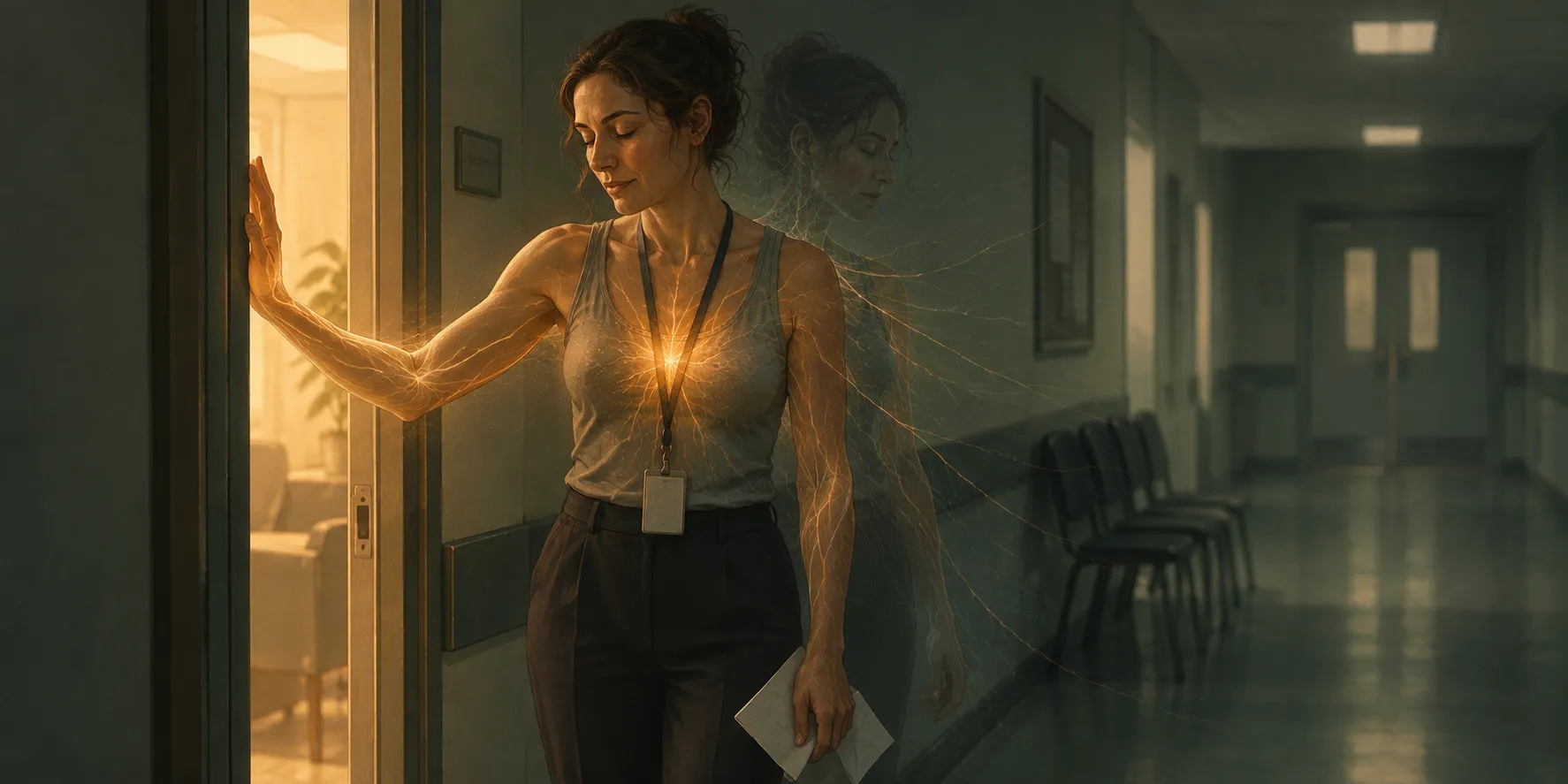
Eighteen years of performing, eleven of them acting, and she is good on stage. Opening night, press night, a full house: fine. Callbacks: fine.
Then the audition room. A table, a reader she has never met, sixteen bars of a song and two minutes of a monologue she knows better than her own phone number. Halfway through the monologue her mind went blank. She stayed in character and stood there for about ten seconds, hunting for a line she has said out loud a thousand times. She had taken deep breaths in the corridor immediately before she walked in. She forgot the lyrics to her song anyway.
Same person, same body, same material, opposite outcome.
Part of our work on nervous system regulation. For the general map of arousal states first, start with the window of tolerance.
You can do it in the show. You cannot do it in the room.
That split is the thing to explain, and almost nothing written for performers tries.
Notice what it rules out. If nerves were a single dial and hers sits too high, the show should be the disaster. The show has more people, more consequence, more that can go wrong in public. The audition has a folding table and three people with coffee. By every measure of how much is at stake, she has the ordering backwards.
Deep breathing did not close the gap either. She did it in the corridor, correctly, minutes before, and forgot the words to a song she has sung for years. That is not a failure of technique. It is a technique aimed at a dial that was not the problem.
Her coaches had told her to be confident, to be herself, and not to think about it. She names the flaw better than I could: it is not advice you can act on if you already have anxiety. You cannot decide to be confident any more than you can decide to be taller. And “do not think about it” is an instruction to do nothing, handed to somebody whose body has already started doing something.
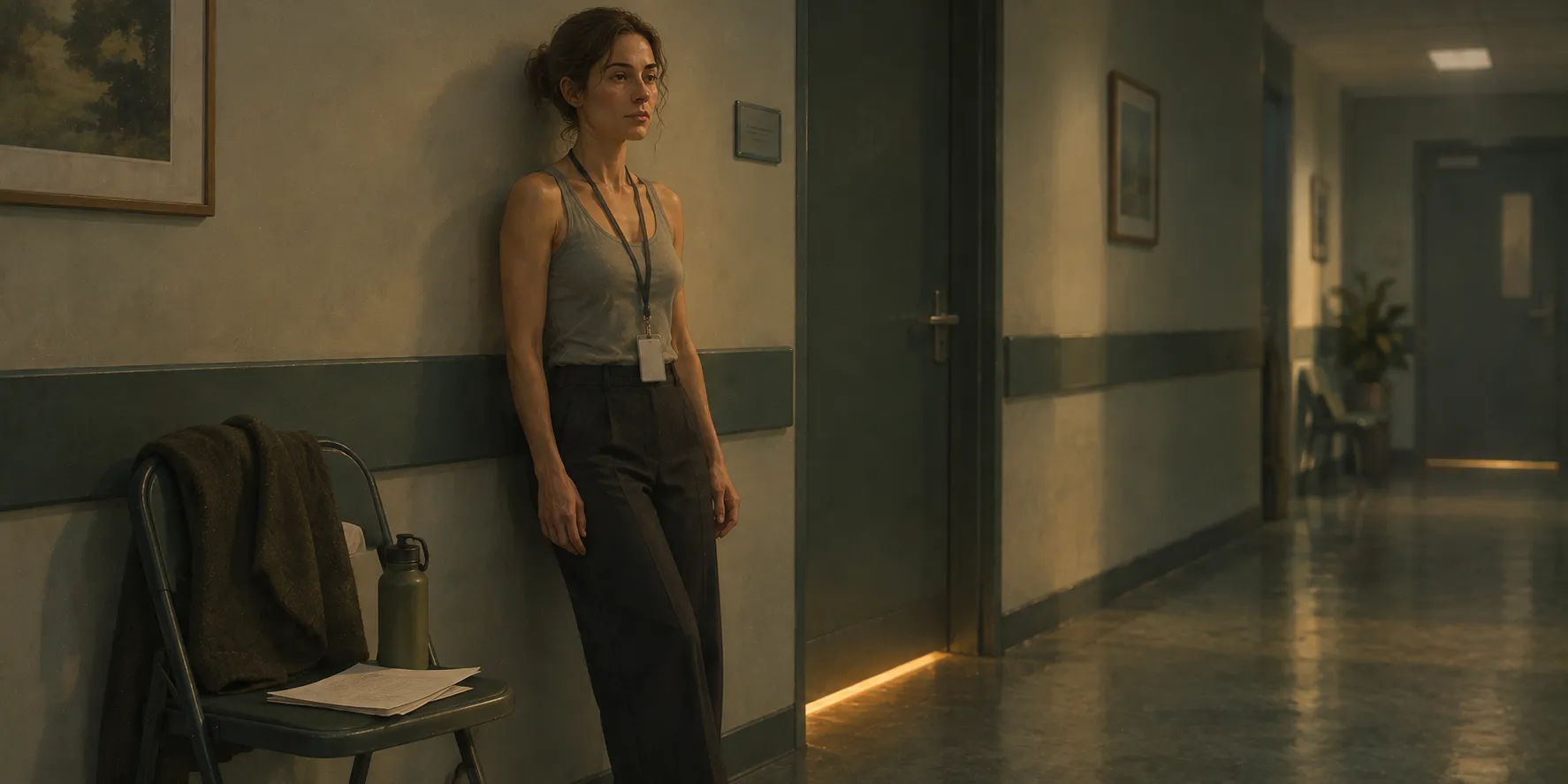 The few minutes before the door opens are not idle time. They are where the appraisal gets made.
Her own summary of that room is better than any diagnosis: her body treats the audition as life-or-death, even though she knows perfectly well it is not.
So the question is not why her body is loud. It is why it reads one room as survivable and the other as not.
What the clinical sheet actually says
The UK’s clinical body for performing arts medicine, BAPAM, publishes an information sheet on managing performance anxiety, and the word “meditation” does not appear on it. Neither does “meditate”, “mindful” or “mindfulness”. We checked mechanically rather than by eye: zero.
What it does say is more interesting than what it leaves out. It defines performance anxiety as “a feeling of fear accompanied by increased bodily arousal, and is experienced by most performers at some point.” It names the Yerkes-Dodson law, and then states the thing almost nobody tells performers: “A certain level of arousal is needed for optimal performance… if arousal is too low or too high, performance will suffer. In order to achieve optimal performance a moderate level of arousal is needed.”
Too little is a problem. That is why the sheet prescribes physical warm-ups, in exactly these terms: “Warming up the body by marching on the spot, for example, can help increase arousal if you are feeling lethargic.” Increase. Under breathing techniques it names box breathing outright, pointing to the exercise as drawn on its performance anxiety poster, and it names visualising a successful performance. It warns plainly against self-medicating, naming excessive alcohol and street drugs. On beta-blockers and tranquillizers it says they “help some people manage anxiety, but it is important to see your GP to discuss if they are appropriate for you.”
| What performers usually get told about nerves | What the clinical sheet actually prescribes |
|---|---|
| ”Calm down before you go on” | A moderate level of arousal, because too little impairs performance too |
| ”Take a few deep breaths” | Box breathing, a counted pattern rather than a general instruction to breathe |
| ”Picture it going well” | Visualising a successful performance, as a technique you rehearse |
| ”Be confident, be yourself” | A physical warm-up, marching on the spot included, to raise arousal when you feel flat |
| ”Have one drink to take the edge off” | A warning against self-medicating, with excessive alcohol and street drugs named |
There is a vocabulary gap in the middle of this, and it costs people years. A performer searching “meditation for stage fright” or “audition anxiety” never reaches the clinical guidance, because that guidance does not use the word. A performer who reaches the guidance never hears the word they would have needed to search.
The level was never the question
The inverted U has a bigger problem than being simplistic. It measures the wrong axis.
A 2025 review in Frontiers in Psychology, in its Performance Science section, examines music performance anxiety through modern stress models, and it is blunt about the curve everyone teaches. The inverted U “posits that both low and high stress levels impair performance, while moderate stress facilitates it”, and then: “there are key limitations to the assumptions of the inverted U model.” A unidimensional view of arousal, the authors argue, “fails to account for the complexity of stress states”, and it has had “an oversized influence on the MPA literature.”
Their replacement is one sentence. The core question “should not be simply ‘How much stress?’ but rather ‘What type of stress?’”
The type is decided by an appraisal, and the appraisal works like a scale. Demands on one side: the panel, the repertoire, the two minutes, the reader you have never met. Resources on the other: your preparation, your experience, your sense of having survived this before. A challenge-type response happens when “appraisals of coping resources exceed appraisals of situational demands (i.e., ‘I believe I can handle this’)”. A threat-type response happens when “perceived demands exceed available resources (i.e., ‘This is too much for me’).” It is not how loaded the scale is. It is which way it tips.
Both fire the same first thing. The SAM axis releases adrenaline and noradrenaline, which is why challenge and threat feel so similar from the inside: racing heart, damp hands, everything sharp. The divergence is downstream. In challenge, cardiac output increases, vascular resistance decreases, and you return to baseline quickly. In threat, the HPA axis also engages and produces cortisol, and vascular resistance rises instead, concentrating blood in the core. (If the cortisol half is the part you want to follow, we have written about what actually lowers it.)
They also point you in opposite directions. Challenge is linked to approach motivation, threat to avoidance, and the review’s example is exact: “an approach orientation could result in trying to perform a piece well, whereas an avoidance orientation could result in trying not to make mistakes.”
| Challenge | Threat | |
|---|---|---|
| The appraisal | "I believe I can handle this." Resources outweigh demands. | "This is too much for me." Demands outweigh resources. |
| What the body does | Adrenaline and noradrenaline. Cardiac output rises, vascular resistance falls, quick return to baseline. | The same, plus the HPA axis and cortisol. Vascular resistance rises, blood concentrates in the core. |
| What you are motivated toward | Approach. Trying to perform the piece well. | Avoidance. Trying not to make mistakes. |
| What it does to the performance | Enhanced cognitive and physical performance, beyond relaxation or non-stress. | Impaired short-term cognitive performance, and cognitive rigidity. |
Read the last row twice, because it holds the whole argument. Challenge states, the review says, “tend to be linked to enhanced cognitive and physical performance compared to states of relaxation or non-stress.”
A challenge state beats calm. Which means aiming at calm aims at the wrong thing twice: the wrong dial, and then the wrong end of it.
Why your hands go before your nerve does
Practice does something specific to playing. It makes it proceduralized, which is the technical way of saying your hands know it and you do not have to.
That matters when you are performing under pressure, because “under stressful conditions, people default to executing cognitive and behavioral response patterns that are well-learned/well-trained, and the stress response helps facilitate these types of responses.” Adrenaline is an amplifier. Point it at something practised and it makes that thing sharper.
Threat removes the thing to amplify. It “breaks down proceduralization. The musician focuses on ‘not making mistakes’ and performing each component of their skill.” The review’s worked example is a violinist who reads the demands as overwhelming and starts worrying about finger placements and intonation. Because breaking a proceduralized act into component parts does not let stress potentiate the well-learned responses, the timing goes, and the performance goes with it.
The top bar is one action, already practised, and adrenaline makes it better. The bottom bar is the same action after threat has taken it apart into bow angle, finger three, intonation, tempo and breathe. Same length, five pieces, nothing left to amplify.
Which explains a thing performers do to themselves without meaning to. A violinist, fifteen at the time, went backstage minutes before a competition and practised again to settle down. She gripped hard enough to break three strings, and says the backstage practice was feeding the anxiety rather than reducing it. Running the hard bar one more time in the wings is component-part attention with a countdown attached.
The hands go first for a physical reason too. Performers in violin forums name it plainly: fight or flight mobilises the big muscles at the expense of the small ones, which is exactly the wrong trade for a bow hand, a fingerboard or a controlled breath.
Why the beta blocker stops at the door
The actor had taken one before an earlier audition. She says it worked until she walked into the room, at which point the nerves came back.
Read enough performers on the subject and the same limit comes back in almost identical words: a beta blocker quiets the physical symptoms and only the physical symptoms. The mental part is untouched, and the preparation is still the preparation.
On the scale, that makes sense. It acts at the periphery, on the output. It does not touch the appraisal, which is where the tipping happens.
BAPAM’s own position is that beta-blockers and tranquillizers “help some people manage anxiety, but it is important to see your GP to discuss if they are appropriate for you, how they work, and the pros and cons including possible side-effects.” That is the right place for this decision, and not a page on the internet.
Loading the other side of the scale
Calming down works on the output, which is the same place the beta blocker works, and it leaves the scale exactly where it was. The demand side does not move for you either: the panel is the panel, the repertoire is the repertoire, the date is the date. There is only one side of this you can actually load.
- Box breathing, treated as a count rather than a cure. It is the technique BAPAM names under breathing techniques, drawn out on its performance anxiety poster, and its value in the wings is not that it lowers anything. It is that you can keep a count long after you have stopped being able to think. There is a condition on it, and the condition is this whole post arriving as a practical instruction. A held breath produces air hunger, and air hunger is one of the physical signatures of a panic response. If you are already reading your arousal as threat, your body is braced against sensation, and the hold adds to the exact thing it is bracing against. Read that same arousal as readiness and the hold is just a metronome. The breathing timer keeps that count on screen, all four phases of it. So take the fork honestly: if the hold makes the air hunger worse, that is information rather than failure, and the pattern to reach for is one with no hold in it, a double inhale and a long exhale. Our guide to breathwork techniques has the patterns and the one trial we could trace that compared them.
- Visualisation pointed at the bar that actually frightens you. BAPAM names visualising a successful performance. Make it narrower, because generic success is a mood, and moods do not survive a cold room. The entry after the rest in bar 34, the line where the reader comes in flat, the key change you have fluffed twice: rehearse those, going well.
- A mental warm-up that is an inventory. The sheet has you march on the spot to raise arousal when you feel flat. Do the equivalent for the resource side and count it out. Eleven run-throughs. Three in front of people. You have performed this monologue before and nobody died. That is not a pep talk. It is the one side of the scale you control, read back to you in specifics.
- Reading the racing heart as readiness rather than as a verdict. Stress reappraisal comes straight out of this model, and it “helps individuals interpret physiological arousal (e.g., racing heart, sweaty palms) as signs of engagement and readiness rather than anxiety.” In a double-blind field experiment, community college students given stress reappraisal instructions performed better on their exams, reported lower anxiety, and showed higher resource appraisals than a placebo group.
- The things performers worked out for themselves. An orchestra teacher’s drill: run round the building until your heart is pounding, come straight back in, and play, so the pounding and the sweat are familiar rather than novel on stage. From violinists who gig: open with a gutsy piece and burn the adrenaline off rather than sit on it. An actor’s green-room rule: do the extra run-throughs days earlier, so that in the waiting room you are allowed to look at nothing at all. And the least glamorous, from the same actor, eat an apple or some nuts on the way in, for the blood-sugar dip nobody warns performers about.
For a shorter version to run in a corridor, a five minute reset is close to the right shape.
Aim at ready, not at calm
Type the state you are actually in, twenty minutes before a callback or the night before a recital, and StillMind writes the session around it. The journal is where the inventory lives: what you have prepared, and how it went last time you were this frightened.
Try StillMind, freeWhen none of this is the answer
The review that supplies most of the argument above also supplies its limit, without flinching.
“Reappraisal- and mindset-based approaches are not ‘silver bullets’ that work in every context for every individual… When individuals objectively do not (or could not) possess the resources to address situational demands, no reappraisal or mindset will help support performance.”
That is the scale telling the truth. If the resource side is genuinely light, reading demands as larger than resources is not a distortion. It is arithmetic. A gigging musician said the same thing in one line: the prepared shows are manageable, and the last-minute ones wreck him. Nothing here substitutes for the run-throughs.
The other limit is medical. If the anxiety is persistent and getting in the way of your work or your life, that is a conversation with your GP, and BAPAM’s sheet is written to be taken into it. Our page on meditation for anxiety is a starting point and not a clinician.
Then the normal case, which nobody tells beginners. The nerves do not go. Performers fifteen years in, thirty, thirty-one and fifty all report being nervous every time. Pablo Casals, who had less to prove than anyone: “Nerves and stage fright before playing have never left me throughout the whole of my career. Can you realize that at each of the thousands of concerts I played at, I felt as bad as I did on that first occasion?”
He was not describing a problem he failed to solve. He was describing the raw material.
Questions people actually ask
Does meditation help stage fright?
It helps with the appraisal, which is the part that decides whether the arousal works for you or against you. It will not stop the adrenaline, and nothing honest promises that. What a practice gives you is somewhere to put your attention in the wings, and the habit of catching which way the scale has tipped early enough to do something about it.
Should I try to calm down before I perform?
Calm is not the target. BAPAM's sheet says a moderate level of arousal is needed for optimal performance and that too little impairs it, which is why it suggests marching on the spot when you feel lethargic. The 2025 Frontiers review goes further, reporting that challenge states are linked to better cognitive and physical performance than relaxation or non-stress. Aim at ready.
Why do I go blank in auditions but not in shows?
Because the question your body is answering is not how big the room is. It is whether your resources cover the demands. A show comes with weeks of rehearsal, a company around you, and a piece you have run in front of people. An audition is two minutes, a stranger reading opposite you, and a verdict. Same nerves, opposite appraisal, opposite result.
Do beta blockers work for stage fright?
Performers describe a specific limit: the physical symptoms get quieter and nothing else changes. One actor took one before an audition and says it worked until she walked into the room. BAPAM's position is that beta-blockers and tranquillizers help some people manage anxiety, and that whether they are appropriate for you is a discussion to have with your GP.
Will the nerves ever go away?
Probably not, and the people best placed to know say so without much regret. Pablo Casals said nerves and stage fright never left him across the thousands of concerts he played, and that he felt as bad at each one as at the first. Performers fifteen, thirty and fifty years in report the same. Their absence is not the goal. Which way they tip is.
Sources
- British Association for Performing Arts Medicine. Managing performance anxiety.
- A review of music performance anxiety in the lens of stress models. Frontiers in Psychology, Performance Science, Volume 16, 2025.