Grieving someone who is still alive: what actually helps
You grieve them twice, and nobody sends flowers the first time. What ambiguous loss is, why grieving early is not a head start, and what to practise instead.
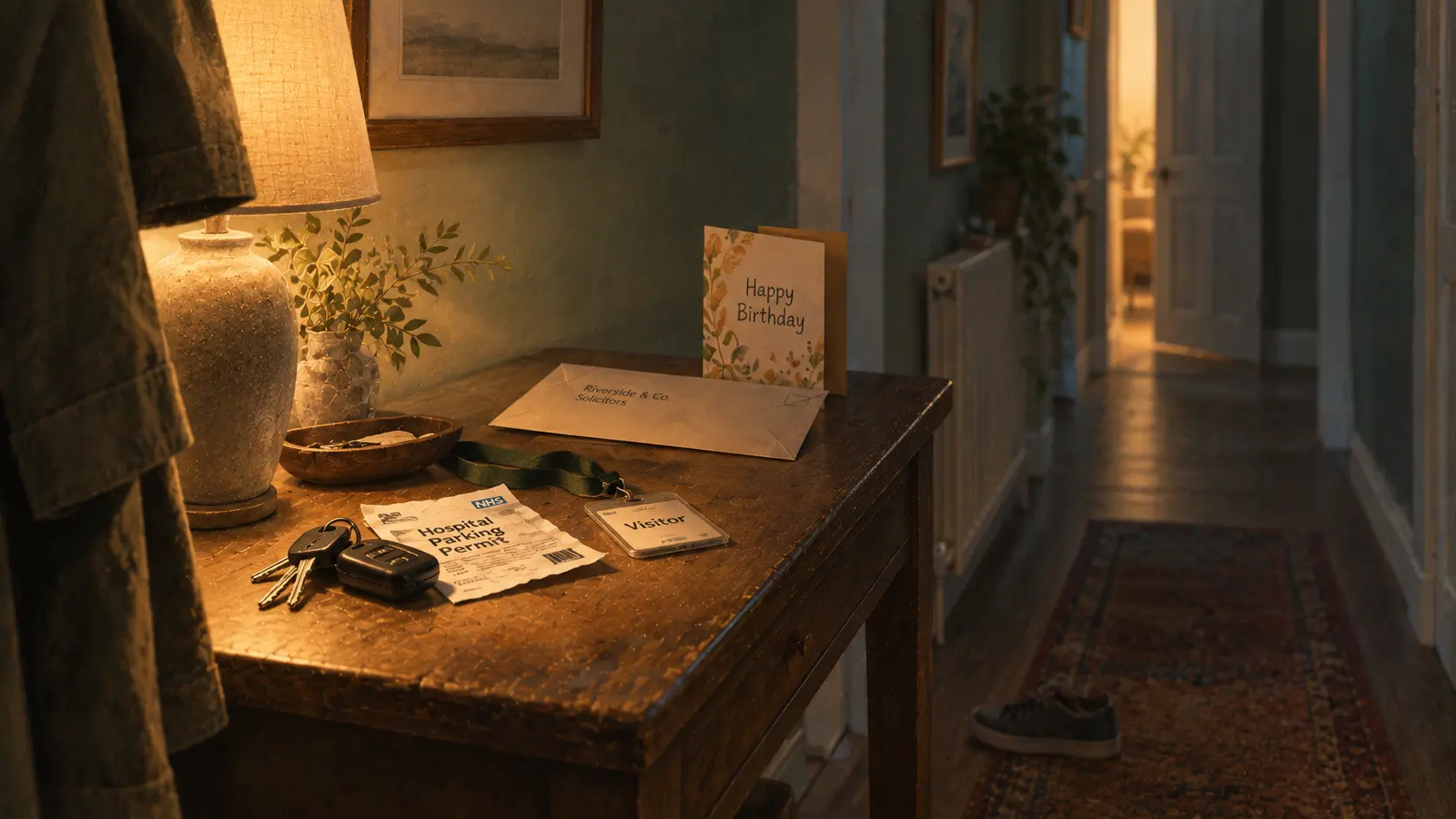
Someone asks how your mother is doing. You say she is comfortable. They say you are lucky, you still have her, and they mean it, warmly, with their whole chest.
The woman who taught you to drive has not used your name since March.
The grief nobody sends flowers for
Nothing arrived for that. No casserole on the step, no cards on the mantelpiece, no awful afternoon where people came round and said the wrong things kindly. Nobody marked it, because nobody has died. You went to work the next morning and said “I’m ok” eleven times, then “it’s going,” because you had run out of ways to answer.
Grieving someone who is still alive has a specific shape, and the shape is what makes it hard to explain. The person is right there. You are still doing the prescriptions and the laundry and the forms. Underneath all of it, running constantly, like a fridge in another room, is a grief you cannot afford to sit down with, because sitting down with it means not being the person who does the prescriptions and the laundry and the forms.
So it waits. It gets into the car with you. It is there at four in the morning, and gone again by seven, when there are things to do.
This is not a page that tells you your feelings are valid and then stops. You already know they are valid. What follows is the name for this, the research that undercuts the assumption everyone is working from, and the reason the standard instruction fails you specifically.
Part of meditation for the life you actually have, our cluster for people holding other people. Alongside it: meditation for caregivers for the practical hallway version, and meditation for grief for what happens after.
Ambiguous loss: the name for the thing
The name comes from Pauline Boss, Professor Emeritus at the University of Minnesota, who has spent her career on a category of loss the rest of the field kept treating as a failure to cope.
Her definition, from a 2022 keynote at the University of Southern Indiana: “A loss that remains unclear and without resolution. A loss that has no official or social verification; thus can’t be clarified, cured, or fixed. A rupture in a close relationship.”
Read the middle clause again. No official verification. No certificate, no date, no moment the world agrees something happened. Boss adds that an ambiguous loss implies there was attachment in the first place, which is why it lands hardest on the people closest in.
She splits it into two types, and where you sit in that split changes what you are dealing with.
| Type | What it means | Where it shows up |
|---|---|---|
| I. Physical absence with psychological presence | The person is gone, and psychologically still here | Missing bodies, kidnapping, imprisonment, refugees and forced separation. More commonly: divorce, estrangement, adoption, migration, deployment, a parent moving into residential care |
| II. Psychological absence with physical presence | The person is here, and psychologically gone | Alzheimer’s and the more than eighty other conditions that cause dementia, brain injury, addiction, serious mental illness. More commonly: preoccupation with work, devices, gaming |
If you are grieving a parent with dementia you are in Type II, and a fair number of people are in both at once. Your father developed dementia, then moved into a home, so he is psychologically gone and also absent from the house he lived in for forty years. Boss notes that ambiguous loss can be personal too: your own memory, your own sight.
Naming it is not a flourish. Boss’s argument is that the brain does not tolerate ambiguity well, and that a loss with no name and no verification produces hopelessness and helplessness, which she lists among the depression symptoms carers arrive with. There is no mastery without facts. The name is the first fact you get.
You grieve them twice, and the second time surprises everyone
The first round is not one grief. It is a series.
He stops driving. He stops cooking the thing he always cooked. He asks the same question in a loop. He stops using your name, then anyone’s. Each one is a small funeral, and none of them is marked. Then one day there is a body in a bed that looks exactly like him and is not him, and has not been for a long time.
You do not get to finish, and you do not get to forget. Both exits are closed at once.
The second round is the death, and it arrives sideways. Someone at the service says they are surprised you are not crying, having forgotten you cried for four years. Friends decide, kindly and privately, that you have not processed it yet and are due a collapse. And the phone lights up and you know what the call is before you answer, and the first thing you feel is relief, clean and immediate, before anything else gets there.
Relief is not a symptom. It is the appropriate response to the end of something unbearable, for the person in the bed and for you. It does not need working through.
If you did not cry at the funeral and it has bothered you since, what numbness actually is splits the flat feeling into four states, only one of which is worth worrying about.
With ambiguous loss, chronic grief is a normal reaction to an abnormal social situation, a relational loss. The source of pathology lies externally in the type of loss, ambiguous, not in a caregiver’s psyche. (Pauline Boss)
You have probably been auditing yourself for months, checking whether you are grieving correctly, too early, too much for someone who is still eating breakfast. Boss’s position is that the thing that is wrong is the situation. Not you.
Grieving early is not a head start
Almost everyone holds this belief without examining it: do the grieving now and there will be less of it later. Anticipatory grief as a savings account. Painful deposits, quieter withdrawal.
In 2016, a team led by M. K. Nielsen put that assumption through a systematic review in Clinical Psychology Review, and it did not survive. Searching 1990 to 2015, they screened 1,192 records, removed 577 duplicates, and worked down to 34 studies of adult carers looking after terminally ill adults: 14 on anticipatory grief and 20 on preparedness.
Their conclusion, in their own words: “The assumptions that grief work before the loss would alleviate bereavement outcome was not confirmed. Thus, the concept of anticipatory grief is questioned. High preparedness was associated with improved caregiver outcome.”
The review found no protective function for grief symptoms during caregiving. What did track with better adjustment was something else entirely, and the two get confused constantly, because they happen in the same months, to the same person, in the same house.
| Grieving | Preparedness | |
|---|---|---|
| What it is | The emotional response to a loss already underway | Knowing what is coming, medically and practically, and having decided things in advance |
| At 3am | Rehearsing the funeral, crying in the car, the fridge-hum of dread | Knowing his wishes, who to ring, what the next stage looks like |
| Can you choose it | No. It runs on its own | Partly. It is made of conversations, documents and questions put to clinicians |
| The 2016 review | No protective function for later adjustment | High preparedness associated with improved carer outcome |
One caveat, plainly. These are associations, not causes. High pre-loss grief and low preparedness both showed up alongside poorer bereavement outcomes, and pre-loss grief may simply mark a person already in more distress, or in a harder situation. Nothing here says grieving early makes it worse. What it says is narrower and more useful: grief while caregiving is not an investment, so stop treating it as one. What appears to help is knowing what is coming.
How to read this
Two primary sources, nothing else. The evidence claims come from Nielsen and colleagues (2016), a PRISMA systematic review in Clinical Psychology Review, reported here as associations because that is what its design supports. The frame comes from Pauline Boss's 2022 keynote slides, a theorist explaining her own construct rather than a study, so we quote her directly, with her dashes rendered as commas to keep the page's punctuation consistent. Where a number is not in one of those two documents, it is not in this post.
Why stillness is the last thing you want
You clean things that do not need cleaning. You reorganise the cupboard under the stairs. You fold laundry while somebody you love is dying down the hall, and the folding feels like a betrayal, and you keep folding, because the alternative is standing still.
The messages sit unread, the emails unanswered, the calls sent to voicemail, because every one is about a future you cannot plan.
 The cupboard did not need doing. The grief arrives in the gaps, so you stop leaving gaps.
This is the part every meditation page for this reader gets wrong. It opens by asking you to sit quietly for ten minutes with your eyes closed, which is precisely the condition you have spent eight months engineering your day to avoid. You are not resistant to stillness. You are load-bearing, and stillness is when the weight arrives.
So build the practice around that constraint instead of ignoring it. Short. Mobile. In transit. Mostly out loud rather than silent. Attached to a threshold you were going to cross anyway. If it needs a cushion and a candle it is not for this month of your life, and no version of you failed by not wanting it.
Ten minutes before you go back in
StillMind builds the practice around the state you name when you open it, so the ward car park and the drive home get different things. No cushion, no candle, no silence you have to fill.
Try StillMind, freeBoth hands: holding two true things at once
Boss’s core move is a sentence she asks carers to say out loud: “I must find a way to both let go, and hold on.”
One hand open, one hand closed. Not a sequence, not a compromise, not letting go by degrees until there is nothing left in either hand. Both, at once, for as long as this lasts. She calls it both/and thinking, and sets it against the ways people fail at it.
The first is denial. Nothing is wrong, nothing has changed, Dad is only forgetful because he is ageing, let him drive. The second she calls premature closure: the person is alive but pushed out of the family. He is dead to me. She does not know who I am any more, so I no longer visit. Underneath both sits binary thinking, the insistence that someone is either present or absent, when the situation is neither and the mind keeps demanding a verdict.
Boss is blunt about closure generally. Popularly it means grief completed, the mourner moved on, over it. She asks whether a carer has closure when the care recipient dies, then declines the frame: we can live with grief if we find some meaning in it, without needing it finished. A harder offer than the one you have been given elsewhere, with the advantage of being true.
In practice, both/and is two clauses joined by “and” where you would normally put “but.”
She is gone, and she is still here. I am furious with him, and I would do this for another two years. I am sad about the plans that are not happening, and there are new ones I am glad about.
Say them together and something loosens. Say either one alone and it lies, which is why every conversation about this feels dishonest: you get one clause into a sentence at a time, and whichever you pick, you have misrepresented yourself to someone who is about to respond to half of it. You are living in a different reality from everyone still making plans, and this is the grammar for it.
The wider cluster on holding other people covers the routing between roles. If this has stopped being grief and started being flat and unreachable, the difference between burnout and stress has a caregiving section written for people who cannot quit.
Four things to try, and what each is for
None takes ten minutes. No order, no daily minimum. Pick one, use it badly, drop it when it stops fitting.
- Name the state before you walk in. One sentence, in the car, before the door: “I am going in tired and angry.” Not to fix it. So you know which version of yourself is about to arrive, and so the person inside is not the first to find out.
- Three breaths on the threshold, in both directions. Going in, and coming out. The doorway is already a boundary, so borrow it rather than build one. Coming out is the one people skip and the one that does more, because it is the only marker between the ward and the rest of your day.
- Speak it instead of writing it. A voice note in the car park, three minutes, nobody listening. Some carers already do a version of this unprompted: recording him saying hello so there is a copy of the voice, writing down his favourite meals, the street he lived on at twelve, the name of his first car. An archive nobody asked for. Speaking is faster than writing when you are exhausted, and it keeps what you would edit out on paper.
- Both hands, out loud. Two true sentences joined with “and,” in Boss’s form, said in an empty car where nobody will respond. “She is gone, and she is still here.” It reads like nothing on a page. It does not sound like nothing at 6pm in a car park.
What this cannot do
It does not shorten the illness. It does not make the loss smaller or the ambiguity clearer, and no practice on earth gives you back the person who taught you to drive. Ten minutes in a car park is ten minutes in a car park, not a miracle. That ceiling is worth stating, because you have been promised more by people who wanted something from you. There is also the admin nobody warns you about: the world says it knows you are grieving, then asks if you could fill in these forms.
One boundary on scope. Boss’s Type II also covers addiction and serious mental illness, and Type I covers estrangement, divorce and family alienation. Same category of loss, and the both/and frame belongs to them too, but the mechanics and the risks differ enough to need their own page. This one is about progressive physical or cognitive decline.
If you are in acute distress, or having thoughts of ending your life, contact your local crisis line or emergency services now. In the UK, Samaritans are on 116 123, free, at any hour, or you can text SHOUT to 85258. In the US and Canada, 988 can be called or texted. If the flatness has lasted weeks and nothing reaches it, that is a conversation with your GP rather than something to sit with alone.
Ask the hospice or palliative team about pre-loss grief support too. They provide it before the death, not only after, and families often find that out late.
Frequently asked questions
Is it normal to grieve someone who is still alive?
Yes, and it has a name. Pauline Boss calls it ambiguous loss, and her position is that chronic grief here is a normal reaction to an abnormal social situation. The difficulty comes from the loss having no official or social verification, not from anything wrong with you.
What is ambiguous loss?
Ambiguous loss is Pauline Boss’s term for a loss that stays unclear and unresolved, with no official verification, so it cannot be clarified, cured or fixed. It comes in two types: physical absence with psychological presence, such as estrangement or a missing person, and psychological absence with physical presence, such as dementia, brain injury, addiction or serious mental illness.
Does grieving before someone dies make it easier afterwards?
The evidence does not support that. A 2016 systematic review by Nielsen and colleagues examined 34 carer studies and found no protective function for grief symptoms during caregiving. What was associated with better adjustment afterwards was preparedness. These are associations rather than causes, so the review cannot tell you that grieving early harms you. What it can say is narrower: it is not an investment that pays out later.
Why do I feel relief instead of sadness?
Because something unbearable ended, for you and for the person who was in it. Relief is an accurate response to that, and it does not need working through. It often arrives before anything else, including grief.
Can meditation help with anticipatory grief?
Not as a treatment for grief, and anyone promising that is overselling it. What short practice offers is a few minutes of regulation in a day organised around not stopping: a threshold pause, a named state, a voice note in the car park.
How do I stop feeling guilty for grieving while they are still here?
Try holding both clauses in one sentence instead of choosing between them, which is Boss’s both/and practice: “She is gone, and she is still here.” The guilt usually comes from a binary demand that the person be either present or absent. Stop making yourself pick and there is less to feel guilty about.