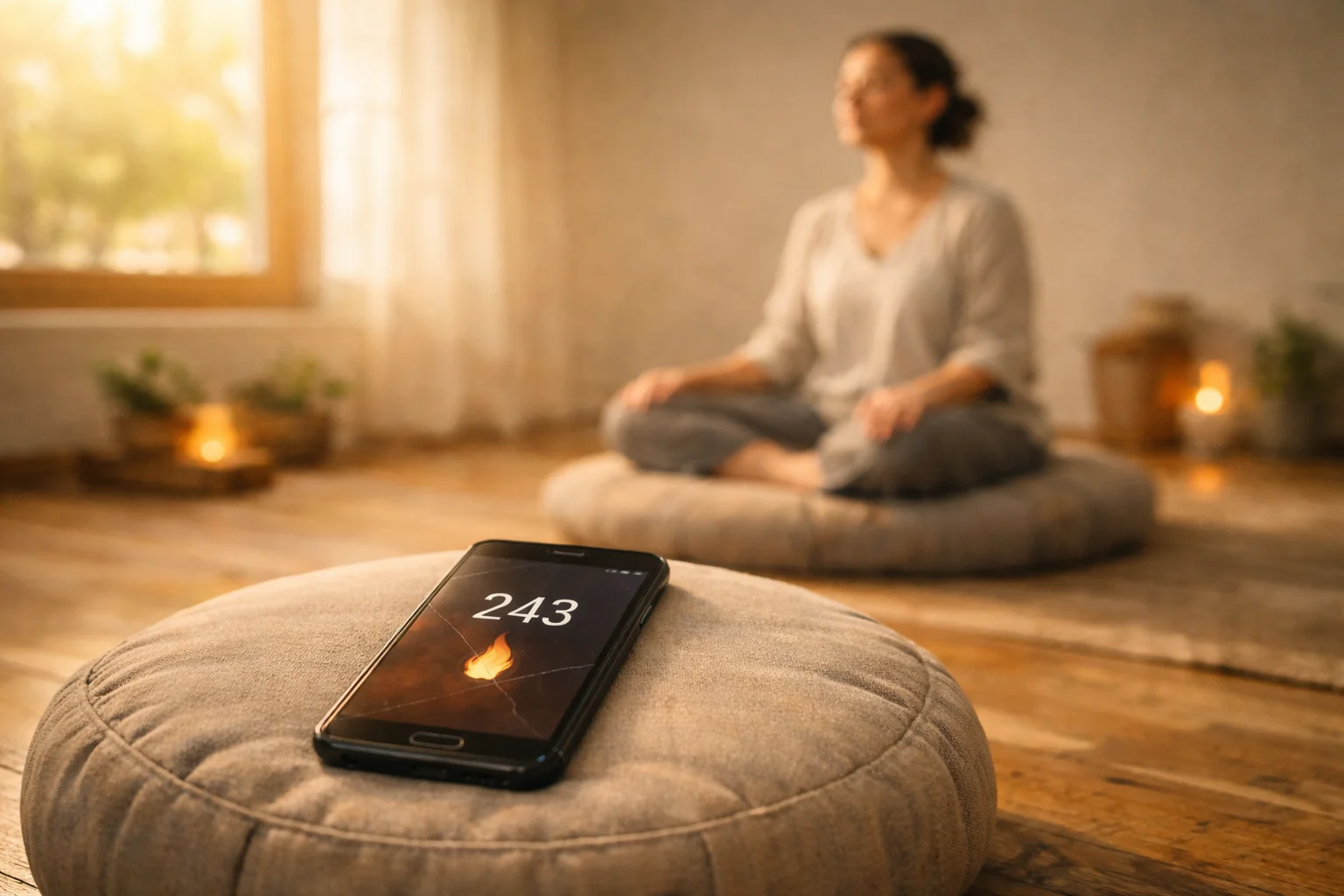
You have a 243-day streak on Headspace. That little number makes you proud. You’ve meditated every single morning for eight months.
But here’s what happened last Tuesday.
Your phone died overnight. You woke up, sat down to meditate, and… nothing. You felt anxious. You didn’t know what to do with your hands. Should you focus on your breath? Do a body scan? Loving-kindness? You made it maybe ninety seconds before you gave up, plugged in your phone, and waited for it to charge enough to open the app.
Two hundred and forty-three days of practice, and you can’t sit in silence for two minutes.
Sound familiar?
You’re not alone. And you’re not broken. You’ve just been trained wrong.
The Dirty Little Secret About Meditation Apps
Here’s something that hit me when I really looked at how these apps work.
They’re optimizing for engagement, not independence.
Think about it. Calm has 300 million downloads. Headspace is worth over $300 million. These are real businesses with real investors who expect growth. And growth means retention. They need you to come back. Every. Single. Day.
Here’s the retention stat that shocked me: most meditation apps have a 5% retention rate after three months. Ninety-five percent of people who download them stop using them. But that 5% who stick around? They become dependent.
You open the app every morning. You can’t imagine meditating without it. You’ve probably even thought about what you’d do if the app shut down or your subscription ended.
That’s not meditation. That’s reliance.
Guided Meditation Creates Passive Listeners
When you meditate with an app, what actually happens?
A voice tells you when to breathe in. When to breathe out. When to notice your thoughts. When to let them go. When to notice tension in your shoulders. When to relax your jaw. When to come back to the present moment.
The voice does everything.
You’re not meditating. You’re following instructions.
And look, I get it. When you’re starting out, that guidance is genuinely helpful. You don’t know what you’re doing. Your mind is chaos. Having someone walk you through it makes meditation accessible.
But here’s the problem most apps never address: when do the training wheels come off?
The Duolingo Parallel
My friend Carlos has a 412-day streak on Duolingo. Four hundred and twelve days. Over a year of daily Spanish practice.
Last month he went to Mexico City. First morning there, he walked to a café for breakfast. The server asked him what he wanted.
He completely froze.
See, Carlos can translate “The boy eats the apple” perfectly. He knows all his colors. He can conjugate regular verbs. But when an actual human asked him an actual question in an actual café, his brain shut down.
Four hundred days of practice. Couldn’t order coffee.
Why? Because Duolingo taught him to respond to Duolingo prompts. It didn’t teach him to speak Spanish. It taught him to pass Duolingo exercises.
The gamification worked brilliantly for engagement. It failed completely at the actual goal.
Meditation apps do the exact same thing.
They teach you to meditate with the app. Not to actually meditate.
Why This Happens: The Business Model Requires Dependency
Let’s talk about incentives.
Traditional meditation apps make money through subscriptions. Monthly or yearly. To keep those subscriptions, they need you to believe you need them.
So what do they offer? Infinite content libraries.
Headspace has over 500 meditations. Calm adds new content weekly. There’s always something new to try. A different teacher. A different technique. A different sleep story.
The message is clear: you need us because we have everything.
But notice what they don’t have. Zero progression systems toward independence.
There’s no “Week 12: Practice without guidance.” No “You’ve completed the foundation course, here’s how to meditate on your own.” No graduation day.
Why would there be? You graduating means you canceling.
I’m not saying this is some evil conspiracy. Most people building these apps genuinely want to help. But the business model and the stated goal are fundamentally misaligned.
The stated goal is to teach you to meditate. The business goal is to keep you subscribed. Those two things are actually opposites.
I’ve written about why apps do this before. Today I want to show you how to fix it.
Signs You’re Dependent (Not Practicing)
Let’s get real. Here are the signs that you’ve become dependent on your app instead of building an actual practice.
You can’t sit without the voice. Even for five minutes. Silence feels wrong. Your brain doesn’t know what to do.
You feel anxious when you forget your headphones. Not disappointed. Anxious. Like you might not be able to meditate at all.
You’ve “tried” dozens of different meditations but can’t explain what you actually learned. You remember which narrator you liked. You don’t remember what technique you practiced.
You need the app to tell you when the session is over. You can’t just sit for ten minutes and stop naturally. You need the bell.
You immediately open your eyes and check your phone when the timer ends. No pause. No integration. Session done, phone immediately in hand.
You can’t answer the question “How do you meditate?” You know how to open the app. You don’t know what meditation actually is.
If two or more of these hit, you’re not meditating. You’re consuming guided relaxation content.
There’s nothing wrong with that. Guided relaxation is pleasant. But it’s not the same as having a meditation practice that works when your phone is dead, when you’re on a plane, when you wake up at 3am anxious.
Want to build actual independence? StillMind guides you in and out, but gives you space in the middle to practice on your own. We’re designed for graduation, not dependency. Try it free.
What Silent Practice Actually Gives You
Here’s what changes when you can sit in silence.
Inner trust. You know what to do when your mind wanders because you’ve practiced bringing it back yourself. You don’t need someone to remind you.
Self-reliance. The skill lives in you, not in an app. You can meditate anywhere. Waiting rooms. Parking lots. Middle of the night. The practice is portable because it’s actually yours.
Real understanding. When you have to figure out what to do with your mind, you learn how your mind actually works. Following instructions teaches you to follow instructions. Wrestling with your own attention teaches you about attention.
Skills that transfer. Silent practice builds the exact skill you need in real life: returning to the present moment without being prompted. In the stressful meeting. During the argument. When you can’t sleep. Those moments don’t come with guided meditation. They require the actual skill.
This is what actually makes meditation work. Not perfect adherence to scripts. Understanding the principles well enough to apply them yourself.
How to Transition from Guided to Independent Meditation
Okay, so how do you actually transition from guided-every-second to independent practice? Here’s the realistic path.
Stage 1: Guided with Intention (Weeks 1-2)
You’re still using guided meditations. But you’re using them differently.
Instead of passive listening, you’re learning.
When the voice says “Notice when your mind wanders,” you don’t just hear it. You think: Oh, that’s the instruction. When my mind wanders, I notice it and come back.
When it says “Bring attention to your breath,” you think: This is the anchor. The breath is what I return to.
You’re extracting the principles, not just following along.
Practice: After each guided session, write down one thing you learned. Not “it was relaxing.” Something like “The instruction is: notice distraction, don’t judge it, return to breath.” You’re building your own internal guide.
Stage 2: Guided + 2-3 Minutes of Silence (Weeks 3-4)
Now you start hybrid sessions.
Use a guided meditation, but here’s the key: close the app with 2-3 minutes left.
The voice gets you settled, reminds you of the technique, and then you finish the session yourself. In silence. Using what you just learned.
Those last few minutes are yours to navigate.
First few times? Your brain will panic a little. “Wait, what do I do now?” That’s normal. The answer is: whatever the meditation just told you to do. Keep doing that.
Practice: Start with just 2 minutes of silence at the end. When that feels manageable, extend to 3 minutes. The goal isn’t perfection. It’s practicing without the voice.
Stage 3: Silence with Simple Anchor (Weeks 5-6)
You’re ready to try full unguided sessions.
Set a timer for 10 minutes. Sit down. Close your eyes.
Pick one simple anchor:
- Your breath (in and out, belly rising and falling)
- Body sensations (weight of your body, contact with the chair)
- Sounds around you (just listening, not analyzing)
That’s it. When your mind wanders—and it will—notice it and come back to your anchor.
No voice. No music. No guidance.
Just you and your attention.
Practice: Do this 3 times a week alongside your guided sessions. You’re building confidence with silence while maintaining some support.
Stage 4: Independence (Week 7+)
By week 7 or 8, something shifts.
Sitting in silence doesn’t feel wrong anymore. You know what to do when your mind wanders. You can tell when you’re actually focused versus when you’re thinking about meditating.
You don’t need the app. You might still choose to use guided meditations sometimes—for learning new techniques or when you want structured support—but you’re not dependent on them.
That’s the difference.
The practice lives in you now.
3 Techniques For Your First Unguided Session
Sitting in silence for the first time can feel paralyzing. Here are three simple techniques. Pick one. That’s your whole session.
1. Count Your Breaths (1 to 10, Repeat)
Breathe naturally. On each exhale, count.
In, out (one). In, out (two). In, out (three)… up to ten.
When you get to ten, start over at one.
When your mind wanders—and you lose count or end up at seventeen—just go back to one. No judgment. No frustration. Just back to one.
That’s the entire practice. Counting to ten. Over and over. For ten minutes.
2. Label “Thinking” (When You Notice Thoughts)
Sit. Focus on your breath or body sensations.
When you notice you’re thinking—planning, remembering, worrying, whatever—just mentally label it “thinking.”
You don’t have to stop the thought. Just notice it and label it: thinking.
Then gently return to your breath.
That’s it. Notice thought. Label. Return. Repeat.
3. Body Anchor (One Area, Repeatedly)
Pick one part of your body. Maybe your hands. Or your belly. Or your feet.
Put all your attention there. Notice the sensations. Temperature. Pressure. Tingling. Texture.
When your mind wanders (it will), bring it back to that same body part.
You’re not scanning your whole body. You’re returning to one anchor point again and again.
Simple. Repeatable. Actually doable without someone narrating it.
Try a meditation app that’s actually designed for your independence. Guided when helpful, silent when it matters, with built-in progression toward self-sufficiency. Start free.
Why I Built StillMind Differently
After realizing all this, I built StillMind to actually fix the problem.
We guide you in and out—help you settle at the start, help you close at the end—but the middle is yours. Silence. Your practice.
The beginning: We help you settle. Set an intention. Choose a technique. Get present. This is where guidance is actually useful.
The middle: Silence. This is your practice time. No interruptions. No constant prompting. You’re doing the work yourself.
The end: We guide you back. Help you integrate. Prompt you to journal what you noticed. Close the practice properly.
The whole point is for you to eventually not need us.
Is that bad for engagement metrics? Yeah. But when you build real skills—when meditation becomes something you can actually do—you stick around because you want to, not because you’re trapped.
We also offer AI-guided sessions for specific situations—like before a difficult conversation or when you’re dealing with insomnia. But even those end with space for you to practice. Because the goal isn’t consumption. It’s capability.
The Honest Truth
Look, I still use guided meditations sometimes. When I’m learning a new technique. When I want to explore a different approach. When I need structured support for something difficult.
But I don’t need them anymore.
And that changes everything.
Because now meditation is something I can do anywhere, anytime, with nothing but my own attention. It’s a skill I own, not a service I subscribe to.
Your 243-day streak is impressive. But can you meditate without it?
If not, it might be time to graduate from being a user to being a practitioner.
The apps taught you meditation exists. Now it’s time to learn how to actually do it yourself.
Ready to build real meditation skills? StillMind trains you toward independence, not reliance. Guidance where it helps, space where you need it, progression toward competence. Try it free.
FAQ: Building Meditation Independence
If I stop using guided meditations, will I lose my practice?
Not if you transition gradually. The progression path above takes 7-8 weeks. You're not going cold turkey. You're building competence alongside guidance, then slowly increasing the unguided portions. Think of it like learning to swim with floaties, then one floatie, then none. You don't jump straight to the deep end.
What if I try unguided meditation and my mind just goes crazy?
That's completely normal. Your mind won't magically be calm just because there's no voice. But here's the truth: guided meditation doesn't actually calm your mind either—it just distracts you from how busy it is. Unguided practice shows you what's actually there. That awareness is the whole point. The busy mind isn't a problem to fix. It's the reality you're learning to work with.
Are guided meditations bad?
No. Guided meditations are excellent for learning techniques, exploring new approaches, and getting support when you're struggling. The problem is only doing guided meditation and never building the capacity to practice independently. Use guided sessions as training, not as the only way you can meditate.
How long should I be able to sit in silence before I'm "good at meditation"?
There's no benchmark. Some experienced practitioners sit for an hour. Some sit for five minutes. The question isn't duration—it's whether you can navigate your own attention without needing constant prompting. If you can sit for 10 minutes, notice when your mind wanders, and bring it back yourself, you have the skill. Everything after that is just practice.
What if I actually prefer guided meditation?
Then use guided meditation. Seriously. Some people prefer structure. Some people find the voice comforting. That's completely valid. The issue isn't preference—it's dependency. If you prefer guided meditation but can meditate independently when needed, you're fine. If you can't meditate without the app, that's when you've got a problem worth addressing.
Related reading:
- Why I Think Meditation Apps Get It Wrong — The deeper problem with how apps are designed
- The Anatomy of Effective Meditation Guidance — What actually makes guidance work
- How to Use a Meditation Timer — For when you’re ready to practice without constant guidance