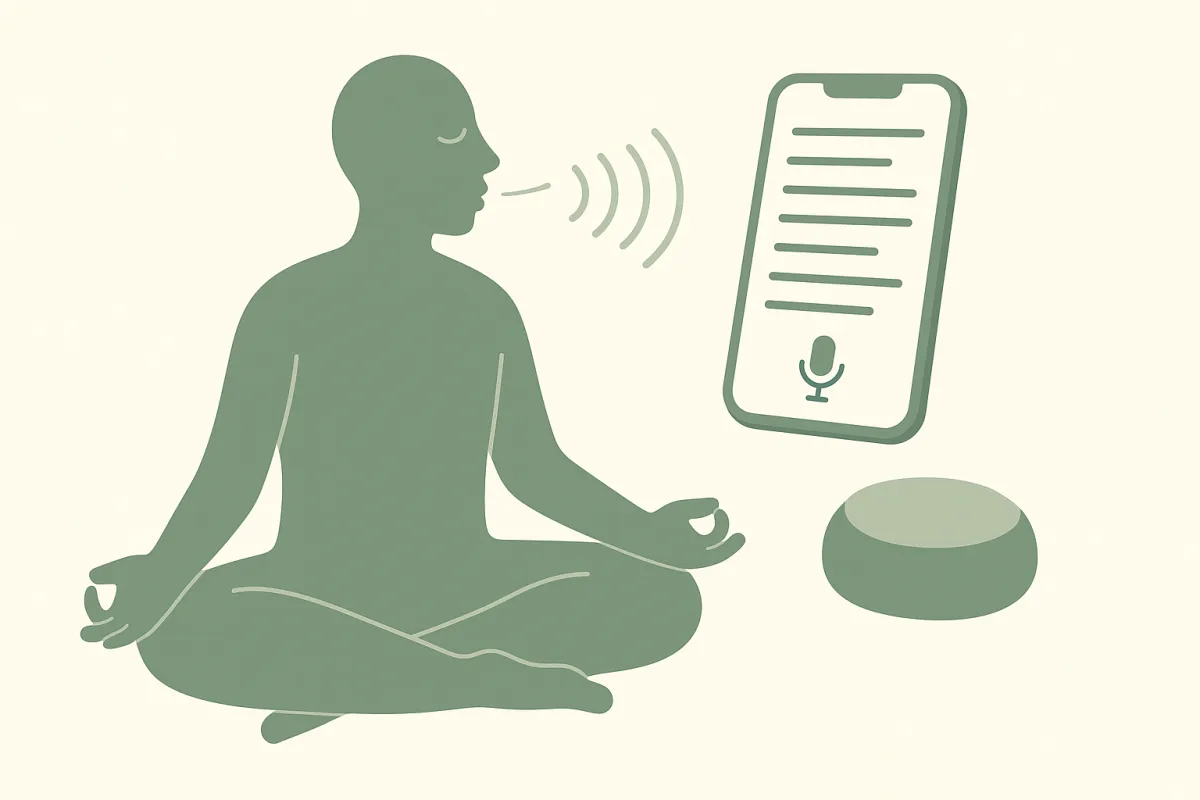
You just finished meditating. Your mind is clear. You had this profound insight about something you’ve been struggling with, and it’s sitting right there, crystal clear. But before you reach for pen and paper, there’s a better way: voice journaling after meditation captures those fleeting insights before typing or writing can break your flow.
Then you grab your journal to write it down.
And it evaporates.
Not completely. But by the time you find a pen, open your notebook, remember how you wanted to phrase it, the clarity is gone. You’re left with a watered-down version of what felt so vivid thirty seconds ago.
Or worse: you’re not a “journal person” at all. You’ve tried writing after meditation. It feels awkward. Slow. Like forcing poetry when you just want to capture a thought.
There’s a different way: just say it out loud.
The Problem Voice Journaling Solves
”I’m Not a Writer” (The Barrier That Blocks Millions)
Let’s be honest: most meditation advice assumes you’ll write in a journal afterward.
And most people don’t.
Not because they’re lazy. Because writing is its own skill. It requires organizing thoughts into sentences. Choosing words. Worrying about whether future-you will even understand what past-you meant.
The barrier: Meditation already feels like enough of a commitment. Adding “now write eloquently about it” turns a 10-minute practice into a 25-minute ordeal.
Voice journaling removes that barrier completely. You don’t have to be a writer. You just have to be able to talk.
And you’re already good at that. You’ve been doing it your whole life.
”Typing Breaks My Flow” (The Meditative State Problem)
Here’s what happens when you finish meditating and immediately open your phone to type notes:
Your body is still. Your breath is calm. Your mind has that rare quality of spaciousness.
Then: screen glare. Autocorrect failures. Thumb-typing. Deleting and retyping. Wondering if you should use the notes app or the meditation app or that journaling app you downloaded last month.
The flow you just cultivated? Gone.
Writing after meditation isn’t just slow. It’s a completely different state. You go from receptive to analytical. From feeling to thinking. From right brain to left brain.
Voice journaling lets you stay in that meditative state. Eyes closed or soft-focused. Body still relaxed. Just… speaking what’s there.
The meditation doesn’t end. It extends into the reflection.
”I Lose the Insight By the Time I Finish Writing”
You know that experience where you’re mid-sentence in your journal and you realize you’ve already forgotten the second thing you wanted to write?
So you rush to finish the first thought, but now it’s sloppy because you’re trying to hold onto the second thought before it disappears.
And by the time you get to the second thought, there was a third thought that’s now completely gone.
The problem: Writing is slower than thinking. And insights after meditation are fragile. They don’t wait around.
Voice journaling solves this through sheer speed. You can speak 150-200 words per minute. You can write maybe 40.
That’s 3-4x faster. Which means you capture the insight while it’s still fresh, before it fades, before you start second-guessing it.
”I Can’t Capture Nuance in Text”
Sometimes after meditation, what you’re feeling isn’t a clear thought. It’s more like… an emotional texture. A shift in perspective. A body sensation that means something.
Try writing that down. It comes out flat. Clinical. “Noticed tension in shoulders.” “Felt calmer today.”
These words don’t capture it.
But when you speak it? Your voice carries the nuance. The pause before you say “it’s like…” The slight change in tone when you realize something. The way you emphasize a word because it matters.
Voice preserves what text erases: the human experience beneath the words.
Why Your Voice Is Perfect for Post-Meditation Reflection
The Neuroscience: Different Pathways, Unique Benefits
Here’s something most people don’t know: speaking and writing use different neural pathways.
When you write, you’re primarily engaging Broca’s area (speech production) and the motor cortex (hand movements). It’s a deliberate, analytical process.
When you speak, you’re engaging a more ancient, automatic system. Speaking evolved millions of years before writing. It’s wired deeper into our neurology.
What this means: Speaking after meditation accesses emotional and intuitive brain regions more directly than writing does.
You’re not translating experience into language. You’re expressing experience through language. That’s a meaningful difference.
Research on “expressive speaking” (saying thoughts out loud for emotional processing) shows it activates the prefrontal cortex and anterior cingulate cortex: regions involved in self-awareness and emotional regulation. The neuroscience of meditation journaling reveals why speaking activates different—and often more beneficial—neural pathways than writing for post-practice reflection. Understanding the ancient practice of meditation journaling helps explain why voice journaling feels like a natural evolution of this centuries-old tradition.
Translation: talking about your meditation might actually deepen the benefits of the meditation itself.
Emotional Authenticity in Spoken Word
There’s a reason therapy is talk therapy, not write-it-down-therapy.
Speaking carries emotion in a way writing can’t. The tremor in your voice when you talk about something difficult. The excitement when you describe a breakthrough. The confusion when you’re working through something complicated.
These aren’t flaws. They’re data.
When you listen back to a voice journal entry (which you don’t have to, but some people love), you hear not just what you said, but how you felt saying it.
That shakiness in your voice three months ago when you were going through that rough patch? Future-you will hear it and remember: “Oh. I got through that.”
Text can’t do that. Text is flat. Voice is dimensional.
Speed: Capture 3x Faster Than Writing
We already covered this, but it’s worth repeating because it’s the most practical benefit:
Speaking is 3-4 times faster than writing.
A two-minute voice note can capture what would take 8-10 minutes to write.
Which means you’re more likely to actually do it. Every day. After every meditation.
Because it’s not a production. It’s just: finish meditating, tap record, speak for 90 seconds, done.
The barrier between “I should journal” and “I just did” disappears.
Accessing the “Right Brain” Through Voice
Here’s the pattern:
Meditation quiets the analytical, planning, left-brain chatter. You access the right brain: intuitive, spatial, emotional, holistic.
Then you try to write about it… and you’re immediately back in left-brain mode. Language. Structure. Grammar. Linear thinking.
It’s like waking up from a dream to take notes. The act of note-taking ends the dream.
Voice journaling keeps you closer to that right-brain state. You’re still in the feeling. You’re describing it from inside the experience, not analyzing it from outside.
It’s the difference between “I noticed I felt calm” (analytical) and “I feel… it’s like my shoulders finally dropped. Like I’ve been carrying something and I just set it down” (experiential).
Same insight. Different access point. Voice gets you there.
What Science Says About Speaking vs. Writing
Verbal Processing and Emotional Regulation
Multiple studies on affect labeling (putting feelings into words) show that speaking about emotions activates the ventrolateral prefrontal cortex, which helps regulate the amygdala (your brain’s alarm system).
Translation: talking about what you’re feeling literally calms your nervous system.
A 2007 UCLA study (Lieberman et al.) found that verbally labeling emotions reduced amygdala activity. Speaking “I’m anxious” made people measurably less anxious.
Now apply that to post-meditation reflection:
You meditate. You surface some difficult emotion. You speak it out loud: “I’m noticing a lot of grief today. It’s about my dad. I didn’t expect that to come up.”
The act of speaking it regulates it. You’re not just recording. You’re processing.
And this effect is stronger with speaking than with writing, likely because speaking is more immediate and embodied.
The “Articulation Effect” on Understanding
Educational psychologists have long known about the “articulation effect”: when students explain something out loud, they understand it better than when they write it or just think it.
Why? Because speaking forces real-time coherence. You can’t pause for five minutes to find the perfect word like you can when writing. You have to make sense in the moment.
This is perfect for meditation insights.
That vague feeling you had during meditation? When you try to speak about it, you have to articulate it. And in articulating it, it becomes clearer.
You’ll hear yourself say something out loud and think, “Oh. That’s what that was about.”
The voice journaling isn’t just capturing the insight. It’s completing it.
Audio Memory vs. Written Memory
Interesting research from the University of Iowa (2018) found that people remember spoken information differently than written information.
Audio memory tends to be more emotionally tagged. You remember not just the content, but the emotional state you were in when you recorded it.
Written memory is more semantic. You remember the words, less so the feeling.
For meditation journaling, emotional memory is the point.
Three months from now, you want to remember not just “I felt anxious about work,” but the specific texture of that anxiety. The way it sat in your chest. The spiral it created.
Voice recordings preserve that. Text doesn’t.
Study: Voice Memos for Stress Reduction
A 2021 study in the Journal of Medical Internet Research tested voice-based journaling for stress management among healthcare workers.
Participants who used daily voice journaling showed significant decreases in perceived stress and increases in emotional awareness compared to text journaling.
The key finding: Voice journaling required less cognitive effort, so people actually did it more consistently.
And consistency matters more than depth. A 90-second voice note every day beats an elaborate written journal entry once a week.
How to Voice Journal After Meditation (Step-by-Step)
Step 1: Create Your Private Audio Space
First: you need to feel safe speaking out loud.
If you live alone, easy. Find your meditation spot, finish your session, start talking.
If you live with others: find your private moment. Maybe it’s morning meditation before anyone wakes up. Maybe it’s in your car after work. Maybe it’s in your bedroom with the door closed.
The key: You need to be able to speak freely without worrying someone will overhear.
Because you’re going to say real things. Vulnerable things. Sometimes weird things. And you can’t do that if you’re performing for an imaginary audience.
Set up your environment so you can be completely honest.
Step 2: Start With a Grounding Statement
Don’t just hit record and freeze. Start with something simple that orients you:
“It’s Tuesday morning, November 20th. Just finished a 15-minute meditation.”
Or: “Meditating after work today. Lot on my mind.”
Or: “Third day in a row. Feeling good about that.”
Why this helps: It gives you a moment to settle into speaking mode. You’re not trying to be profound immediately. You’re just stating facts. Easy.
Then you naturally flow into the reflection.
Step 3: Speak Stream-of-Consciousness
This isn’t an essay. Don’t worry about structure.
Just talk. Start anywhere. Let it unfold.
“I noticed today that my mind was really busy. Like, more than usual. Lots of work thoughts. That project deadline. But halfway through, I noticed I was trying to control it. Trying to force myself to relax. Which obviously doesn’t work. So I just… let it be busy. And it actually started to settle on its own. Weird.”
Notice: no editing. No perfect sentences. Just following the thought wherever it goes.
The quality of “just talking” is the point. You’re not writing for someone to read. You’re speaking to process.
Step 4: Use Prompts If You Get Stuck
Sometimes you hit record and your mind goes blank. No problem. Use prompts:
- “What I noticed today was…”
- “The thing that surprised me during this session…”
- “If I’m being honest about how I’m feeling…”
- “The main thing on my mind right now is…”
- “Something shifted when…”
You’re not answering a quiz. You’re just giving yourself a starting place.
Often, once you answer one prompt, the rest flows naturally.
(For more structured guidance, pattern-revealing journal prompts can transform quick voice notes into diagnostic insights about your practice.)
Step 5: Save and (Optionally) Transcribe
After you’re done speaking, save the recording.
Some people love listening back to old entries. Others never do. Both are fine.
The real value is in the act of speaking, not necessarily the archive.
But having the archive is powerful for pattern-spotting. You might notice:
“Huh. I’ve mentioned work stress in 8 of my last 10 entries. Maybe that’s something to actually address.”
Or: “Three months ago I was so anxious about this thing. I completely forgot that was even a problem. It just… resolved.”
If you want text, many apps (including StillMind) automatically transcribe your voice notes using speech-to-text. You get the speed of voice, the searchability of text.
Best of both worlds.
Voice Journaling Techniques for Meditation
The “Dear Future Me” Method
Speak as if you’re talking to yourself six months from now.
“Hey, future me. Right now it’s November 2025. I’m dealing with this work transition and feeling pretty uncertain about it. But I want you to know: I’m doing the practice. I’m meditating. I’m trying. Whatever happens, I showed up today.”
Why this works: It creates perspective. You’re not just venting. You’re leaving a message. There’s a sense of care in it.
Plus, when you actually listen back months later, it’s incredibly moving. Past-you was talking directly to you.
The “Meditation Debrief” (Talk Like You’re Teaching)
Pretend you’re explaining the session to a friend who’s curious about meditation.
“So I sat down, started with breath focus. First few minutes were chaotic. Mind all over the place. But around minute 7, something shifted. I stopped trying to control it. Just watched thoughts like they were clouds. And that actually worked. Way better than forcing it.”
Why this works: Teaching forces clarity. You have to make it make sense to someone else, which means you have to understand it yourself.
Even though you’re not actually teaching anyone. The frame helps.
The “Three Things” Framework
Simple structure. Three things:
- “Something I noticed during the meditation…”
- “Something I’m feeling right now…”
- “Something I want to remember…”
That’s it. Keeps you focused. Gives you a starting point. And you can complete it in under two minutes.
Why this works: Structure without rigidity. You have guideposts, but freedom within them.
The Continuous Recording Method (During Practice)
This is unique to apps like StillMind: you can enable voice recording during the meditation itself.
Not constantly speaking. But the app listens throughout your session. When a thought arises that you want to capture, you just speak it out loud:
“Noticing a lot of tension in my jaw.”
Return to silence.
Three minutes later: “Idea for the project. Start with the problem, not the solution.”
Return to silence.
Why this works: You capture insights the moment they arise, without breaking your flow. No need to remember everything until the end.
(See our guide on capturing thoughts during meditation for more on this approach.)
The Tap-to-Speak Method (After Practice)
Prefer to keep meditation silent? No problem.
After the session ends, you tap the voice note button and speak your reflection. The app isn’t listening during the meditation, only when you activate it.
More traditional. More control. Some people prefer this.
Why this works: Clear boundary between “meditation time” and “reflection time.” You’re not mixing the two.
Both methods are valid. Try both. See which fits your practice.
Voice vs. Written: When to Use Each
Voice journaling isn’t superior to writing in all situations. It’s superior in specific ones.
Here’s when to use what:
Use Voice When: Capturing Ephemeral Insights
If you just had a meditation where something clicked and you need to capture it right now before it fades: voice.
Speed matters. The insight is fresh. You don’t have time for writing. Just speak it.
“Oh my god, I just realized why I’ve been so anxious about this. It’s not actually about the thing. It’s about control. I’m scared of not being in control.”
Captured in 10 seconds. Would take 2 minutes to write. By which point the clarity would be diluted.
Use Voice When: Emotion Is High
You’re feeling big emotions. Grief. Joy. Anger. Relief.
Writing will flatten it. Voice will preserve it.
“I’m crying right now. Not sad crying. Just… release. Something let go during that session. I don’t even know what it was. But my body knows.”
The shakiness in your voice will tell future-you more than polished sentences ever could.
Use Voice When: You’re Meditating Away From Home
In your car before work? On a park bench? Lunch break at the office (with headphones)?
You don’t have your journal. You do have your phone.
Voice note. Done. The location and context are part of the entry.
Use Writing When: Analyzing Patterns
Voice is great for capturing raw experience. Writing is better for synthesis.
If you’re reviewing your last two weeks of meditation and noticing patterns, write about it. Many practitioners find that journaling after meditation becomes the missing step that transforms sporadic practice into sustained growth.
“I’ve noticed that every time I meditate in the morning, I have more patience during the day. When I skip morning meditation, I’m reactive by noon. This is a real pattern. Need to protect morning sessions.”
That’s analytical. Reflective. Writing makes sense here.
Use Writing When: Deep Contemplation Needed
Some insights need to be thought through slowly. Turned over. Examined from multiple angles.
Writing gives you that space. You can pause. Rewrite. Sit with a sentence. Think deeply.
Voice is immediate. Writing is deliberate. Both have their place.
Best: Hybrid Approach (Voice + Writing)
Here’s what many people settle into:
Daily: Voice notes after meditation. Fast. Consistent. Captures the raw experience.
Weekly or monthly: Written reflection. Review your voice notes. Notice patterns. Go deeper. Track your practice progress in a meditation journal to see how voice journaling transforms your reflection habit.
You get the consistency of voice, the depth of writing.
That’s the ideal setup.
Privacy and Voice Journaling
Let’s talk about the elephant in the room: you’re speaking your most vulnerable thoughts out loud, and an app is recording them.
Is that safe?
Why Most Voice Apps Are Privacy Nightmares
Most voice recording apps are built for productivity, not privacy.
They assume you’re dictating grocery lists or meeting notes. Not processing trauma. Not talking about relationship struggles. Not speaking thoughts you’ve never said out loud to anyone.
The risks:
- Voice recordings uploaded to cloud servers without encryption
- Third-party transcription services that store your data
- AI processing that uses your voice data to train models
- Metadata that reveals when you meditate, how often, what you talk about
- No option for local-only storage
If you’re using a generic voice memo app for meditation journaling, you need to know where your data goes.
Most people have no idea.
Local Storage vs. Cloud: What You Need to Know
Local storage: Voice recordings stay on your device. Never uploaded. Never accessible to anyone but you.
Cloud storage: Voice recordings uploaded to servers. Accessible from multiple devices. Vulnerable to breaches, subpoenas, and third-party access.
For meditation journaling, local storage is the safer default.
Yes, you lose the ability to access your journals from multiple devices. But you gain complete privacy.
The question: Do you need your voice journals on your iPad and your phone, or do you need to know that nobody else will ever hear them?
For most people, privacy wins.
End-to-End Encryption for Voice Notes
If you do want cloud sync (so you can access journals from multiple devices), the minimum requirement is end-to-end encryption.
This means:
- Voice files are encrypted on your device before upload
- The company can’t decrypt them (they don’t have the key)
- Even if servers are hacked, your files are unreadable
- Only you, on your devices, can decrypt and listen
This is the standard for secure messaging (Signal, WhatsApp). It should be the standard for meditation journals.
Apps like StillMind use end-to-end encryption for voice notes. Your meditations are private. Actually private.
Transcription: On-Device vs. Server-Based
Many voice journaling apps offer automatic transcription. Convenient.
But how does it work?
Server-based transcription: Your voice recording is sent to a third-party AI service (Google, Amazon, etc.) for speech-to-text processing. Fast. Accurate. Completely not private.
On-device transcription: Speech-to-text happens locally on your phone using your device’s built-in AI. Slower. Less accurate. Completely private.
For meditation journals, on-device transcription is worth the tradeoff.
StillMind uses on-device transcription by default. Your voice notes are converted to text on your phone. Nothing leaves your device unless you explicitly choose cloud backup (which is end-to-end encrypted).
Privacy isn’t a nice-to-have. For this kind of journaling, it’s essential.
Practical Concerns Answered
”I Feel Weird Talking to Myself”
Yeah. You will. At first.
Everyone does.
You’ll hit record, open your mouth, and feel ridiculous. “What am I even doing. This is so awkward.”
Here’s what helps:
Give yourself permission to sound awkward. To ramble. To say “um” forty times. To trail off mid-sentence.
Nobody is listening except future-you. And future-you will care about the content, not the delivery.
After three or four sessions, the weirdness fades. You stop performing. You just talk.
And that’s when it becomes powerful.
”What If Someone Overhears Me?”
Then you’re not in a private enough space yet.
This is critical: you cannot voice journal effectively if you’re worried about being overheard.
You’ll self-censor. You’ll speak in code. You’ll avoid the real stuff. Which defeats the entire purpose.
Find your private space:
- Morning meditation before others wake up
- Bedroom with door closed and white noise machine
- Car in a parking lot
- Walk in the woods with headphones (speak into your phone mic)
- Late-night sessions when the house is asleep
Privacy is non-negotiable. Protect it fiercely.
”Should I Listen Back to My Voice Journals?”
Some people love it. Others never do. Both are valid.
The case for listening back:
You hear patterns you didn’t notice in the moment. You track your growth. You remember where you were three months ago and realize how far you’ve come.
It’s incredibly moving to hear your own voice working through something difficult, knowing you’re on the other side of it now.
The case for never listening back:
The value is in the speaking, not the archive. You processed it by saying it out loud. That’s enough.
Listening back can feel indulgent or even painful. Why revisit old struggles when you’re past them?
Try it once a month. Listen to a few entries from the past week. See if it adds value. If it does, keep doing it. If it doesn’t, stop.
There’s no right answer here.
”How Long Should Voice Entries Be?”
However long they need to be.
Some days: 30 seconds. “Quick session. Felt good. Moving on with my day.”
Other days: 5 minutes. Everything pours out. Work stress, relationship stuff, existential questioning, a weird dream, an insight about your childhood.
Average: 1-3 minutes.
That’s enough time to capture the essence without turning reflection into a production.
But don’t force it. If you’re done in 20 seconds, you’re done. If you need 10 minutes, take 10 minutes.
The meditation tells you how much you need to say.
The Best Tools for Meditation Voice Journaling
What to Look for in a Voice Journal App
Before we get into specific apps, here’s what matters:
Privacy: Local storage or end-to-end encryption. On-device transcription. No third-party data sharing.
Ease of use: One tap to record. No friction. The easier it is, the more you’ll actually do it.
Integration with meditation: Voice notes that live alongside your meditation sessions, not in a separate app.
Transcription options: Automatic speech-to-text so you can search and read entries without listening.
No audio quality obsession: You’re not recording a podcast. Phone mic quality is fine.
Export capability: Can you get your data out if you switch apps? (Answer should be yes.)
Built-in Voice Memos (iOS/Android) - Pros and Cons
Pros:
- Already installed. No new app needed.
- Simple. Tap record, speak, done.
- Local storage by default.
- Free.
Cons:
- Not designed for meditation. No integration with practice tracking.
- No automatic transcription (you have to listen back).
- No organization. Voice memos are just chronological files.
- No prompts or guidance.
- Easy to forget to do it (no reminder after meditation ends).
Verdict: Works in a pinch. But not ideal for consistent meditation journaling.
Dedicated Meditation Apps with Voice (StillMind, etc.)
StillMind is built specifically for this use case:
How it works:
- Start a meditation session with meditation timer
- Enable voice notes (continuous recording or tap-to-speak)
- During or after meditation, speak your reflection
- Automatic transcription (on-device, private)
- Voice notes appear in your meditation journal entry
- Optional: generate AI-guided meditation based on what you’re working through
Pros:
- Designed for meditation journaling specifically
- Privacy-first: end-to-end encryption, on-device transcription
- Voice notes integrated with session tracking
- Continuous recording option (unique to StillMind): capture insights during meditation without breaking flow
- Tap-to-speak option for those who prefer silence during meditation
- Transcription automatic and private
- Pattern tracking: see recurring themes across sessions
Cons:
- Requires downloading a dedicated app (though it’s free to try)
- iOS only currently (Android coming)
Verdict: If you’re serious about meditation journaling and want voice as a core feature, this is purpose-built for you.
General Voice Journal Apps Adapted for Meditation
Apps like Day One, Journey, or Reflectly offer voice notes as a feature.
Pros:
- Multi-purpose journaling (you can use for meditation and other life stuff)
- Usually polished, well-designed
- Often include prompts and mood tracking
Cons:
- Not meditation-specific (no integration with session timing or meditation tracking)
- Privacy varies widely (check their policies)
- Voice is often a secondary feature, not the main focus
- May require subscription for voice transcription
Verdict: Good if you want one app for all journaling. Less ideal if meditation journaling is your primary goal.
Why Voice Might Be Superior (Not Just “Alternative”)
Let’s be honest about something the meditation world doesn’t often say:
For many people, voice journaling is better than written journaling. Not equivalent. Better.
Here’s why:
Speed. You’ll actually do it. Consistently. That matters more than depth.
Emotional authenticity. Voice captures what text erases.
Accessibility. You don’t have to be “good at writing.” You just have to be able to speak.
Meditative continuity. You stay in the state instead of breaking it to type.
Neurological difference. Speaking accesses different (arguably more beneficial) brain regions than writing for emotional processing.
This isn’t to say writing is bad. Writing has its place. Deep analysis. Pattern synthesis. Slow contemplation.
But for daily, post-meditation capture of raw experience? Voice wins.
The meditation world has emphasized written journaling for decades because that’s what was practical. You had a notebook. You wrote.
Now we have technology that makes voice journaling as easy as writing. Easier, even.
So why keep defaulting to the slower, harder method?
Voice journaling isn’t a compromise. It’s an upgrade.
The StillMind Difference
Full transparency: StillMind is built around this insight.
Voice journaling isn’t a feature we added. It’s the foundation.
Here’s what that means:
Continuous recording during meditation. Unique to StillMind. The app listens throughout your session. When a thought arises, you speak it. No need to tap anything or break your flow. Just voice and silence, flowing together.
Tap-to-speak after meditation. If you prefer silence during practice, no problem. When the session ends, tap the voice note button. Speak your reflection. Done.
Automatic transcription (private). Everything you say is converted to text using on-device speech recognition. Your voice never leaves your phone unless you choose encrypted cloud backup.
Integration with meditation timer. Voice notes live alongside session data. You see not just what you said, but when (morning or evening), how long you meditated, what you were working on.
Pattern tracking. Over time, you’ll notice themes. “I’ve mentioned work stress 6 times this week.” That’s actionable insight.
AI-guided meditation based on what you’re processing. (Optional.) If your voice journals reveal you’re struggling with something specific, you can generate personalized meditation for that exact thing.
Example flow:
You meditate for 10 minutes using the meditation timer. Continuous voice recording is enabled.
Minute 3: “Noticing a lot of shoulder tension today.”
Minute 7: “Thought about the conversation with Sarah. Still bothering me.”
Session ends. You open your eyes. There’s your journal entry:
- 10-minute session
- Two voice notes, automatically transcribed
- Option to add more reflection or just save and move on
Total time from meditation to journaled: 10 minutes. Because the journaling happened during the meditation.
That’s the insight. Voice notes don’t have to happen after meditation. They can happen during meditation without breaking it.
That’s what changes everything.
Getting Started
If you’ve read this far and you’re curious, here’s how to start:
Option 1: Try with what you have
Finish your next meditation. Open voice memos on your phone. Hit record. Speak for 60 seconds about what you noticed. Done.
See how it feels. You’ll know within one session whether this clicks for you.
Option 2: Try a meditation-specific app
Download StillMind. Free to try.
Enable voice notes (either continuous or tap-to-speak). Meditate. Let the app handle the rest.
After three sessions, you’ll know if this becomes part of your practice.
Option 3: Hybrid experiment
Some sessions: voice. Some sessions: writing. Some sessions: both.
See what emerges. There’s no rulebook here.
What Actually Changes
When you start voice journaling after (or during) meditation, here’s what people notice:
More consistency. You meditate more often because reflection takes 90 seconds, not 10 minutes.
Better insights. You capture thoughts before they fade. The raw, unedited version is often more valuable than the polished version.
Emotional processing. Speaking about difficult emotions regulates your nervous system in ways writing doesn’t.
Pattern recognition. After a month of voice entries, you’ll see themes you didn’t notice day-to-day.
Less meditation guilt. You stop feeling bad about “not journaling properly” because voice journaling doesn’t feel like work.
And sometimes, the biggest change is this:
You hear your own voice working through something. And you realize: I’m not stuck. I’m processing. That’s growth.
The Permission You Need
You don’t have to be a writer.
You don’t have to journal the “right” way.
You don’t have to produce polished reflections that sound wise when you read them back.
You’re allowed to just talk. Messy. Rambling. Trailing off. Saying “um” a lot. Changing your mind mid-sentence.
That’s not a flaw in the method. That’s the method working.
Because meditation isn’t about producing perfect insights. It’s about being present with what is.
And voice journaling is just an extension of that presence. You’re speaking what’s there, as it is, without trying to make it sound better.
That’s the whole point.
Ready to experience meditation where your insights have somewhere to go? Download StillMind and discover what happens when speaking your truth becomes part of your practice.