
Sleep Meditation for What's Actually Keeping You Awake
For the racing mind at bedtime, the 45 minutes of staring at the ceiling, and the sleep quality that never quite feels like enough. Personalized wind-down sessions that adapt to your night.
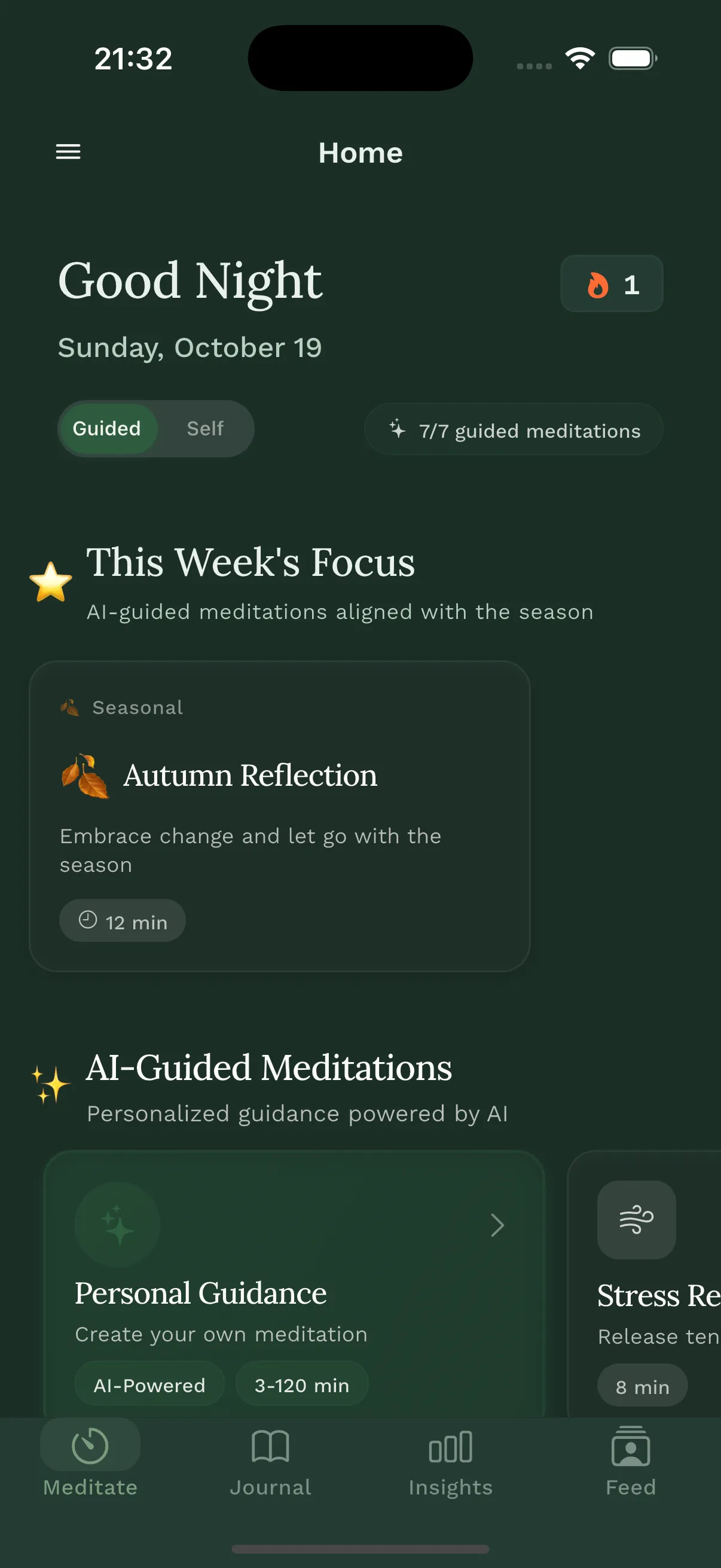
Personalized sleep meditation that adapts to your evening. Had a stressful day? Different session. Can't stop replaying conversations? Different technique. Racing through tomorrow's to-do list? A wind-down built for your actual mind tonight.
You don't have trouble sleeping. You can sleep. You just... can't switch off.
The day replays. Tomorrow's list assembles itself. You're physically tired but mentally running. So you scroll your phone because at least that's doing something, and then it's 12:47am and you have an early morning. Ocean sounds and bedtime stories work for some people, some nights. When your mind is louder than waves, you need something that addresses the specific thoughts keeping you awake — something that works with what's on your mind, directly.
You want sleep that feels restorative. Not just unconsciousness. You want to wake up feeling like sleep actually did its job. That starts with how you wind down — with a bedtime routine that accounts for whether today was a hard day, a boring day, or a day where everything felt slightly wrong for no reason.
How StillMind Helps You Sleep
Wind-Down Sessions Matched to Your Day
Had a stressful day? Different session than a restless day. Tell StillMind about your evening and get a sleep meditation that fits. No two nights are the same, so no two sessions should be either.
Gradual Transition, Not a Hard Stop
Your brain doesn't have an off switch. Sessions ease you from waking thought into sleep-ready calm, at your pace. 5, 10, or 20 minutes. The transition feels natural, not forced.
Morning Check-Ins That Improve Tonight
Quick voice note when you wake up: how'd you sleep? Over time, StillMind spots what helps you sleep better and what doesn't. Your personal sleep data, in your own words.
How Sleep Meditation Works in StillMind
Tell StillMind About Your Evening
Open the app 15-30 minutes before bed. Describe your day or what's on your mind. 'Stressful meeting, can't stop replaying it' or 'just restless, no reason' — both work.
Get a Personalized Wind-Down
The AI creates a sleep meditation matched to your evening. Work rumination gets cognitive offloading techniques. Physical restlessness gets progressive relaxation. Choose your length.
Ease Into Sleep
Follow the guidance as you get comfortable. Sessions are designed to fade naturally — no jarring endings. If you fall asleep mid-session, that's success.
Check In Tomorrow Morning
Quick voice note when you wake: how was your sleep? Over time, you build a picture of what helps you sleep better. Share insights with a doctor if needed.
Sleep Meditation Questions
What's the difference between sleep meditation and insomnia meditation?
Sleep meditation is for general sleep difficulties — trouble winding down, racing thoughts at bedtime, wanting better sleep quality. It's for people who can sleep but struggle with the transition.
Meditation for chronic insomnia targets clinical-level sleep problems — chronic 3am wake-ups, sleep maintenance issues, severe sleep anxiety that persists for months. If you're dealing with occasional difficulty, sleep meditation is your starting point.
How long before bed should I start a sleep meditation?
15 to 30 minutes before you want to be asleep. This gives your nervous system time to shift from alertness to sleep-readiness. Starting meditation the moment your head hits the pillow is too late — your brain is still in doing mode.
Think of it as a runway, not a switch. Some people benefit from a longer wind-down: dimming lights 30 minutes before bed, then starting a meditation 15 minutes before sleep.
Why do sleep stories work for some people but not me?
Sleep stories work by occupying your mind with something low-stakes, preventing rumination. But they fail when your mind is louder than the story. If you're replaying a work conflict or planning tomorrow, a narrative can't compete with the urgency of your thoughts.
StillMind creates sleep sessions based on what's actually on your mind, addressing it directly rather than trying to distract you from it.
Can I use sleep meditation every night or will I become dependent on it?
Using meditation nightly is a healthy sleep hygiene practice, not a dependency. You wouldn't worry about becoming "dependent" on brushing your teeth before bed. A consistent wind-down routine signals your brain that sleep is coming.
Over time, the routine itself becomes the signal — you may find you fall asleep faster even without the meditation because your body associates the routine with sleep onset.
What's better for sleep — guided meditation or just background sounds?
Guided meditation works better if your thoughts are the problem — the guidance gives your mind something to follow instead of spiraling. Background sounds work better if you're physically restless but mentally calm.
Some people need guided meditation to get to a calm state, then switch to background sounds for falling asleep. StillMind lets you start with guided wind-down meditation and transition as you get drowsy.
I can't stop thinking about work when I try to sleep. What kind of meditation helps?
Work rumination at bedtime needs cognitive offloading. Before meditation, spend 2 minutes writing down everything on your mind — tasks, worries, unfinished thoughts. Get it out of your head.
Then start a meditation that focuses on releasing the day rather than suppressing thoughts. Techniques that label thoughts ("that's a work thought, I'll handle it tomorrow") work better than trying to stop thinking.
Does meditation for sleep actually work or is it just a placebo?
Research shows meditation improves sleep quality through measurable mechanisms: reduced cortisol, lower heart rate, activation of the parasympathetic nervous system. A 2015 JAMA Internal Medicine study found mindfulness meditation significantly improved sleep quality compared to sleep hygiene education alone.
Meditation works best as part of a wind-down routine, not as a magic cure. If the cause of poor sleep is medical (sleep apnea, restless legs, chronic pain), meditation helps but won't solve the underlying issue.
Try Sleep Meditation Tonight
Free to download. Personalized to your evening. Built for what's on your mind tonight.
Sleep Better Tonight
Personalized wind-down sessions. Free on iOS & Android.